What is the quick answer?
Learn how to monetize YouTube Shorts with our 2026 guide. We cover YPP, ad revenue, brand deals, and how to optimize your Shorts for real income.
Key takeaways
- The Truth About Making Money with Shorts in 2026
- Unlocking Your First Dollar The Official Way
- What YouTube actually requires
- What to do after you qualify
- Maximizing Your Ad Revenue Per View
- The editing choices that help
Overview
Most creators still think the money in Shorts comes from the view count. It usually doesn't. Current monetization guidance puts Shorts earnings at about $0.01 to $0.06 per 1,000 views, which means 1 million views may generate only about $10 to $60 in ad-style revenue depending on engagement, geography, and music usage, according to Voomo's 2025 Shorts statistics roundup.
That sounds disappointing until you use Shorts the right way.
The strategic approach to how to monetize youtube shorts in 2026 is to treat them like distribution first, revenue second. Shorts can reach a huge audience fast, pull in subscribers, and feed higher-value offers like affiliates, sponsors, products, memberships, and long-form videos. That's the part most “how to monetize Shorts” articles skip. They tell you how to get approved, but not how to turn approval into an actual business.
The Truth About Making Money with Shorts in 2026
Shorts money is usually made after the view, not on the view.
That is the mistake I see most often. Creators rack up huge view counts, then wonder why the payout feels tiny. Shorts ad revenue can be useful, but it rarely carries the whole business unless volume is extreme and the content is advertiser-friendly at scale. Treating feed revenue as the plan is how channels end up with strong analytics and weak cash flow.
A Shorts channel that earns well in 2026 usually runs as a system. Reach comes first. Then subscriber growth, trust, and click intent. Then revenue from the next action, which is often worth far more than the ad split. If you want a broader breakdown of how YouTube revenue works across formats, this guide to YouTube video monetization strategies covers the bigger picture.
Here is the practical model that holds up:
Practical rule: If a Short cannot lead a viewer somewhere valuable, it is just content. If it leads to a subscriber, buyer, client, or long-form viewer, it is an asset.
That distinction changes how you judge performance.
A Short with 80,000 views that sends qualified traffic to an affiliate offer or a related video can beat a 1 million view Short that attracts the wrong audience. I have seen both outcomes. The bigger number looks better in YouTube Studio. The smaller one often wins on revenue.
This matters even more in 2026 because YouTube is harder on low-value repurposing, repetitive formats, and AI-assisted content that adds little original input. Views without originality are risky. Views without a next step are cheap. The best operators build Shorts that are fast to produce, clearly theirs, and connected to something monetizable.
- Reach brings new people in. Shorts still get discovered faster than many long-form uploads.
- Audience fit determines whether those views matter. A broad viral clip can inflate numbers without building a useful audience.
- Conversion is where margins improve. Affiliate clicks, email signups, product sales, services, and brand inquiries usually beat ad revenue per viewer.
Unlocking Your First Dollar The Official Way
You can't earn from Shorts ads until YouTube lets you into the system. That part is essential.
What YouTube actually requires
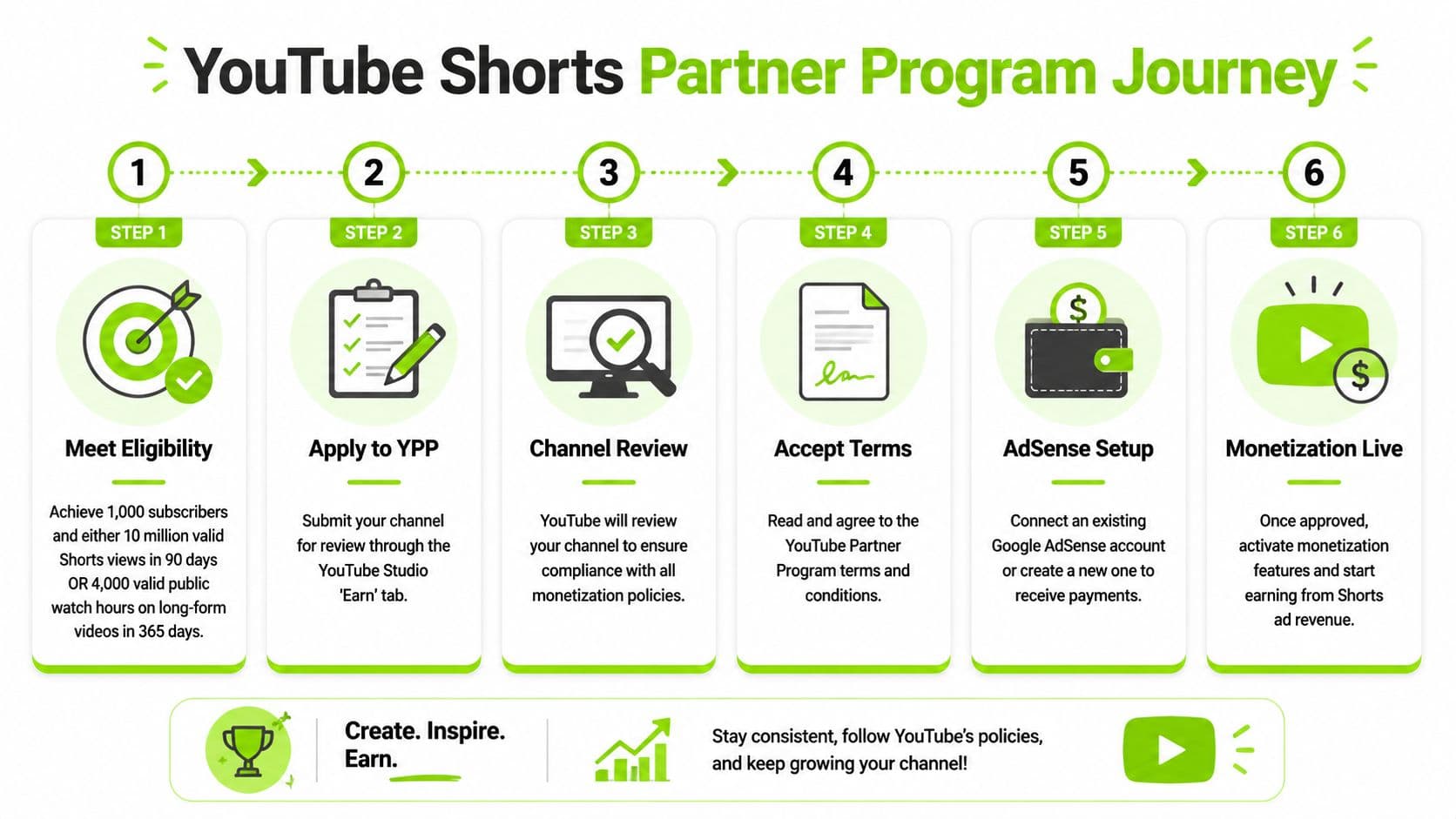
According to current 2026 guidance summarized by vidIQ's breakdown of YouTube Shorts monetization, creators need at least 1,000 subscribers and 10 million valid Shorts views in the last 90 days to qualify for ad revenue through the Shorts route. The alternate long-form route is 1,000 subscribers plus 4,000 public watch hours in the last 12 months.
That second path matters more than most Shorts-first creators realize. If you already publish longer videos, you may get into the YouTube Partner Program through long-form before your Shorts volume is high enough.
Two details trip people up.
First, the Shorts requirement is based on a 90-day window. You don't get to stack those views forever. If your channel spikes once and then goes quiet, that spike can fade out of the qualification window before you cross the line.
Second, YouTube cares about valid views. If the traffic quality is weak, or the content falls into ineligible patterns, the total public view count and the views that matter for monetization are not always the same thing.
What to do after you qualify
Getting eligible is not the same as turning monetization on.
Once accepted, you still need to accept the Shorts Monetization Module. vidIQ notes that YouTube starts counting engaged views from Shorts uploaded after acceptance toward ad revenue sharing once that module is in place. A lot of creators assume approval alone flips the switch. It doesn't.
Use this order:
Don't build your posting plan around “once I get in.” Build it around “what kind of content still earns after I get in.”
If you're struggling to hit the threshold, the best approach is usually not “post more random Shorts.” It's better topic selection, stronger hooks, and consistency around repeatable formats. A useful reference for ideation is AdCrafty's framework for viral growth, especially if you need a repeatable way to generate concepts instead of guessing every day.
If your broader revenue plan includes more than Shorts ads, it also helps to understand the full YouTube monetization ecosystem, not just feed payouts. This guide on YouTube video monetization models is a good complement because it shows where Shorts fits in the bigger picture.
- Open YouTube Studio Earn tab. Check whether you qualify through the Shorts path or the long-form path.
- Apply for YPP. Don't leave the application sitting once you're eligible.
- Review channel compliance. If your content style depends heavily on clips, AI voiceovers, or repetitive templates, clean that up before review.
- Accept all required terms. That includes the Shorts-specific monetization module.
- Connect AdSense. No payment flow, no payout.
- Confirm monetization is live. Then watch which uploads are contributing.
Maximizing Your Ad Revenue Per View
Ad revenue on Shorts is won before the payout shows up. It starts with whether the right viewer stops, watches, and stays in your content long enough to train the system that this Short deserves better distribution.

A lot of creators ask the wrong question. They ask what one view pays. The better question is which Shorts attract viewers who watch, return, and fit a topic that advertisers and sponsors care about. That is the difference between a channel that gets views and a channel that becomes a business.
The first variable is the hook. Shorts monetization is tied to feed performance, and feed performance starts in the first second. If the opening feels like setup, you lose the swipe battle before the content has a chance to prove itself.
The hooks that tend to help monetization are one of these:
One rule I use across Shorts channels is simple. If the first line can be deleted without hurting the Short, it should be deleted.
Topic fit matters just as much. A broad entertainment Short can explode and still produce weak business results if the audience has low buying intent or no clear connection to your niche. A finance, software, creator tools, or career audience often monetizes better than a general meme audience, even at lower view counts. If you want a clearer benchmark, this breakdown of YouTube Shorts RPM by niche and audience mix will help you set expectations before you blame editing for a niche problem.
- Immediate payoff hooks. Open with the result, not the backstory.
- Specific tension hooks. State a clear mistake, gap, or problem.
- Fast context hooks. Give the viewer enough context to care without making them work.
- Visual proof hooks. Show the outcome, screen, product, or transformation first.
The editing choices that help
Editing should serve retention, not style points. Clean Shorts feel fast because every cut earns its place.
A few changes improve revenue potential more than flashy effects:
Here's a helpful breakdown on the mechanics behind Shorts performance:
Titles and channel packaging still matter. Shorts viewers may find you in the feed first, but monetization improves when a winning Short leads to more viewing across your channel. Strong titles, clear niche signals, and recognizable formatting increase the odds that one view turns into a second and third view.
There is also a 2026 trade-off creators cannot ignore. Repurposed clips, AI-assisted voiceovers, and templated edits can speed production, but low-originality patterns raise monetization risk and weaken audience trust. If a Short feels mass-produced, it may still get sampled. It is less likely to build the kind of viewer relationship that supports stronger ad performance, affiliate clicks, and brand interest.
That is why I treat ad revenue as a signal, not the finish line. The best-performing Shorts are the ones a sponsor can understand in ten seconds and a buyer can act on after thirty. If you want to see how brands evaluate creator fit beyond raw views, it helps to amplify social presence with JoinBrands and study what makes a channel commercially useful.
- Cut pauses hard. Extra breathing room feels longer on Shorts than it does on long-form.
- Front-load proof. Put the result, mistake, demo, or claim near the beginning.
- Use text selectively. Captions and callouts should add clarity, not duplicate every spoken word.
- Keep one promise per Short. Split crowded ideas into separate uploads.
- End with momentum. A loop, open curiosity gap, or direct path to a related video can increase session value.
Moving Beyond Ads Building Your Monetization Stack
Shorts ad revenue is the smallest part of the business for many channels that are run well.
The creators who build stable income from Shorts treat views as cheap attention at the top of the funnel. The money usually shows up later through affiliate clicks, inbound leads, product sales, email capture, and sponsorships. That matters even more in 2026, because channels built on repurposed clips or AI-assisted output can still pull views while struggling to hold trust, keep monetization, or convert viewers into buyers.
Three revenue streams that make Shorts worth the work
Affiliate offers are usually the fastest path to meaningful revenue. A Short that solves one clear problem can send a viewer to a related tool, template, gear list, or tutorial. The key is intent. Broad recommendations get ignored. Specific recommendations tied to the exact problem in the Short convert far better.
I have seen small channels earn more from one well-matched affiliate offer than from a large batch of Shorts views. A software tutorial Short can point to the tool. A desk setup Short can point to the gear. A finance Short can point to a calculator or resource page. If you are building that side of the business, Satura's affiliate workflow resources can help structure the offer, link path, and follow-up content.
Brand deals often start earlier than creators expect. Brands care about fit, consistency, and whether the creator can make a product feel native to the channel. A creator with a clear niche and repeatable format can be more attractive than a general channel with bigger spikes and weaker audience identity. If you want to see how brands screen creators and campaigns in practice, amplify social presence with JoinBrands is a useful reference point.
Your own products or services give you the most control. They also take the most setup. Digital products, consultations, templates, paid communities, service packages, and mini-courses all work if the Short handles one pain point and the next step is obvious. At this stage, low-quality repurposing falls apart. If the Short feels generic, viewers rarely trust the offer enough to click or buy.
A few stacks work well in practice:
Shorts become far more valuable when each video feeds a business asset you control.
- Educational creators: teach one actionable tip, then send viewers to a deeper guide, worksheet, or email opt-in.
- Review channels: show the result first, then route interested viewers to an affiliate page or comparison post.
- Faceless niche channels: use Shorts for discovery, long-form for trust, and an email list for repeat monetization.
- Service businesses: use Shorts as proof of competence, then turn profile traffic into booked calls or leads.
Shorts Monetization Stack Comparison
| Method | Potential Income | Effort Level | Audience Size Needed |
|---|---|---|---|
| Shorts ad revenue | Usually modest and variable | Low once monetized | Large reach helps most |
| Affiliate marketing | Can outperform ads when offer fit is strong | Medium | Small to medium, if intent is high |
| Brand deals | Higher upside per campaign | Medium to high | Audience clarity matters more than raw size |
| Own products or services | Often the most controllable | High upfront, lower later | Even a focused smaller audience can work |
| Long-form funnel | Stronger ad value and deeper trust | Medium to high | Best when Shorts topic matches long-form topic |
Keep the stack simple.
One offer is enough to start. One traffic path is enough. One next step is enough. A Short should do one job well, attract the right viewer, make a promise, and point that viewer toward the next action that pays better than ads alone.
Accelerate Your Workflow with Satura AI
The hard part of Shorts isn't understanding the strategy. It's executing it consistently without burning out or sliding into low-value content.
Most creators lose time in three places: finding clip-worthy moments, editing fast enough to keep up with posting, and figuring out why a Short failed. That's where a creator workflow tool can help, especially if you repurpose podcasts, interviews, livestreams, or tutorials into short-form.

Repurpose faster without making low-value content
One practical option is Satura AI, which combines a browser-based editor with tools like AutoClip, subtitles, voiceover support, clip finding, thumbnails, and performance feedback in one workspace. For Shorts creators, that matters because the bottleneck usually isn't one big creative breakthrough. It's turning raw material into polished, watchable videos without wasting half a day per upload.
The strongest use case is repurposing with intent.
Instead of chopping a random sixty-second excerpt from a long video, pull a moment with a clear standalone hook, tighten the opening line, add context on screen, and package it as a complete Short. That kind of workflow is much safer and more monetizable than mass-producing generic fragments.
If you need a practical editing environment for that process, the browser-based YouTube Shorts video editor gives creators a direct way to cut, subtitle, polish, and export without bouncing between separate tools.
What are the common questions?
What is the short answer for How to Monetize YouTube Shorts: The 2026 Playbook?
Learn how to monetize YouTube Shorts with our 2026 guide. We cover YPP, ad revenue, brand deals, and how to optimize your Shorts for real income.
What should creators do first?
Re-cut the next Short based on those signals
Who is this guide for?
This guide is for YouTube creators, faceless channel operators, agencies, and teams using AI tools to improve video production and growth.
Action checklist
Apply this to your channel today.
- 1Re-cut the next Short based on those signals
- 2Copy-paste repurposing. Taking raw podcast clips or livestream chunks and posting them with minimal transformation.
- 3Over-repetitive templates. Same structure, same voice, same visual package, over and over until the channel looks machine-made.
- 4Thin AI assembly. Stock footage plus generic voiceover plus scraped facts is exactly the kind of format that invites scrutiny.
- 5Careless music choices. Music use affects revenue mechanics, and sloppy usage can create monetization problems beyond performance.
Sources & methodology
- Satura editorial guide based on the source video, topic cluster, and article sections.
- Source video reviewed for this article: https://www.outrank.so/