What is the quick answer?
Learn how to go viral on YouTube Shorts with a step-by-step playbook. Master hooks, editing, retention, and the algorithm to get millions of views in 2026.
Key takeaways
- The Virality Code Is Not What You Think
- Why virality behaves like a feedback loop
- The four levers you can actually control
- Mastering the First Three Seconds
- Three hook types that consistently stop the scroll
- How to read retention like a diagnosis
Overview
Most creators still talk about virality like it’s a lottery ticket. It isn’t. On YouTube Shorts, the clues are hiding in plain sight: viral Shorts average a 76% watch retention rate, and Shorts with a strong hook in the first 2 seconds retain 19% more viewers than slower starts, according to Zebracat’s YouTube Shorts statistics roundup.
That matters because the platform is no side project anymore. YouTube Shorts has over 2.3 billion monthly active users, with daily views projected to surpass 200 billion in 2026, and over 52 million channels uploading Shorts, based on TVREV’s Tubular reporting. In a market that crowded, “just post consistently” is weak advice. You need a system.
The good news is that how to go viral on youtube shorts is more mechanical than mystical. Strong hooks stop the scroll. Tight editing protects retention. Smart packaging improves discovery. Promotion creates repeatable distribution. Then analytics tell you what broke. That’s the loop.
The Virality Code Is Not What You Think
Virality on YouTube Shorts is usually engineered, not stumbled into.
Creators who hit repeatedly are not relying on taste or timing alone. They run a tighter process. They publish, read the response, identify the failure point, and ship a stronger version. That is why I treat Shorts less like individual posts and more like a testing system with clear inputs and measurable outputs.
The four levers you can actually control
I break Shorts virality into four controllable levers:
Iteration belongs on this list because creators often misread the process. They treat each Short like a final exam when it works better as a fast diagnostic cycle. One version can reveal that the idea was strong but the opening was weak. Another can show that retention held until the midpoint, then collapsed when the story drifted.
That shift matters. The useful question is not, “How do I get lucky?” It is, “Which part of this Short failed the test?”
- Hook: The first frame and opening line earn the stop.
- Pacing: Every beat has to justify the next second of attention.
- Packaging: Title, selected frame, captioning, and topic clarity shape who gets the video first.
- Iteration: The first upload gives you feedback. The next version is where the gains compound.
Mastering the First Three Seconds
On YouTube Shorts, the first three seconds decide whether the rest of your work gets seen at all.
A viewer is not evaluating your full story yet. They are making a fast prediction. Is there tension here? Is this headed somewhere? Is this worth another second?
That is why strong ideas still fail. The concept can be solid, the payoff can be real, and the editing can be clean. If the opening frame does not create an immediate reason to stay, the Short dies before the premise has a chance to prove itself.

Three hook types that consistently stop the scroll
The best hooks usually do one job fast. They open a loop, create surprise, or promise a clear outcome.
Start with an unresolved question or contradiction. “This Short should have flopped. It hit 12 million views instead.” That gives the brain a reason to wait for resolution.
Use a visual or verbal cue that breaks the feed’s rhythm. A failed result before the explanation. A surprising object in frame. A line that sounds slightly off and forces a second look. Good interruption creates focus, not confusion.
State the benefit with precision. “Fix this retention drop in 10 minutes” beats “Here are some YouTube tips” because the viewer knows exactly what they will get and why it matters.
One practical rule has held up across niches. If your first line needs setup, the hook is late.
Creators often waste the opening on greetings, topic framing, or context the audience did not ask for. Shorts rewards directness. Put the most charged phrase, image, or claim first, then earn the explanation.
A useful way to sharpen this is studying anti-hooks, the opening choices that implicitly tell viewers to leave. This breakdown of anti-hooks in YouTube Shorts openers shows the patterns that weaken first-second retention.
- Curiosity gap
- Pattern interrupt
- Value promise
How to read retention like a diagnosis
Do not judge a hook by whether it sounded clever in the script. Judge it by the retention curve.
If viewers drop immediately, the problem is usually one of four things. The first frame looked familiar. The promise was too broad. The line created no tension. Or the video asked for patience before giving proof.
A systems approach beats guesswork. In Satura, I would review the opening as a sequence of signals. First frame clarity, spoken promise, caption load, and time to first payoff. That keeps the diagnosis narrow. Instead of rewriting the whole Short, you can test one variable at a time and learn what caused the drop.
This example is worth watching with that lens in mind:
When I audit underperforming Shorts, these opening mistakes show up constantly:
A strong hook creates commitment. It makes the next second feel necessary.
For creators who want a second reference point on retention behavior, BeyondComments YouTube growth strategies covers how audience drop-off patterns connect to performance.
- Delayed payoff: The title and first frame imply a result, but the video stalls before showing it.
- Generic framing: “So today we’re talking about...” burns time without creating urgency.
- Low visual tension: The opening image is static, predictable, or missing a focal point.
- Competing messages: Too much text, too many objects, or no clear place for the eye to land.
Editing Techniques for Maximum Retention
If the hook wins the click, editing wins the watch. Many creators tend to overcomplicate things. They chase flashy transitions and expensive effects when the core objective is much simpler: remove boredom before it appears.
Shorts viewers don’t need cinematic editing. They need momentum.
Pacing beats polish
The most reliable retention edits are often the least glamorous. Strategic editing can boost completion rates by up to 60%, with key techniques including inserting new B-roll every 3 to 5 seconds and syncing cuts to musical beats, according to Opus on viral Shorts editing.
That tracks with what works in practice. Viewers start to feel visual fatigue long before they consciously think, “I’m bored.” A fresh angle, new text card, zoom, object change, reaction shot, or cutaway resets attention.
The editing moves that hold attention
A retention-focused Short usually includes a mix of these:
Here’s the trade-off most beginners miss. Fast editing is useful when the idea is simple. If the idea is dense, too many cuts can make the Short harder to follow. You’re not trying to maximize movement. You’re trying to minimize dead air.
Good pacing feels invisible. Bad pacing makes the viewer aware they are waiting.
Another common mistake is using effects to compensate for weak structure. If the script has no progression, no amount of motion blur will save it. The edit should strengthen the idea, not disguise the lack of one.
If you want a broader retention-first framework outside the usual Shorts advice, BeyondComments YouTube growth strategies has a useful audience-retention perspective.
For workflow, AI editing tools can save a ridiculous amount of time. A browser editor that handles clipping, subtitles, reframing, and fast cut adjustments helps because retention editing is repetitive work. Satura’s AI video editor is one example of that kind of setup for creators who want to turn raw footage into Shorts without spending their whole week inside a timeline.
Use automation for speed. Keep judgment for the moments that matter: where to cut, what to emphasize, and when the viewer needs a reset.
- B-roll swaps every few seconds: Show the next proof point before the current one gets stale.
- Beat-synced cuts: Even subtle audio alignment makes a Short feel tighter and more intentional.
- Caption emphasis: Don’t just transcribe. Highlight the words that carry tension or payoff.
- Motion with purpose: Zooms, pans, and reframes should support attention, not decorate emptiness.
Your Guide to Smart Packaging and Discovery
A great Short can still stall if the packaging sends weak signals. Shorts autoplay, yes, but packaging still shapes who sees the video, how it’s categorized, and whether a viewer treats it like disposable feed noise or something worth watching.
Creators often separate content from packaging. That’s a mistake. The package is part of the content experience.
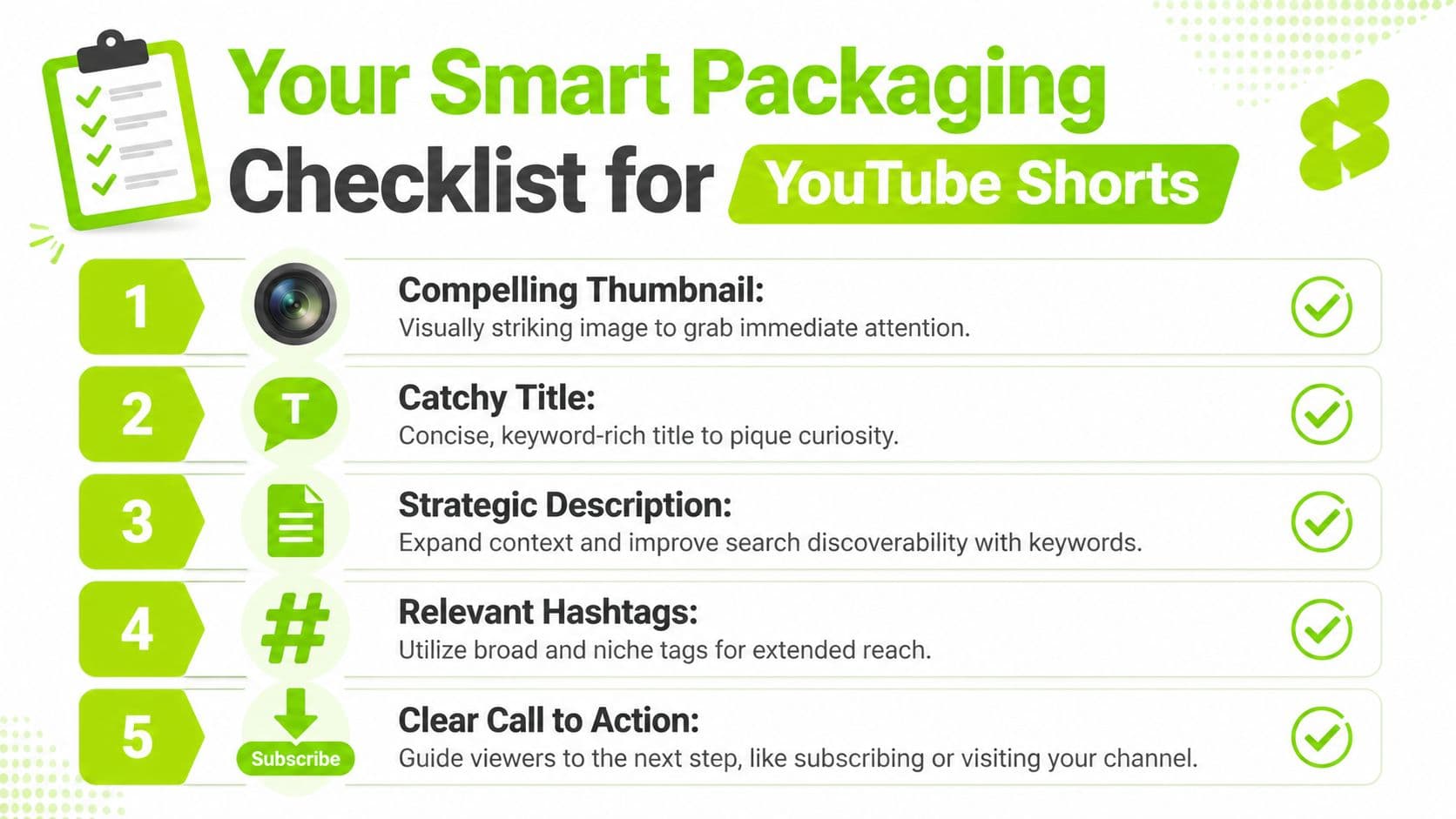
Packaging is the bridge between content and discovery
Think about packaging as alignment. The title frames the promise. The selected frame gives a visual cue. The description provides context. Tags help classification. Audio choice can make the whole Short feel more native to the feed.
The strongest packaging doesn’t oversell. It sharpens the angle.
Based on Boolv’s guide to viral Shorts strategy, top-performing Shorts average 24 tags, which correlates with a 7% engagement uplift, and systematically A/B testing hook and title variations can yield 20% to 30% more engagement.
That gives you a practical checklist:
- Title clarity: Promise one idea, not three. Curiosity is good. Vagueness is not.
- Chosen frame: Pick a frame with motion, contrast, or an unresolved moment.
- Description: Keep it short and useful. Give context, keywords, and a reason the video exists.
- Tags: Use enough relevant tags to help categorization without turning the upload into clutter.
- Sound choice: Borrow energy from trends when it fits, but don’t let the sound become the concept.
What are the common questions?
What is the quick answer for How to Go Viral on YouTube Shorts: A 2026 Playbook?
Learn how to go viral on YouTube Shorts with a step-by-step playbook. Master hooks, editing, retention, and the algorithm to get millions of views in 2026.
What should creators do first?
Publish with a clear hypothesis
What is this article based on?
Satura editorial guide based on the source video, topic cluster, and article sections.
Action checklist
Apply this to your channel today.
- 1Publish with a clear hypothesis
- 2Read the performance pattern
- 3Identify the main failure point
- 4Change one major variable
- 5Repeat fast enough to learn
Sources & methodology
- Satura editorial guide based on the source video, topic cluster, and article sections.
- Source video reviewed for this article: https://www.outrank.so/