What is the quick answer?
Unlock views! Master your YouTube Trust Score. Discover algorithm signals, measure your score, & get steps to improve your channel now.
Key takeaways
- Why Your YouTube Views Are Not Random
- The term is messy but the model is useful
- What this changes for creators
- What Is the YouTube Trust Score Really
- A practical formula
- Why YouTube needs a system like this
Overview
Most YouTube channels don’t stall because the algorithm is random. They stall because the channel hasn’t earned enough trust for YouTube to risk distributing it.
That’s the uncomfortable part creators often miss. People talk about a youtube trust score like it’s some hidden number locked inside YouTube Studio. It isn’t that simple. As one creator discussion points out, the term creates confusion because many creators treat it like a literal metric, while the more accurate view is that it’s a model for understanding YouTube’s ranking system, not a visible score you can look up in your dashboard (creator discussion on the trust score disconnect).
Once you see that clearly, your strategy changes. You stop asking, “Why did this flop?” and start asking, “What signals did this channel send that made YouTube cautious?”
That’s a much better question. It leads to fixes.
For creators trying to decode why some videos spread and others die on upload day, this lines up with the same idea behind what makes a video go viral. Distribution follows signals. Luck can help, but trust decides whether your video gets a real shot.
Why Your YouTube Views Are Not Random
Creators love to say YouTube is unpredictable. That belief is comforting, but it’s wrong often enough to keep people stuck for years.
When two channels post equally solid videos and one gets traction while the other barely gets tested, that usually isn’t chaos. It’s YouTube making a distribution decision based on channel-level confidence. The platform is constantly asking a simple question: “If we show this to more people, are we likely to improve the viewer experience or waste impressions?”
That’s where the youtube trust score idea becomes useful.
The term is messy but the model is useful
You won’t open YouTube Studio and find a big dial labeled “Trust Score.” That’s part of why creators argue about it. Some treat it like an official metric. Others say it isn’t real at all.
Both sides are half-right.
The term itself is a shortcut. It gives creators language for something YouTube clearly does in practice: weigh the reliability of a channel and its content before expanding distribution. The name is informal. The behavior is not.
A channel can have good content and still get weak distribution if YouTube doesn’t trust the packaging, consistency, or viewer response patterns yet.
That’s why “I made a great video” isn’t enough. Great by your standards doesn’t matter if the platform sees weak early signals, shaky consistency, or increased risk.
What this changes for creators
Once you stop framing views as random, your workflow gets sharper.
I’ve seen this mindset shift change how creators operate. They stop chasing hacks and start building repeatable trust signals. That usually leads to better packaging, stronger viewer satisfaction, and cleaner channel behavior.
The algorithm isn’t emotional. It’s cautious.
- You audit patterns instead of guessing. You look at openings, retention drops, comments, shares, and publishing habits.
- You think in earned distribution. Recommendations become something your channel qualifies for, not something it wins in a lottery.
- You stop overvaluing one upload. A channel’s history affects how new videos are judged.
What Is the YouTube Trust Score Really
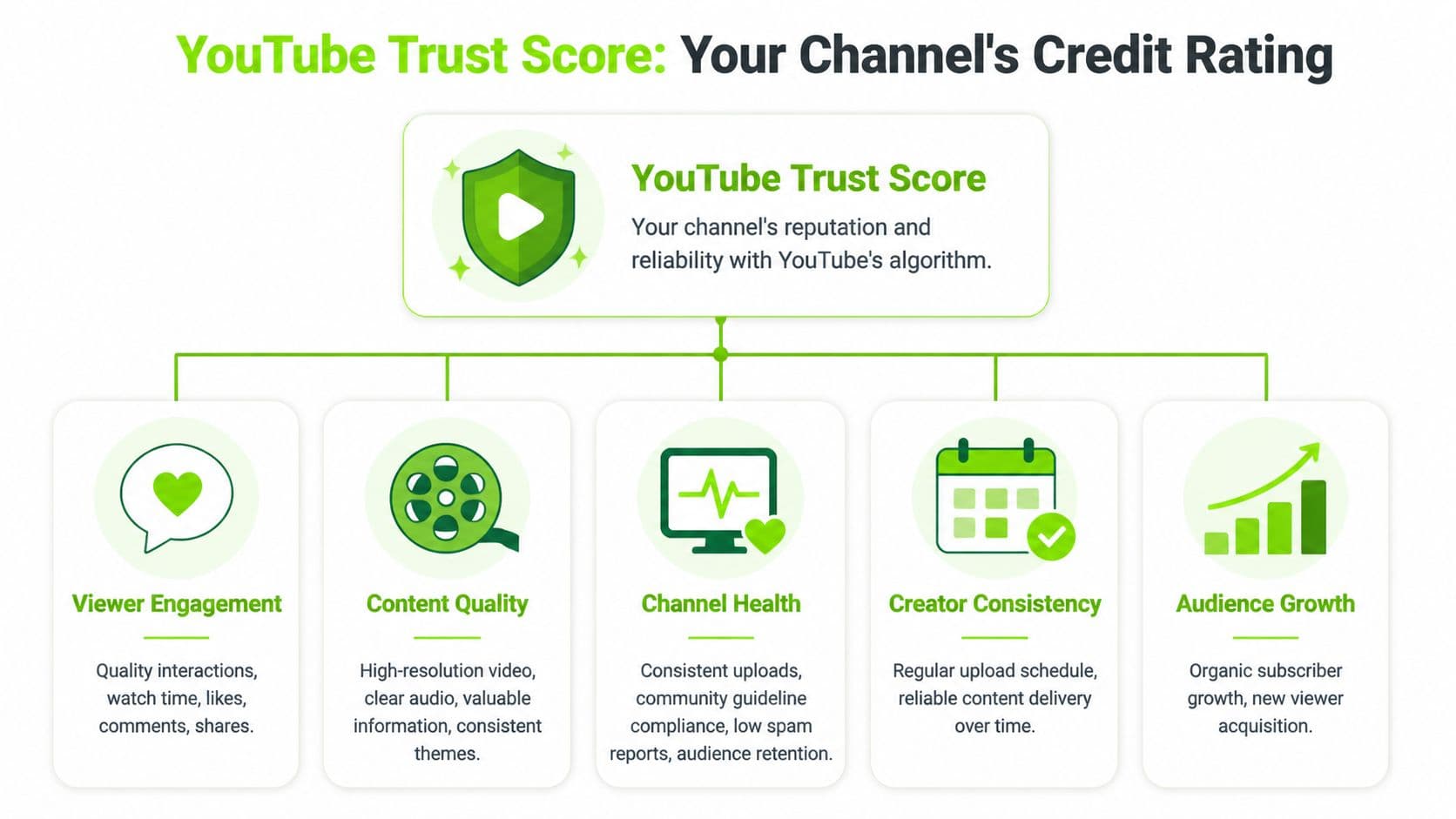
Think of the youtube trust score like a credit rating for your channel.
A bank doesn’t lend money based on one nice-looking paycheck. It looks for patterns. Can this person be trusted to handle more responsibility? YouTube works similarly with distribution. Before it gives a video meaningful reach, it needs evidence that your channel is a safe bet for viewers.
For new channels, that matters a lot. Creator analysis describing YouTube’s hidden trust logic says the platform can hold back recommendations until a channel reaches a baseline level of trust, and that channels with enough trust may be tested with a seed audience of about 30,000 viewers before broader distribution (creator analysis of YouTube trust and seed audience testing).
A practical formula
A useful working model is this:
watch time + viewer satisfaction + consistency - policy risk
That isn’t a visible YouTube formula printed in Studio. It’s a practical way to organize what the system appears to care about.
Here’s how to read it:
If you’ve ever wondered why a flashy title can get clicks but still lead to a dead video, this is why. The click gets you in the door. The rest of the experience decides whether the system trusts you with more reach.
- Watch time tells YouTube whether people stay.
- Viewer satisfaction tells YouTube whether the experience felt worth having.
- Consistency tells YouTube your performance isn’t a fluke.
- Policy risk tells YouTube whether recommending your content could create problems.
Why YouTube needs a system like this
YouTube serves a massive audience. In creator and platform analysis cited around this topic, the platform’s scale is described as 2.58 billion global users, including 500 million users in India and 254 million users in the US (Satura Trustscore overview). At that scale, YouTube can’t rely on gut instinct. It has to rank probability.
That means the platform isn’t asking, “Is this creator talented?”
It’s asking, “Based on the signals we have, how confident are we that viewers will respond well if we show this to more people?”
Practical rule: YouTube rewards channels that feel reliable, not just channels that occasionally make a good video.
That’s also why the trust score model is helpful even if the term itself isn’t official. It translates a complex ranking system into something creators can use. Not perfectly. But usefully.
The Key Signals That Build or Break Your Trust Score
If trust is the outcome, signals are the evidence.
Most creators focus too hard on one metric. Usually click-through rate. That matters, but it’s only part of the story. YouTube reads clusters of behavior. A strong title paired with poor retention is a warning. A modest title paired with excellent viewer satisfaction can be a green light.
Signal breakdown table
| Signal | Why It Matters | How to Improve It |
|---|---|---|
| Hook strength | Early viewer behavior tells YouTube whether the promise matches the opening. If people bounce fast, the platform gets cautious. | Rewrite intros so the first moments confirm the title and thumbnail promise immediately. Cut greetings, disclaimers, and slow context. |
| Retention and watch time | Sustained viewing suggests the content keeps earning attention. That’s one of the clearest trust builders. | Track where viewers leave, then tighten those segments. Remove repeated points, slow transitions, and scenes that don’t move the idea forward. |
| Viewer satisfaction | Likes matter, but shares, comments, and strong audience response often signal deeper value. | Make videos worth passing along. Teach something useful, challenge a belief, or give viewers a reason to discuss the topic. |
| Posting consistency | Erratic publishing makes the channel harder to model. Consistency gives YouTube cleaner expectations. | Pick a schedule you can actually maintain. Reliable monthly publishing beats a burst of uploads followed by silence. |
| Policy risk | Content that looks spammy, manipulative, or risky can suppress trust even when the idea is strong. | Avoid misleading packaging, repetitive CTA stuffing, and anything that flirts with guideline problems. Keep the channel clean. |
What creators often get wrong
A lot of channels hurt themselves with tactics that look smart in the short term.
Repeating “like and subscribe” too aggressively can make a video feel mechanical. Overwriting titles for shock can create a retention problem the moment the video starts. Uploading in random bursts can make channel performance look unstable.
The opposite works better. Clear promise. Fast delivery. Familiar publishing rhythm. Clean audience response.
For packaging and discoverability, I also like meowtxt's video optimization advice because it pushes creators to think about search intent and metadata without pretending those elements can rescue a weak video. That’s the right balance. SEO can help a strong video get found. It can’t manufacture trust.
How the algorithm likely reads these together
YouTube doesn’t need every signal to be perfect. It needs enough evidence that recommending your content is a good bet.
That’s why one weak area can drag down the whole channel.
For a deeper explanation of how engagement signals feed ranking decisions, this breakdown of YouTube’s point system and engagement ranking is worth reading.
Shares are different from likes. A like says, “I approved of this.” A share says, “I’m willing to attach my name to this and send it to someone else.”
That’s a stronger trust signal in practice.
- Good clicks with weak retention suggests packaging outperformed content.
- Strong retention with low satisfaction can mean the video held attention but didn’t leave viewers happy.
- Solid videos with inconsistent uploads can slow momentum because the channel lacks dependable patterns.
How to Measure Your Current Trust Score
You cannot measure a YouTube trust score by hunting for a hidden number in Studio, because there isn’t one. Trust score is a working model. It helps explain why YouTube keeps testing some channels harder, while it limits reach on others after a few weak signals stack up.
That distinction matters.
Creators get stuck when they treat trust like a mystery instead of a diagnosis problem. Studio shows the raw parts. Retention curves, click behavior, returning viewers, shares, upload patterns. The primary job is combining those parts into a channel-level read on reliability.
What are the common questions?
What is the quick answer for Mastering Your YouTube Trust Score?
Unlock views! Master your YouTube Trust Score. Discover algorithm signals, measure your score, & get steps to improve your channel now.
What should creators do first?
Add one clear payoff early. Give the viewer a useful insight, a reveal, or a strong example before the video settles into explanation.
Who is this for?
This article is for YouTube creators, faceless channel operators, agencies, and teams improving video production, editing, analytics, and growth workflows.
Action checklist
Apply this to your channel today.
- 1Add one clear payoff early. Give the viewer a useful insight, a reveal, or a strong example before the video settles into explanation.
- 2Ask for interaction at the right moment. A pinned comment with a specific question works better than generic begging.
- 3Build videos people want to send. Practical frameworks, strong opinions, and useful breakdowns tend to earn more meaningful audience response than vague motivation.