What is the quick answer?
Learn the optimal answer to how long should a youtube short be for viral content in 2026. Maximize impact with insights on the 60-second limit & sweet spot.
Key takeaways
- The Official Rules The Platform Wont Tell You
- The rules are a boundary, not a strategy
- What creators should do in practice
- Finding the Algorithmic Sweet Spot
- The first few seconds carry absurd weight
- What this means for length decisions
Overview
If you want the practical answer, make most YouTube Shorts 15 to 30 seconds, and treat 20 to 30 seconds as your default starting point. Yes, Shorts can be up to 60 seconds or more, but the sweet spot for most viral content is the shortest version that keeps people watching nearly all the way through.
That's the part most advice gets wrong. Creators obsess over the maximum length like the algorithm is grading homework. It isn't. YouTube cares far more about whether viewers stay, finish, and rewatch than whether your Short runs for 12 seconds, 28 seconds, or 54 seconds. If you're asking how long should a youtube short be, stop thinking in terms of limits and start thinking in terms of retention density.
A bloated Short dies fast. A tight Short gets replayed. That's the game.
The Official Rules The Platform Wont Tell You
The old “Shorts are 60 seconds max” advice is outdated. YouTube's official documentation says square or vertical videos up to 3 minutes can be classified as Shorts, but there's a catch. Some songs in the Shorts Audio Library can limit your video to 90 seconds, 60 seconds, or even 30 seconds, so your audio choice can effectively set your actual ceiling before you export (YouTube Help on Shorts length and audio limits).
The rules are a boundary, not a strategy
A lot of creators hear “3 minutes” and make the wrong move immediately. They assume a bigger canvas means they should use it.
Bad idea.
The platform limit tells you what's allowed. It doesn't tell you what's smart. Your real checklist is simpler:
Practical rule: Treat the platform maximum like the edge of the map. Don't build your strategy around it.
- Check format first: Your video needs to be square or vertical to qualify as a Short.
- Check upload timing and channel context: YouTube's rollout for longer Shorts differs by channel type, which is why some creators still bump into older assumptions from the 60-second era.
- Check music before editing: If you build around a track from the Shorts library, that song may shrink your usable runtime.
- Check packaging and trust signals: If you're publishing aggressively, it helps to understand broader channel quality signals like YouTube trust score factors.
What creators should do in practice
Export for the format you know will qualify. Then decide whether your content deserves more time.
If the answer isn't obvious, the answer is usually shorter.
Most creators don't lose because they posted a 22-second Short instead of a 47-second one. They lose because they dragged a one-idea video past its natural ending. The platform gave you room. That doesn't mean viewers gave you patience.
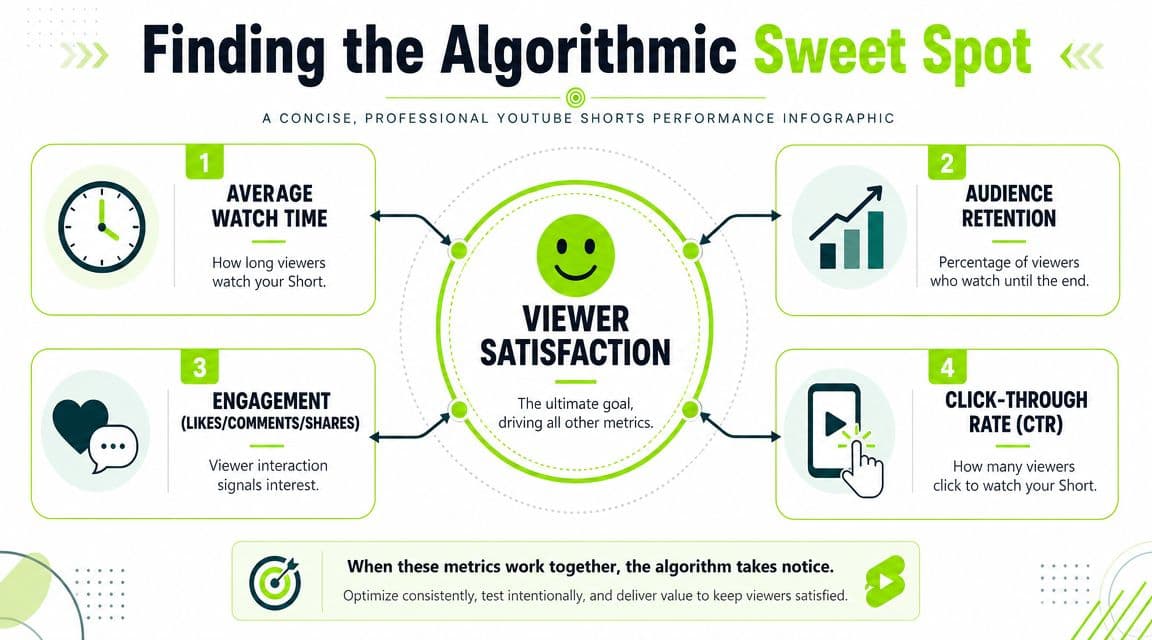
Finding the Algorithmic Sweet Spot
Stop looking for a magic number.
The algorithm rewards viewer satisfaction, and on Shorts that usually shows up as strong Average Percentage Viewed, or APV. Analysts at Shortimize found that high-performing Shorts consistently show an APV of 80% or more, and for a 20-second Short, that means the average viewer needs to watch at least 16 seconds (Shortimize on YouTube Shorts performance).
That should change how you judge length. Raw watch time can make a longer Short look stronger than it is. If viewers feel drag, extra seconds work against you.
Use a simpler standard. Pick a runtime that people can finish, then tighten it until the payoff arrives without delay.
For a visual summary, keep this framework in mind:
The first few seconds carry absurd weight
Early retention decides whether your Short gets a real shot. Strong Shorts hold attention immediately, stay steady through the middle, and finish with enough momentum to earn rewatches. The opening is decisive.
If your first frames are slow, unclear, or self-indulgent, the edit is already in trouble. Viewers do not wait for context on Shorts. They swipe.
What this means for length decisions
A Short spreads when the runtime fits the idea. That is the sweet spot.
A reveal clip might need 9 seconds. A clean visual tutorial might need 28. A faceless explainer might need a bit more room, but only if every beat earns its place. Creators focused on repurposed clips, voiceover explainers, or creating YouTube Shorts for faceless channels should obsess over pacing, visual motion, and payoff timing because those formats fall apart fast when the setup drags.
Use this as your operating rule:
You can also pressure-test hook strength and retention patterns with tools built for Short performance analysis, like Satura's swipe ratio guide and 81 percent rule breakdown.
A 25-second Short that people nearly finish is stronger than a 50-second Short they abandon halfway through.
That's the play. Stop treating maximum length like strategy. Choose the shortest runtime that delivers the goal, holds attention, and earns the rewatch.
- If APV is weak, cut runtime before adding more edits.
- If viewers drop in the opening seconds, rewrite the first line and change the first shot.
- If the middle loses steam, trim setup and get back to movement.
- If the ending falls off, the payoff came too late or landed too softly.
Matching Your Shorts Length to Your Goal
There isn't one perfect length. There's a perfect length for the job.
A common pitfall is that most creators get lazy. They ask “how long should a youtube short be” as if the answer is a single number. It isn't. A punchline clip, a mini tutorial, and a repurposed podcast moment should not be edited to the same runtime.
Data from Opus suggests 15 to 30 seconds is the strongest range for retention, notes that 50 to 60% of viewer drop-offs happen in the first 3 seconds, and says retention tends to decrease significantly after 45 seconds in many niches (Opus on ideal Shorts length and retention).
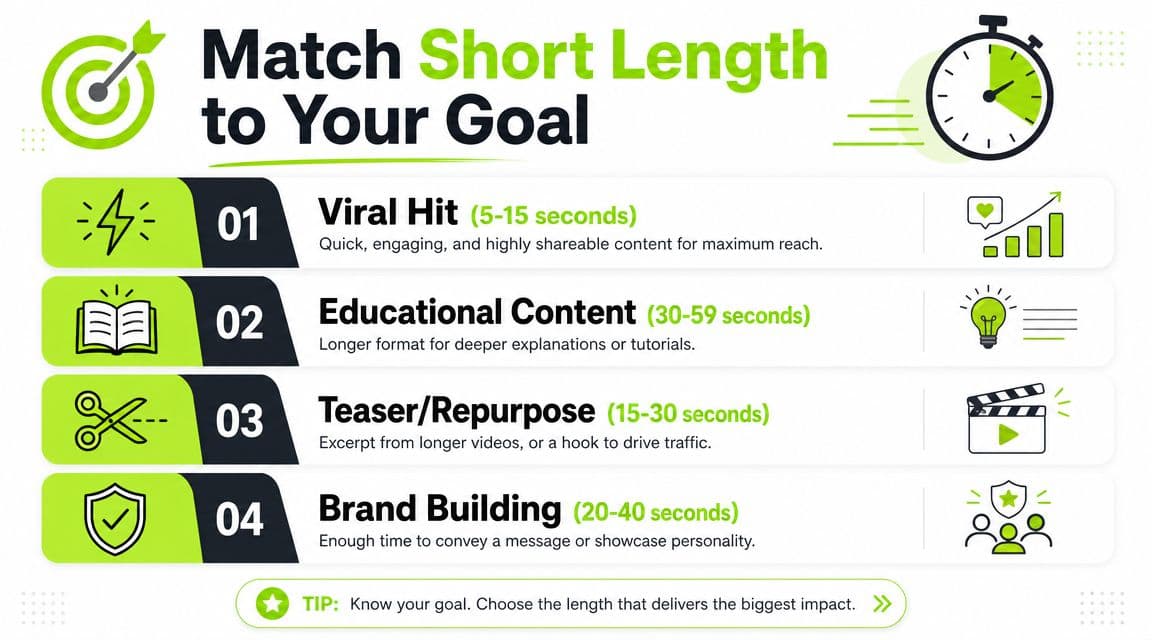
Use this table before you script
| Content Goal | Ideal Length | Rationale |
|---|---|---|
| Viral hit | 5 to 15 seconds | Best for one joke, one reveal, one reaction, or one visual payoff. The shorter format helps remove dead space. |
| Teaser or repurposed clip | 15 to 30 seconds | Strong range for cutting one self-contained moment from a longer video without forcing extra context. |
| Brand building | 20 to 40 seconds | Gives you room for personality, framing, and a clear point without drifting into filler. |
| Educational content | 30 to 59 seconds | Useful when the idea needs a few steps or examples, but only if the pacing stays tight. |
What works by format
Some formats naturally want less time:
Other formats can justify more runway:
Your Short should end the second the value is delivered. Not three sentences later.
If you script before you edit, use a calculator that forces discipline. A tool like the YouTube script length calculator can help you spot when a “quick” Short is already too wordy for the runtime you're aiming for.
- Memes and punchlines: Keep them brutally short. If the joke lands in one beat, don't add a second beat.
- Commentary hooks: Stay compact unless the twist needs setup.
- Before-and-after reveals: Let the transformation carry the runtime, not your explanation.
- Micro tutorials work when each step earns its place.
- Story clips can breathe a little if every beat changes the viewer's understanding.
- Repurposed interviews or podcasts need the payoff early, not after a throat-clearing intro.
My blunt recommendation
Start here unless you have channel data that says otherwise:
Creators get in trouble when they edit to the limit instead of the payoff. Don't do that.
- Aim for 15 to 30 seconds for broad reach.
- Use 20 to 30 seconds as your default for most ideas.
- Push past that only when the content structure justifies it.
- Treat anything much longer as advanced mode.
Editing Strategies to Make Every Second Count
Length is chosen in strategy. Performance is won in editing.
A weak 15-second Short still flops. A tight 35-second Short can crush. The difference is pacing, not just runtime.
What are the common questions?
What is the short answer for How Long Should a YouTube Short Be for Viral Success??
Learn the optimal answer to how long should a youtube short be for viral content in 2026. Maximize impact with insights on the 60-second limit & sweet spot.
What should creators do first?
Repeat across several uploads until a runtime range starts showing up among your winners.
Who is this guide for?
This guide is for YouTube creators, faceless channel operators, agencies, and teams using AI tools to improve video production and growth.
Action checklist
Apply this to your channel today.
- 1Repeat across several uploads until a runtime range starts showing up among your winners.
- 2Opening response: Did viewers understand the topic instantly?
- 3Middle hold: Did every beat add new information, tension, or proof?
- 4Payoff timing: Did the result land before attention faded?
- 5Runtime pattern: Do your strongest Shorts keep clustering in the same range?