
What is the quick answer?
Want to know how to start a faceless YouTube channel that grows? Get the full playbook on niches, AI tools, video production, SEO, and monetization for 2026.
Key takeaways
- The Anonymous Creator Economy is Booming
- What faceless creators get right
- The real question
- Find Your Unfair Advantage Niche
- Start narrower than feels comfortable
- Pressure-test the niche before you commit
Overview
Most advice on how to start a faceless youtube channel is too neat. Pick a niche. Make a logo. Post consistently. Wait for the algorithm to notice you.
That advice leaves out the hard part. Faceless channels don't fail because the creator forgot a banner image. They fail because the channel was never designed like a system. The niche doesn't connect to monetization. The production workflow breaks when upload volume rises. The packaging is weak. The analytics come too late. And the creator ends up juggling too many tools to move fast.
The better way is to treat a faceless channel like an integrated operating model. Topic selection, scripting, editing, thumbnails, upload cadence, and revenue planning all need to work together from day one. When they do, anonymity becomes an advantage instead of a limitation.
The Anonymous Creator Economy is Booming
The biggest myth in faceless YouTube is that it's easy. It isn't. You remove the camera, but you add pressure everywhere else. The script has to carry more weight. The edit has to create momentum. The thumbnail has to sell curiosity without a recognizable face doing the work.
Still, this isn't some fringe creator tactic anymore. Faceless channels now make up 38% of all new creator monetization ventures as of 2025, up 217% from 2022, according to industry analysis on faceless creator statistics. That same analysis says these channels require about 39% more uploads to reach monetization, but once established they maintain around 68% profit margins because they avoid many traditional creator costs.

That trade-off matters. A face-based creator can lean on personality, presence, and parasocial pull earlier. A faceless creator usually has to earn traction with a larger volume of strong packaging and cleaner execution. But the payoff is a leaner business with fewer recurring costs and far more flexibility.
What faceless creators get right
Faceless works best when the content itself is the product. Tutorials. Breakdowns. Storytelling. Explainers. Screen-recorded workflows. Research-led videos. Formats where the viewer showed up for the answer, not the personality.
That's why anonymity often becomes a strategic advantage. You can separate the brand from the person. You can test multiple formats without locking yourself into an on-camera identity. You can build assets that are easier to delegate later.
Practical rule: If the value of the video survives without your face, you have the foundation for a scalable faceless channel.
A lot of beginner guidance also treats channel setup as the main event. It's not. Setup is the easy part. If you need a clean walkthrough of the basics like account creation, branding, and publishing mechanics, Vidito has a useful guide on how to start a YouTube channel. The hard part starts after that, when you need a repeatable system that can survive months of testing.
The real question
The question isn't whether faceless YouTube works. The market has already answered that. A more pertinent question is whether you can build a channel that survives the awkward stage where output is inconsistent, feedback is messy, and revenue hasn't stabilized yet.
Creators who treat faceless YouTube like a low-effort shortcut usually burn out. Creators who treat it like a media business have a much better shot.
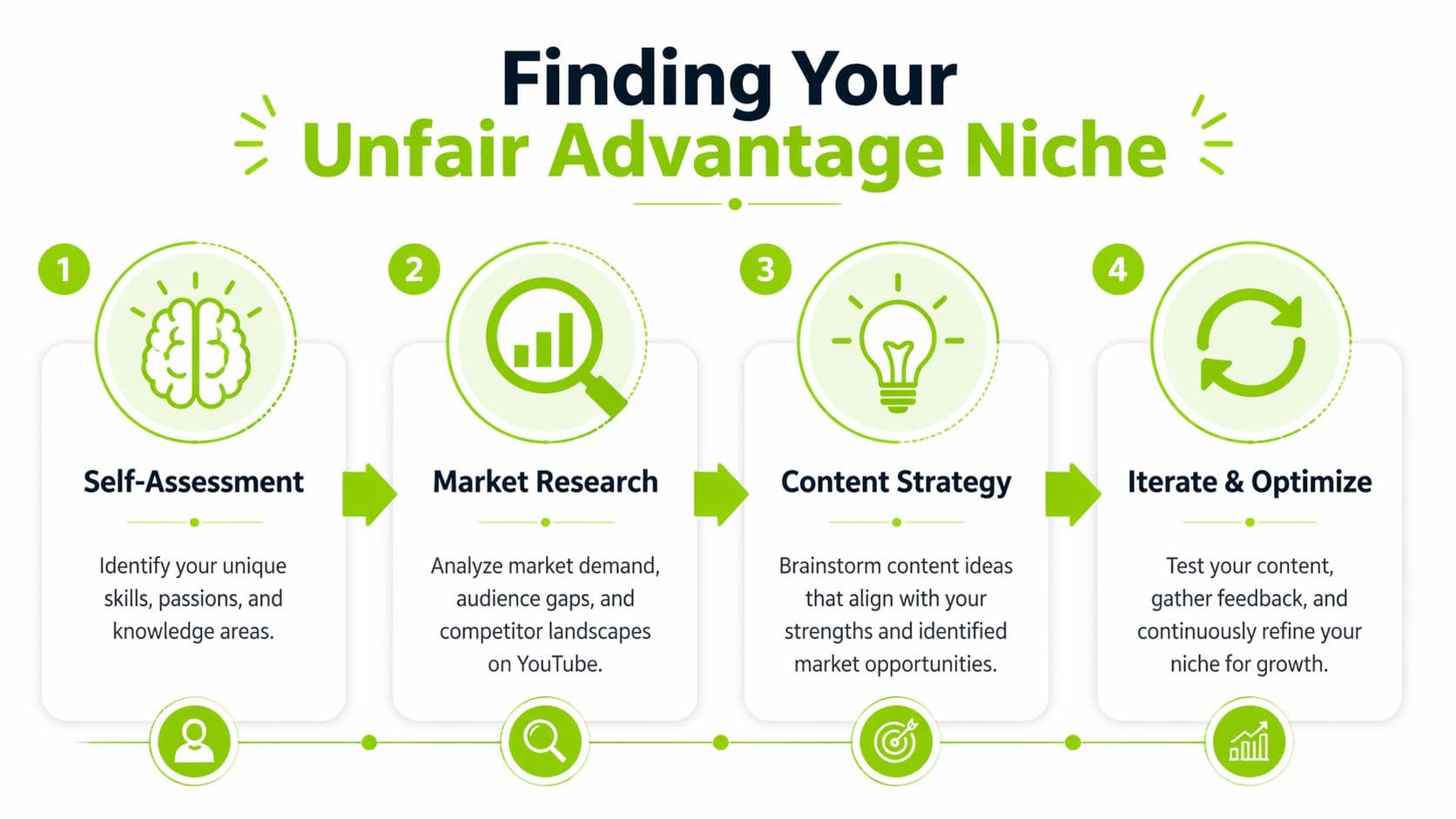
Find Your Unfair Advantage Niche
"Follow your passion" is bad niche advice. Passion helps you last longer, but it doesn't tell you whether anyone is searching for the topic, whether the competition is beatable, or whether the subject can support dozens of videos without getting thin fast.
A stronger approach is to find the overlap between three things: what you can explain well, what people already search for, and what other channels haven't packaged cleanly yet. That is your unfair advantage.
Start narrower than feels comfortable
The best faceless channels rarely begin broad. They start with a tight sub-topic and expand later. According to Epidemic Sound's guide, creators can launch with stronger early potential by targeting low-competition keywords with KD under 30 and search demand in the 10k to 50k range, which can produce 20% to 30% higher initial view rates. The same guidance recommends claiming social handles across major platforms to improve discoverability through multi-platform traffic by 15% to 25%. You can read that breakdown in their piece on faceless YouTube niche strategy.
Broad niche: productivity. Better niche: Notion systems for freelancers. Even better niche: Notion client onboarding systems for solo designers.
Broad niche: pet videos. Better niche: dog training mistakes. Even better niche: dog training fail compilations with voiceover lessons.
The narrower version gives you clearer titles, sharper thumbnails, and a more obvious promise to the viewer.
Pressure-test the niche before you commit
Don't just ask, "Can I make one good video here?" Ask harder questions.
A quick way to sharpen your thinking is to study channels that dominate a narrow lane and reverse-engineer what they own. A framework like YouTube niche monopoly strategy proves useful in this context. The point isn't to copy a channel. It's to identify what corner of demand they captured and what adjacent gap is still open.
- Can it support a series: You want at least five strong video ideas before launch, not one hero concept and four filler uploads.
- Does the viewer have recurring problems: Tutorials, explainers, comparisons, and mistakes-to-avoid content tend to repeat well.
- Can you source visuals without friction: A niche might look good on paper and still be a production nightmare.
- Is there a revenue angle beyond ads: Some topics naturally connect to affiliate tools, templates, or digital products.
Build your first five videos as a cluster
New creators often choose a niche and then improvise each upload. That's slower and sloppier than it sounds. Build the first five videos as a connected cluster instead.
A simple cluster might look like this:
| Video role | Example angle |
|---|---|
| Entry topic | The beginner mistake everyone makes |
| Tool comparison | Best option for a specific use case |
| Tutorial | How to get one clear result |
| Reaction or teardown | What went wrong and why |
| Next-step guide | What to do after the beginner stage |
This structure tells you if the niche has depth. It also helps the channel feel coherent from the start.
Pick a niche where the audience has repeat questions, not just momentary curiosity.
If you can't quickly generate more than a handful of useful titles, the niche probably isn't strong enough yet. Adjust before you publish, not after ten random uploads.
Build Your Content Machine with AI
Most faceless creators don't have a content problem. They have a workflow problem. They can script one decent video. They can maybe edit two. Then the whole process slows down because every upload is being rebuilt from scratch.
That gets worse when volume increases. Voices.com's analysis points to a major bottleneck for faceless channels: creators struggle to scale production without quality slipping, especially when moving from weekly output to 3 to 5 videos per week. Their write-up on faceless channel production bottlenecks is useful because it focuses on operations, not just idea generation.

Stop building one video at a time
The amateur workflow looks like this: choose topic, panic, open six tabs, draft a script, hunt for visuals, generate a voice, edit manually, then start over next week.
The stronger workflow uses batches.
Write three scripts in one sitting. Record or generate voiceovers in a block. Collect reusable visual elements by category. Build a repeatable editing template. Create a packaging checklist before export. This is how you reduce decision fatigue and keep quality stable.
If you're comparing stacks, it's worth browsing a current roundup of best AI tools for content creation just to see how fragmented the normal setup has become. Most creators end up stitching together separate apps for research, script drafting, voice generation, clipping, captions, editing, and thumbnails. That's exactly where time disappears.
Design a repeatable workflow
A faceless channel should run on a documented production path. It doesn't need to be fancy. It does need to be consistent.
Write the core promise of the video in one sentence. If you can't explain the value clearly, the video usually turns into rambling filler.
Faceless videos die when the narration sounds written instead of spoken. Use shorter lines. Read them aloud. Cut anything that sounds formal or padded.
Good faceless editing changes the visual when the idea changes. That can mean screen recording, stock footage, charts, slides, captions, or cropped references. It should feel intentional, not decorative.
Before export, check four things: pronunciation, pacing, visual relevance, and dead air. AI helps speed up output, but it also creates weird mistakes fast.
A platform that helps here is an AI video generator built for creators, especially if you want one workspace for cutting footage, adding subtitles, cleaning audio, and turning rough material into publishable assets without bouncing between tools.
Later in the workflow, a visual walkthrough helps more than another paragraph. This demo gives a good sense of what an efficient creation flow should feel like:
- Topic brief first
- Script for voice, not for reading
- Match visuals to the sentence, not the paragraph
- Create quality gates
What breaks when creators scale
Here are the failure points I see most often:
Batch what the audience never sees, then spend your attention on what they immediately feel.
The point of AI isn't to flood YouTube with generic sludge. It's to remove repetitive labor so you can spend more energy on topic selection, stronger scripting, and better packaging.
- Every video uses a new process: That feels creative, but it kills speed.
- The AI output never gets reviewed: Robotic voice moments, wrong emphasis, and mismatched visuals slip through.
- Too much effort goes into visuals nobody notices: Motion for the sake of motion hurts clarity.
- The creator becomes the bottleneck: If only one person knows how the channel works, output stalls the second life gets busy.
What are the common questions?
What is the quick answer for How to Start a Faceless YouTube Channel (& Make Money)?
Want to know how to start a faceless YouTube channel that grows? Get the full playbook on niches, AI tools, video production, SEO, and monetization for 2026.
What should creators do first?
Did the video create a next action?
What is this article based on?
Satura editorial guide based on the source video, topic cluster, and article sections.
Action checklist
Apply this to your channel today.
- 1Did the video create a next action?
- 2Chasing broad topics only because they seem "viral"
- 3Posting without a clear offer or business angle
- 4Ignoring audience intent in favor of random traffic
- 5Quitting when the revenue lag feels too long
Sources & methodology
- Satura editorial guide based on the source video, topic cluster, and article sections.
- Source video reviewed for this article: https://www.outrank.so/