
What is the quick answer?
Unlock your first paycheck. This guide breaks down all creator fund requirements for TikTok, YouTube & more and gives you a playbook for hitting your metrics.
Key takeaways
- The Creator Fund Dream Getting Paid to Post
- Why this matters to new creators
- Stop treating it like a lottery
- What Exactly Is a Creator Fund
- It's a pool, not a paycheck
- Why platforms built these programs
Overview
You're probably in the same spot most creators hit right before monetization starts feeling real. Your videos are finally getting traction, your views are moving, maybe a few posts even broke out, and yet your bank account still looks like none of that happened.
That gap is where creator funds get interesting. They're usually the first moment a platform says, “You're not just posting anymore. You're now eligible to earn.” For a lot of creators, that first payout matters more psychologically than financially. It proves the machine can work.
I've seen too many creators treat creator fund requirements like some mysterious badge the platform hands out randomly. That's the wrong mindset. These programs are gatekept by metrics, account health, and consistency. If you know the thresholds and build toward them on purpose, qualifying stops feeling like luck.
There's also a second layer most beginners miss. Hitting eligibility faster is rarely about posting more junk. It's about making sharper content, improving retention, and building a workflow that lets you stay consistent without burning out. If you're already thinking beyond platform payouts, resources around empowering brands with influencer marketing can help you understand where creator income expands after your first monetization milestone. And if you want to think more strategically about creator growth systems, the ideas on the Satura AI blog are worth studying.
The Creator Fund Dream Getting Paid to Post
A creator posts every day for months. Nothing happens at first. Then one clip lands. Then another. Suddenly the analytics look alive, friends start sending screenshots, and strangers are quoting your lines back in the comments. That's the moment when the question changes from “Can I grow?” to “When do I get paid?”
That jump matters because attention without monetization gets old fast. Views feel exciting, but they don't cover software, gear, editing time, or the hours you spent learning hooks and pacing. A creator fund becomes the first real bridge between making content for fun and treating content like a business.
Why this matters to new creators
It's easy to assume creator fund requirements are just boring platform policy. They're not. They're a scoreboard. The platform is telling you exactly what kind of creator behavior it rewards, recent views, follower momentum, account health, original content, and consistency.
If you can read that scoreboard properly, you stop posting blindly.
Practical rule: Don't chase monetization by asking, “How do I apply?” First ask, “What signals does the platform need to see from me before it trusts me with payouts?”
That shift changes your whole strategy. Instead of obsessing over random virality, you focus on output that stacks. Better hooks. Better watch time. Better publishing discipline. Better account hygiene.
Stop treating it like a lottery
The creators who hit these thresholds fastest usually aren't the most talented. They're the ones who make content in a format they can repeat, improve, and publish consistently enough to create momentum.
That's the game. Not magic. Not luck. Not waiting to be discovered.
What Exactly Is a Creator Fund
A creator fund is not a salary. It's also not a simple pay-per-view system where every view pays the same amount. Think of it more like a performance bonus pool that a platform distributes to eligible creators based on how their content performs and whether those views qualify.
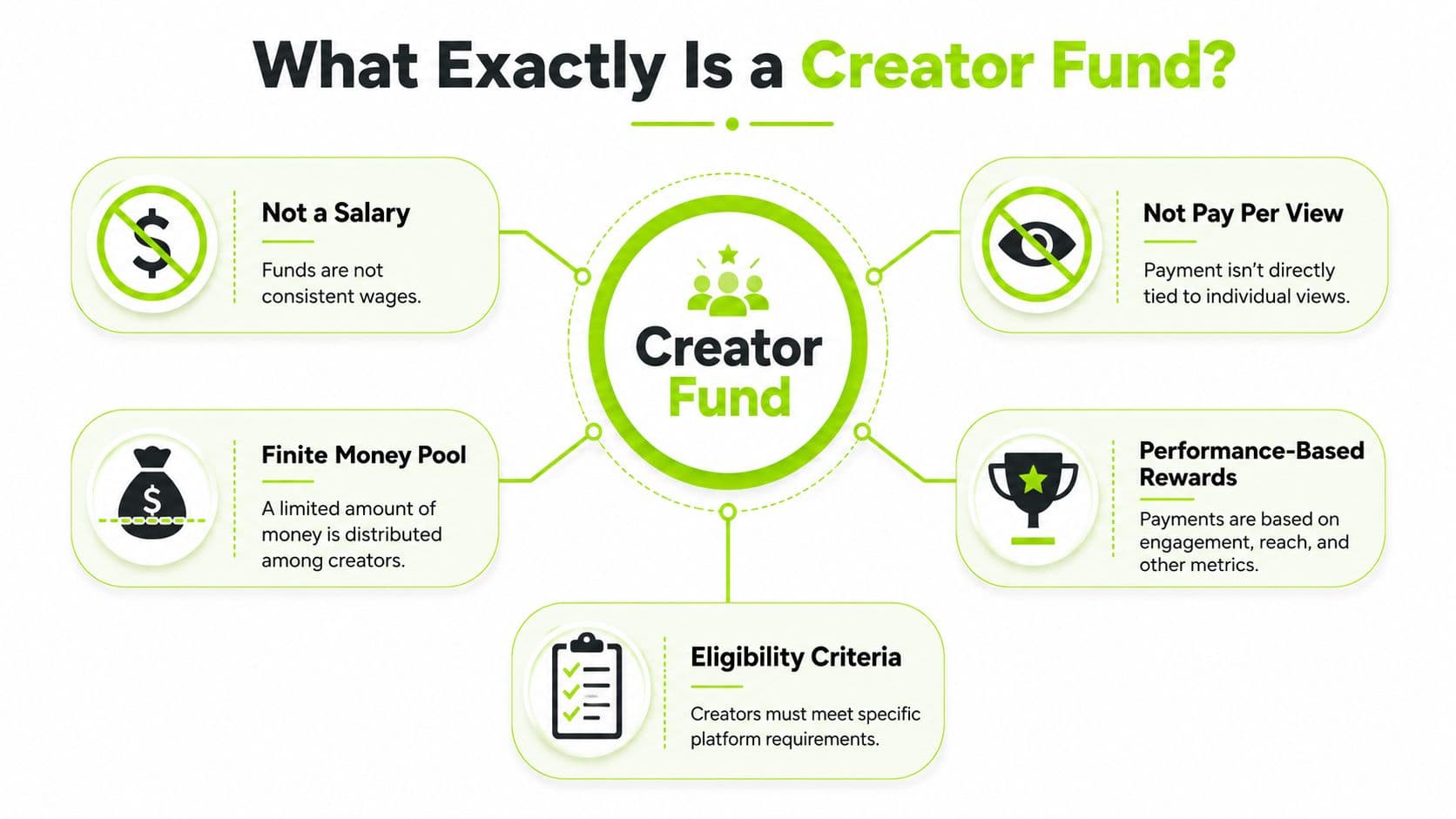
It's a pool, not a paycheck
A lot of creators become confused. They assume a creator fund works like a fixed CPM or RPM. It usually doesn't. TikTok's original fund made that especially obvious because payouts often felt inconsistent from creator to creator and month to month.
TikTok itself framed the system as dynamic. Its payout mechanism was calculated using a proprietary algorithm that weighted Content Engagement Rate, Number of Views, and Authenticity of Views, with no fixed per-view rate disclosed by the platform, according to Dash Social's breakdown of TikTok Creator Fund mechanics.
That means two creators can get similar raw views and still earn differently if the quality of those views isn't the same.
Why platforms built these programs
Platforms built creator funds for one reason. They wanted creators to stay and keep publishing.
A fund gives creators an early monetization path before they land sponsorships, sell products, or build a serious backend business. It's a retention tool for the platform and a motivation tool for the creator.
A creator fund is closer to a global bonus pool than a wage. You earn access first, then your content competes inside that pool.
That's why understanding the mechanics matters. If you think the system is “post video, get paid,” you'll make bad decisions. If you understand that performance, qualified views, and account eligibility all matter, your content choices get sharper.
For creators trying to decode how these programs connect to RPM, view quality, and monetization structure, this guide on understanding TikTok Creator Program is a useful companion read.
Your Platform by Platform Requirement Checklist
You post for 30 days, one platform gives you a real shot at a payout, and another leaves you months away from the threshold. That is the decision. Pick the platform where your current metrics are already within striking distance, then build for eligibility on purpose.
Creators who get paid first are rarely the most talented. They are the ones who audit the requirements early, choose the easiest qualifying path, and optimize for retention, view quality, and output volume fast.
TikTok Creator Fund and Creator Rewards Program
TikTok was the clearest starting point for many new creators because the entry thresholds were defined. For the original Creator Fund, creators needed to be at least 18, live in an eligible country, have at least 10,000 authentic followers, generate at least 100,000 video views in the previous 30 days, use the right account setup, stay in good standing, and wait 30 days before reapplying after a rejection, according to TikTok's Creator Fund Q&A.
Here is the practical read on that checklist:
Payment ops matter too. Business Insider reported that creators needed a valid linked digital payment account, payouts generally required at least $50.00 USD, and withdrawals had to be claimed within 30 days after month-end under the program's rules, as summarized in its Creator Fund overview.
My recommendation is simple. If you are already close to 100,000 monthly views on short-form, TikTok is often the fastest test case for your first platform payout. Use it to prove your hooks, watch time, and posting system. Then port the winners elsewhere.
- Follower count is a filter, not the hard part: 10,000 followers sounds big until you realize the primary choke point is sustained view velocity over 30 days.
- Qualified views matter more than vanity spikes: One viral clip helps. A repeatable format helps more.
- Account health can kill monetization: If your content style keeps triggering moderation, fix that before you chase thresholds.
- Originality is part of the job: Reposts and low-effort recycling slow growth and reduce your odds of qualifying.
YouTube monetization paths
YouTube is a better long game. It is not always the fastest first paycheck.
Short-form creators need to treat YouTube as two tracks at once: discovery through Shorts, then deeper monetization through channel growth and watch behavior. If Shorts is your top funnel, study the actual program paths before you guess at them. Start with ClipCreator on Shorts monetization and keep this guide to YouTube Shorts monetization requirements open while you plan your content mix.
The smart move is to build Shorts that earn repeat views, then turn your best topics into longer videos, series, or subscriber-driven formats. That gives you two shots at monetization instead of one.
AI helps here more than creators admit. It speeds up ideation, scripting, clipping, and testing, which means you can publish enough volume to find patterns before motivation drops off.
Snapchat Spotlight
Snapchat Spotlight makes sense for creators who already know how to produce clean vertical videos quickly. If your workflow is slow, Spotlight becomes a distraction.
Use it if you can do three things well:
If every post needs a custom concept, custom edit, and custom caption for one platform, your output falls apart. Eligibility always follows consistency.
- Repurpose short-form content without quality loss
- Respond to trends fast
- Keep your creative style consistent across apps
Creator Fund Requirements At a Glance 2026
| Platform | Follower/Subscriber Minimum | View/Watch Hour Minimum | Age Requirement |
|---|---|---|---|
| TikTok Creator Fund | 10,000 authentic followers | 100,000 video views in the last 30 days | 18+ |
| YouTube | Varies by program | Varies by program | Platform rules apply |
| Snapchat Spotlight | Varies by program | Varies by program | Platform rules apply |
Pick the platform where your gap is smallest. Then use AI to increase output, test more hooks, improve retention, and hit the threshold faster.
What are the common questions?
What is the short answer for Creator Fund Requirements: Your Guide to Getting Paid?
Unlock your first paycheck. This guide breaks down all creator fund requirements for TikTok, YouTube & more and gives you a playbook for hitting your metrics.
What should creators do first?
Brand deals: Sponsors care less about vanity hype and more about audience fit, consistency, and trust.
Who is this guide for?
This guide is for YouTube creators, faceless channel operators, agencies, and teams using AI tools to improve video production and growth.
Action checklist
Apply this to your channel today.
- 1Brand deals: Sponsors care less about vanity hype and more about audience fit, consistency, and trust.
- 2Affiliate income: This works especially well when your content naturally recommends tools, products, or workflows.
- 3Digital products: Templates, guides, memberships, and courses can turn audience trust into more durable income.
- 4Direct audience support: Loyal viewers often want a closer relationship than the platform feed allows.
Sources & methodology
- Satura editorial guide based on the source video, topic cluster, and article sections.
- Source video reviewed for this article: https://www.outrank.so/