What is the quick answer?
Wondering 'why are my YouTube videos not getting views'? We break down the core reasons and give you a step-by-step diagnostic plan to fix your channel.
Key takeaways
- The Zero View Void and Why You Are Not Alone
- Why this feels personal
- The three failure points that create the zero-view feeling
- How the YouTube View Engine Actually Works
- Your Diagnostic Checklist Finding the Real Bottleneck
- Start with impressions
Overview
You uploaded. You refreshed. You waited for the graph to move. It didn't.
That's the part nobody tells new creators. You can make a decent video, spend half a day editing it, write a title you think is smart, and still get almost no traction. A few pity views. A stray subscriber click. Maybe one comment from a friend. Then the spiral starts. Is the niche dead? Is the channel shadowbanned? Does YouTube hate small creators?
Usually, no. Usually the problem is simpler. Your video failed at one of three jobs: getting discovered, earning the click, or keeping attention. That's it. If you diagnose the right bottleneck, you can fix it. If you guess, you'll waste months changing the wrong thing.
The Zero View Void and Why You Are Not Alone
You publish a video you spent hours planning, scripting, editing, and polishing. A day later, it has 12 views. Maybe 3. Maybe none that matter. That gut-punch is real, and it makes smart creators ask the wrong question.
The question is not whether YouTube hates your channel. The question is where the breakdown happened.
Low-view videos are normal on YouTube. Brutally normal. The platform is crowded, attention is scarce, and effort does not buy distribution. Performance does.
Why this feels personal
A stalled video messes with your judgment. You start questioning the edit, your niche, your camera, your voice, the whole channel.
Usually, that is wasted energy.
I have seen strong creators bury good ideas under weak packaging. I have seen useful videos die because the topic had no real demand. I have seen polished uploads get ignored because the opening took too long to get to the point. The problem is rarely “my content is terrible.” The problem is usually more specific, which is good news, because specific problems can be fixed.
Stop asking, “Is this video good?” Ask, “Where did this video fail. Discovery, click, or retention?”
That is the entire framework.
The three failure points that create the zero-view feeling
Most videos that underperform break in one of three places:
This is the lens that matters. Not guesswork. Not motivation. Diagnosis.
If you have also seen a sudden traffic freeze on Shorts or older uploads, read Satura AI's breakdown of why videos and Shorts suddenly get absolutely no views.
Stop treating every flop like a mystery. Find the bottleneck first. Then fix the right thing.
- Discovery: You chose a topic, angle, or format YouTube had little reason to show.
- Click: People saw the impression, but your title and thumbnail did not earn the click.
- Retention: People clicked, then dropped off fast, which cut off further distribution.
How the YouTube View Engine Actually Works
YouTube is not judging your video in one big moment. It is running a sequence.
First, the platform decides who might care. Then it measures whether those people click. Then it watches how long they stay and what they do next. That chain matters more than your opinion of the edit.
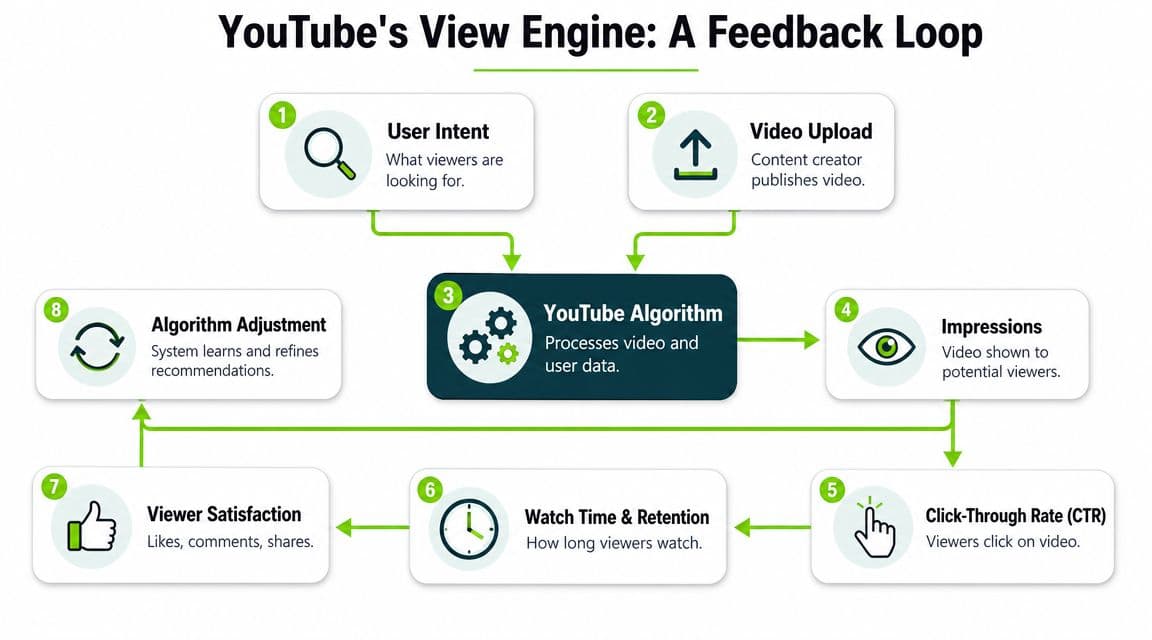
A lot of creators get stuck because they treat views like one metric. Views are the result of three separate wins. Discovery. Click. Retention.
Miss one, and the video stalls.
YouTube starts small. It puts your video in front of a limited group on different surfaces, watches the response, and adjusts distribution based on performance. Strong early response earns more chances. Weak response cuts the test short.
That is why random-looking results are usually not random. The system is asking simple questions.
Creators who understand this stop making vague fixes. They stop saying, “I need better content,” when the problem is a weak title. They stop blaming thumbnails when the topic had no pull in the first place.
- Can YouTube identify the right audience for this video?
- Will that audience click when they see it?
- Will they keep watching long enough to justify more distribution?
- Search: clear topic targeting and strong intent match
- Suggested: relevance to nearby videos and solid viewer response
- Browse: immediate appeal, clear packaging, and a fast promise
Your Diagnostic Checklist Finding the Real Bottleneck
Guessing is why channels stay stuck.
Open YouTube Studio and act like a doctor reading vitals. You're looking for three signals: impressions, click-through rate, and average view duration. Those three tell you where the leak is.
A widely used creator benchmark says that if a channel has posted 20 videos and still has fewer than 100,000 total impressions, that points to a severe distribution problem. If impressions are above that level, the focus shifts to whether CTR is over 6% and average view duration is over 5 minutes according to this creator diagnostic model.
Start with impressions
If impressions are weak, don't obsess over editing tricks yet. You have a discovery problem.
That usually means one of three things. The topic doesn't have enough pull. The angle is too broad or too vague. Or your channel has not given YouTube enough clarity about who should get this video first.
Low impressions are often where beginners break channels without realizing it. They keep posting disconnected ideas and blame the algorithm instead of the strategy. If that sounds familiar, read Satura AI's breakdown of why beginners get no YouTube automation views and the three failure points that kill channels.
Then check click and watch time
If impressions exist but views don't, your next question is simple: are people refusing the click, or are they abandoning after clicking?
Practical rule: Don't redesign your editing workflow until you've checked whether people are even clicking.
- Low CTR with solid impressions: packaging problem.
- Good CTR with weak average view duration: retention problem.
- Weak across all three: topic mismatch plus weak execution.
YouTube Performance Diagnostic Checklist
| Symptom in Analytics | Likely Problem Area | Priority Fix |
|---|---|---|
| Very low impressions across recent uploads | Discovery | Choose topics with clearer audience demand and tighter positioning |
| Healthy impressions but weak CTR | Packaging | Rewrite title and redesign thumbnail around one clear promise |
| Healthy CTR but weak average view duration | Retention | Rebuild the opening and remove slow setup |
| Weak impressions and weak CTR | Discovery plus packaging | Change the topic angle first, then improve the package |
| Strong early metrics on one video but flat results on others | Inconsistent format or topic selection | Double down on the winning angle instead of starting from scratch each time |
You don't need fancy software to read this. But tools that translate patterns faster can help. Use them as a shortcut, not a crutch.
Fixing the Click Problem with Better Packaging
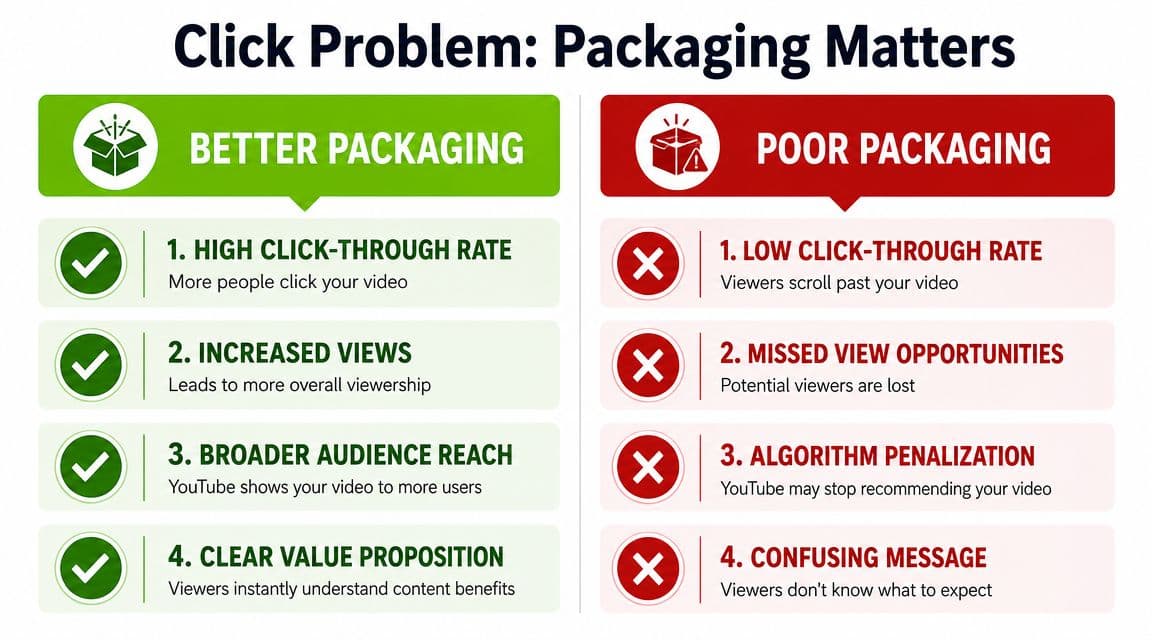
If YouTube is giving you impressions and people still aren't clicking, your packaging is weak. That's not an insult. It's a diagnosis.
Your title and thumbnail are not art projects. They are competitive tools. They sit next to dozens of alternatives, and viewers make a snap choice. If your package is confusing, low-energy, or too clever, you lose.
Your title and thumbnail are sales assets
Good packaging does one job. It makes the viewer believe this video is worth their next click.
That means your title and thumbnail must work together, not repeat each other. If the title explains the promise, the thumbnail should intensify it. If the thumbnail creates intrigue, the title should clarify the payoff.
Here's where creators go wrong:
A lot of creators also need a more concrete sense of what CTR is telling them. This breakdown of what click-through rate actually keeps YouTube videos alive is useful for that.
- They write for themselves: clever, vague, insider language.
- They stuff the title: too many words, too many ideas.
- They design thumbnails after the fact: random frame, random text, no singular message.
- They ignore trust details: if your account setup is incomplete, fix that first with something practical like Mifu's YouTube verification guide.
Weak packaging versus strong packaging
Weak title: “My Thoughts on YouTube Growth”
Stronger title: “Why My Videos Stopped Getting Views”
Weak thumbnail: your face, tiny text, busy background.
Stronger thumbnail: one facial expression, one bold visual cue, one idea that supports the title.
Don't promise “value.” Promise a result, a mistake, a reveal, a contrast, or a consequence.
If someone has to think for two seconds to understand your video package, you've already lost the click.
A practical workflow helps here. Many creators sketch several title-thumbnail pairs before editing the final cut so the video is built around the package, not the other way around.
For a concrete walkthrough on making more clickable videos, this creator video is worth watching:
What are the common questions?
What is the short answer for Why Are My YouTube Videos Not Getting Views? the Real Fix?
Wondering 'why are my YouTube videos not getting views'? We break down the core reasons and give you a step-by-step diagnostic plan to fix your channel.
What should creators do first?
Start the content before the intro voice in your head says you're ready
Who is this guide for?
This guide is for YouTube creators, faceless channel operators, agencies, and teams using AI tools to improve video production and growth.
Action checklist
Apply this to your channel today.
- 1Start the content before the intro voice in your head says you're ready
- 2Is this a topic viewers already care about, or just one I want to talk about?
- 3Is the angle specific enough to create interest?
- 4Does this fit what my channel is becoming known for?
- 5Would a stranger understand why this matters in one sentence?