
What is the quick answer?
When is the best time to upload YouTube videos? We break down 8 data-driven strategies for peak hours, content types, and finding your channel's unique window.
Key takeaways
- 2. The Consistency Advantage
- Consistency beats precision
- What consistent publishing looks like
- 3. The Day-of-Week Strategy
- Day-of-week patterns reflect viewer mood
- Match the day to the job your video needs to do
Overview
Most advice about the best time to upload YouTube videos is too neat. It gives you one magic slot, repeats a generic weekday window, and leaves out the part that matters: your channel has its own audience rhythm, its own format mix, and its own performance pattern. A gaming channel, a tax explainer, and a beauty Shorts account shouldn't follow the same clock.
That's why chasing a universal answer usually leads to mediocre scheduling. Broad benchmarks can help, but they're a starting point, not a strategy. The better approach is to build a repeatable testing system, then refine it until your upload window fits your viewers, your content, and your workflow. If you're already thinking this sounds a lot like how creators approach the best time to post on Instagram, you're right. Platform timing always gets better when it becomes a testing discipline instead of a guessing game.
Forget "magic" times. Find your channel's perfect upload window. Every creator asks it, but most articles give the same vague answer. There's no single best time to upload YouTube videos that works for everyone. The key to explosive growth isn't finding a magic hour. Rather, it's building a data-driven system to discover the perfect window for your specific audience. This guide breaks down eight strategic models creators use to dominate the algorithm. Stop guessing and start testing.
2. The Consistency Advantage

Creators lose more growth from random publishing than from picking the “wrong” hour.
A fixed upload rhythm trains three systems at once. Viewers learn when to look for you. Your team gets a repeatable production target. YouTube gets a clearer pattern of when a new video tends to enter the market for your channel. That matters more than chasing a different time slot every week because a generic chart said Tuesday beat Thursday.
Consistency beats precision
The practical trade-off is simple. A slightly weaker hour that you can hit every week usually outperforms a perfect hour you miss half the time.
I see this with channels that keep changing their schedule after one soft launch. They blame timing, then switch again, and never collect enough clean data to know what worked. Consistency fixes that. It gives you a stable baseline, which is the only way to compare one timing model against another across the eight approaches in this article.
Established creators do this well. They do not rely on minute-level superstition. They build audience expectation. Even if the exact upload time is not ideal for every viewer, repeat behavior closes part of that gap because subscribers know when to check, notifications arrive in a pattern, and the whole release process gets less chaotic.
What consistent publishing looks like
Consistency does not mean posting daily. It means choosing a cadence your production system can hold for months without quality slipping.
For one channel, that is every Wednesday at 3 PM. For another, it is every other Sunday morning. The right model depends on editing time, approval bottlenecks, and how fast your niche rewards fresh uploads. If you need a clearer framework for that cadence decision, this guide on whether uploading once a week helps YouTube growth breaks down the trade-offs well.
The mistake is copying a schedule that belongs to a different channel size, format, or team setup.
If you want to optimize YouTube posting times, start by locking one repeatable slot and protecting it. Then test from there with Satura AI. That gives you cleaner comparisons between consistency, day-of-week, seasonal windows, and the rest of the timing models, instead of mixing all your variables and guessing after the fact.
3. The Day-of-Week Strategy
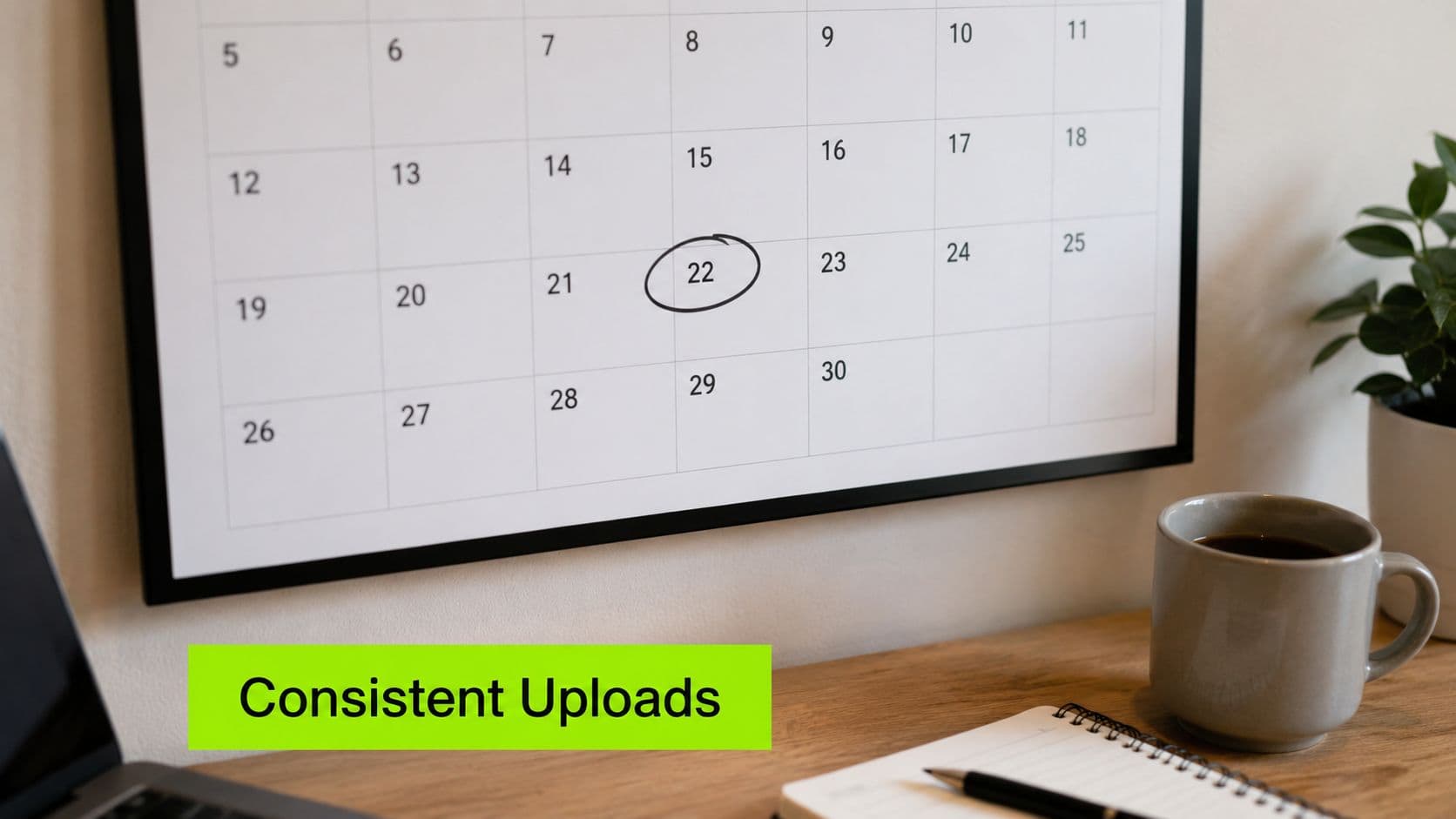
The day you publish often matters more than the exact minute. Creators fixate on clock time because it feels precise, but viewer behavior is usually shaped more by routine, energy level, and available attention.
That is why there is no single best day for every channel. Weekend patterns can help long-form entertainment, commentary, and bingeable content because viewers have more room to settle in. Weekdays can work better for utility content, market updates, or videos built for lunch breaks and commute gaps.
Day-of-week patterns reflect viewer mood
A Sunday upload and a Wednesday upload do not enter the same attention environment.
On weekends, viewers are more likely to browse, catch up, and watch longer sessions. Midweek viewing can be more fragmented. People are checking in between work, school, errands, and everything else competing for attention. That does not make Wednesday bad. It means the video needs to fit a different viewing mindset.
I see creators miss this constantly. They ask, "What day gets the most views?" The better question is, "What day fits the way my audience uses YouTube?"
Match the day to the job your video needs to do
Different content types tend to benefit from different days:
These are starting assumptions, not rules. A finance channel may win on Sunday if viewers use weekends to plan the week. A sports channel may spike on the day after a major event. A creator serving parents may get stronger results late Sunday night than Saturday afternoon.
Context decides.
- Monday: Reset content, planning, productivity, business updates
- Tuesday to Thursday: Tutorials, explainers, niche education, short practical videos
- Friday: Entertainment, reaction content, lighter commentary
- Saturday and Sunday: Long-form videos, storytelling, gaming, lifestyle, deeper watch sessions
Use day-of-week testing like a strategist
Do not test seven random upload days with seven different video formats. That gives you noise, not insight.
Keep the format stable, then rotate the day. Test the same content category across a few comparable uploads and track click-through rate, first 24-hour views, average view duration, and how often the video gets picked up in Browse after release. Satura AI is useful here because it helps you compare those patterns across uploads without relying on memory or gut feel.
The goal is to identify which day gives each video type the cleanest launch. This is the core value of the day-of-week strategy. It is one model inside a larger system, not a magic answer.
3. The Day-of-Week Strategy
The upload day gets less attention than the upload hour, but that's backwards. Day-of-week patterns often reflect audience mood better than clock precision does.
One large study found that Sunday videos outperform other days by about +3.5%, Saturday by +2.2%, while Wednesday is the weakest at -2.2%, based on vidIQ's YouTube timing study. You don't need to worship those exact gaps, but the direction is useful. Some days set up stronger viewing behavior.
The day matters more than most creators think
Sunday works because people often have more open attention. They're scrolling, catching up, and more willing to commit to a longer video. Wednesday can be rough because viewers are buried in work, school, or routine. A creator can absolutely win on Wednesday, but the content usually has to fight harder for attention.
That's why broad rules like “always post midweek” aren't reliable. If your channel depends on long watch sessions, weekends often give you a better shot. If you make quick, practical content for work breaks, weekdays may fit better.
Sunday tends to reward depth. Midweek tends to reward convenience.
Match the day to viewer mood
Strategic timing is more effective than generic advice. Productivity channels often fit Monday because viewers want a reset. Gaming and entertainment often do well near Friday and the weekend because viewers have more leisure time. News and commentary can work well midweek when audiences are already in information mode.
A simple test framework works better than overthinking:
Give each day enough runway before switching. If you change the day every upload, you'll never know what's working.
- High-effort long-form: Try Saturday or Sunday.
- Fast utility content: Try weekday afternoons.
- Community-driven entertainment: Test Friday into weekend.
- Professional or B2B topics: Start with weekday mornings or early afternoons.
4. The Seasonal Upload Strategy
Some channels don't have one best time. They have several. The pattern changes when audience intent changes.
Fitness gets a different viewer in January than it gets in late summer. Tax content behaves differently in spring. Travel content wakes up when people start planning trips. Back-to-school, holiday cooking, decorating, hiring, budgeting, exam prep. These are all timing cycles, not just topic cycles.
What are the common questions?
What is the short answer for Best Time to Upload YouTube Videos: 8 Strategies for 2026?
When is the best time to upload YouTube videos? We break down 8 data-driven strategies for peak hours, content types, and finding your channel's unique window.
What should creators do first?
Entertainment Shorts: Often thrive when viewers are unwinding.
Who is this guide for?
This guide is for YouTube creators, faceless channel operators, agencies, and teams using AI tools to improve video production and growth.
Action checklist
Apply this to your channel today.
- 1Entertainment Shorts: Often thrive when viewers are unwinding.
- 2Bank content ahead: Record and edit in batches so you're not creating under deadline pressure.
- 3Increase cadence carefully: Move from weekly to twice weekly only if quality holds.
- 4Measure channel health: Look at whether stronger cadence supports retention, not just output.
- 5Use analytics to avoid self-deception: Satura's trust and growth diagnostics are useful here, especially if you're checking how to evaluate your YouTube channel trust score.
Sources & methodology
- Satura editorial guide based on the source video, topic cluster, and article sections.
- Source video reviewed for this article: https://www.outrank.so/