What is the quick answer?
Learn how to create a hook that grabs attention in 3 seconds. Our guide covers proven formulas, psychological tricks, and data-driven testing for viral video.
Key takeaways
- Why Your Videos Die in the First Three Seconds
- Audience velocity is the signal that matters
- The Psychology Behind a Perfect Hook
- Curiosity, tension, and relevance do the heavy lifting
- The hook has to promise, not just tease
- Hook Formulas You Can Steal Today
Overview
Most videos don't die because the topic is bad. They die because the opening gives viewers no reason to stop, and mobile feeds punish that instantly. A hook has to earn attention fast, or the scroll wins.
Why Your Videos Die in the First Three Seconds
A weak opening doesn't just lose one viewer. It tells the platform that the video didn't create momentum, and that matters because hooks are judged almost immediately. In content guidance, the hook is the opening line or pattern interrupt that has to stop the scroll in roughly 2–8 seconds and quickly signal a payoff, while short-form viewers may leave in the first 5 seconds if the opening misses. That's the critical pressure point, not the rest of the video. The opening has to make a viewer think, “This is for me,” before the feed moves on. Arfadia's hook glossary says the strongest openings combine curiosity, clarity, and relevance, and that's exactly why generic intros fall apart.
A lot of creators still write intros like the whole video gets equal consideration. It doesn't. On mobile, the opening is often all a viewer sees before deciding whether to expand, swipe, or keep watching, and long hooks over 15 words can reduce click-to-expand rates by up to 40% Dreamstate's hook engagement stats. That's why a tight opening is more than style. It's a packaging decision.
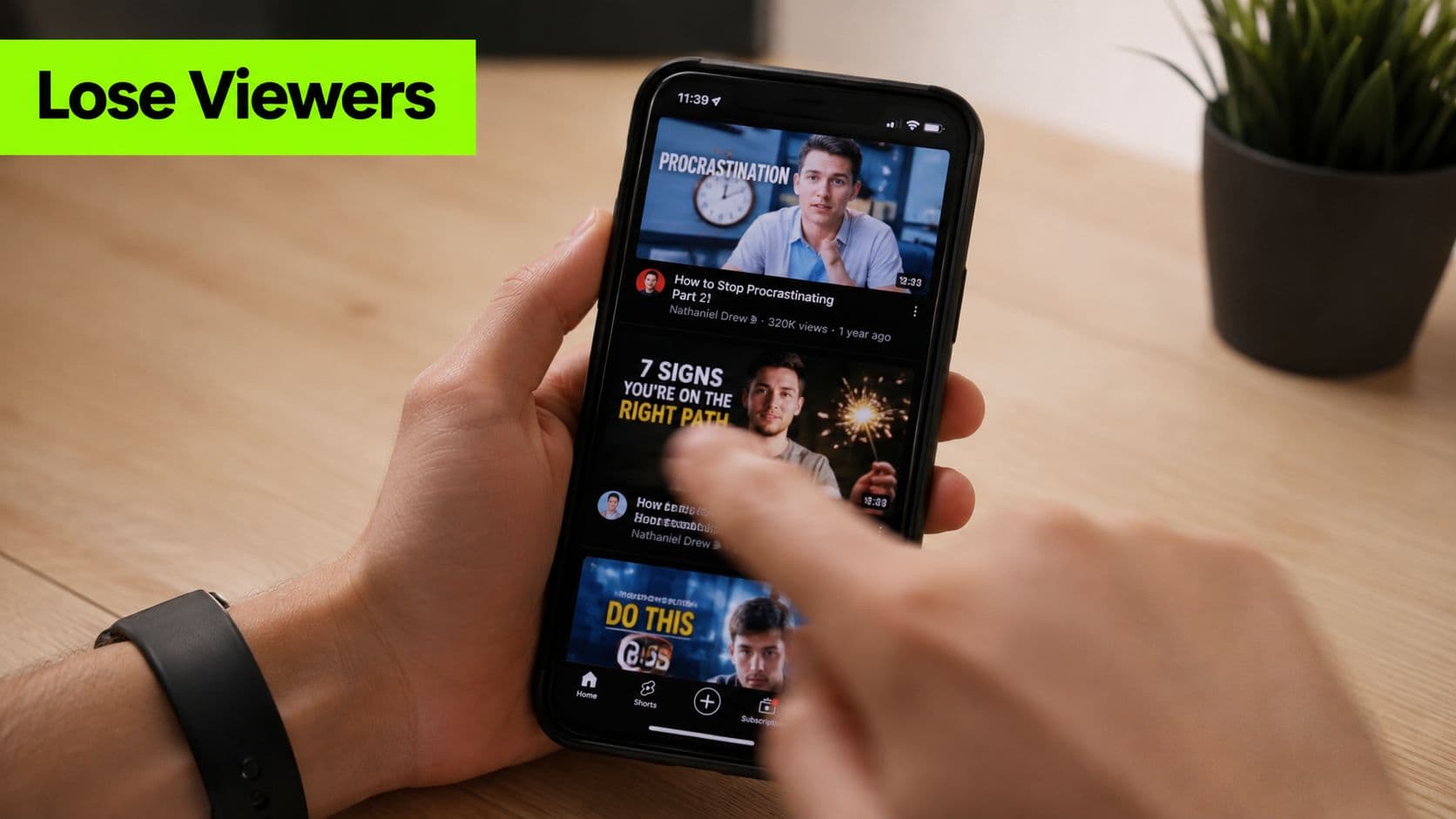
Audience velocity is the signal that matters
Think of audience velocity as the speed at which viewers commit or leave. If people hesitate, the platform sees friction. If they stop, the platform gets a stronger signal that the content deserves more reach. That's why the opening is less about “introducing the topic” and more about proving there's a reason to stay.
A useful way to audit your own uploads is to compare the hook with the promise of the rest of the video. If the opening sounds broad and the body is specific, viewers feel the mismatch immediately. That trust gap is expensive.
For creators looking at format strategy, YouTube Shorts growth strategies are worth reading because hook quality shapes everything that follows, especially when the feed makes fast decisions. The same logic shows up in the Shorts swipe ratio 81 percent rule, where the first impression has to do real work before the swipe.
Practical rule: a hook should feel like a door already half open, not a hallway the viewer has to walk down.
The Psychology Behind a Perfect Hook
The strongest hooks don't feel random. They activate a small set of mental triggers that make people stop and lean in. That's why the best openings usually feel simple on the surface but precise underneath.
Curiosity, tension, and relevance do the heavy lifting
A curiosity gap works because the viewer can sense missing information. If the opening creates a question the brain wants answered, the viewer stays long enough to close that gap. A line like “The mistake most creators make before filming” works because it withholds the exact problem just long enough to create interest.
A pattern interrupt works for a different reason. The viewer's thumb is moving automatically, so the hook has to break that autopilot with contrast, a strange image, or a statement that doesn't sound like everything else in the feed. The point isn't to be chaotic. It's to feel different enough that the mind pauses.
A social proof angle suggests the idea is already validated by reality. It can sound like “Everyone keeps making this same editing mistake,” or “The best-performing creators use this opening pattern.” The psychology is simple, people pay attention faster when something sounds established or widely recognized.
A loss aversion hook frames the cost of ignoring the content. People tend to react more strongly to avoiding a mistake than to chasing a gain, so “Stop doing this before your next upload” often lands harder than “Try this new idea.” That's not about fearmongering. It's about showing stakes.
The hook has to promise, not just tease
A hook should grab attention, intrigue the viewer, and promise a payoff, all before the brain decides to move on.
That's why bait-and-switch openings backfire. They spike curiosity, then disappoint it. When creators overdo mystery, they often get attention and lose trust in the same breath. That trade-off matters more now because attention-grabbing tactics are everywhere, and viewers have learned to be skeptical of empty tease.
A useful internal reference is what makes video go viral, because hooks work best when they fit the larger creative pattern, not when they're treated as isolated tricks. The cleanest openings make one promise, then pay it off quickly.
Hook Formulas You Can Steal Today
The fastest way to write a stronger hook is to stop forcing originality on the first line and start from a structure that already earns attention. A formula does not make the hook sound mechanical. It gives the opening a clear job, then leaves room for your voice, your proof, and your angle.
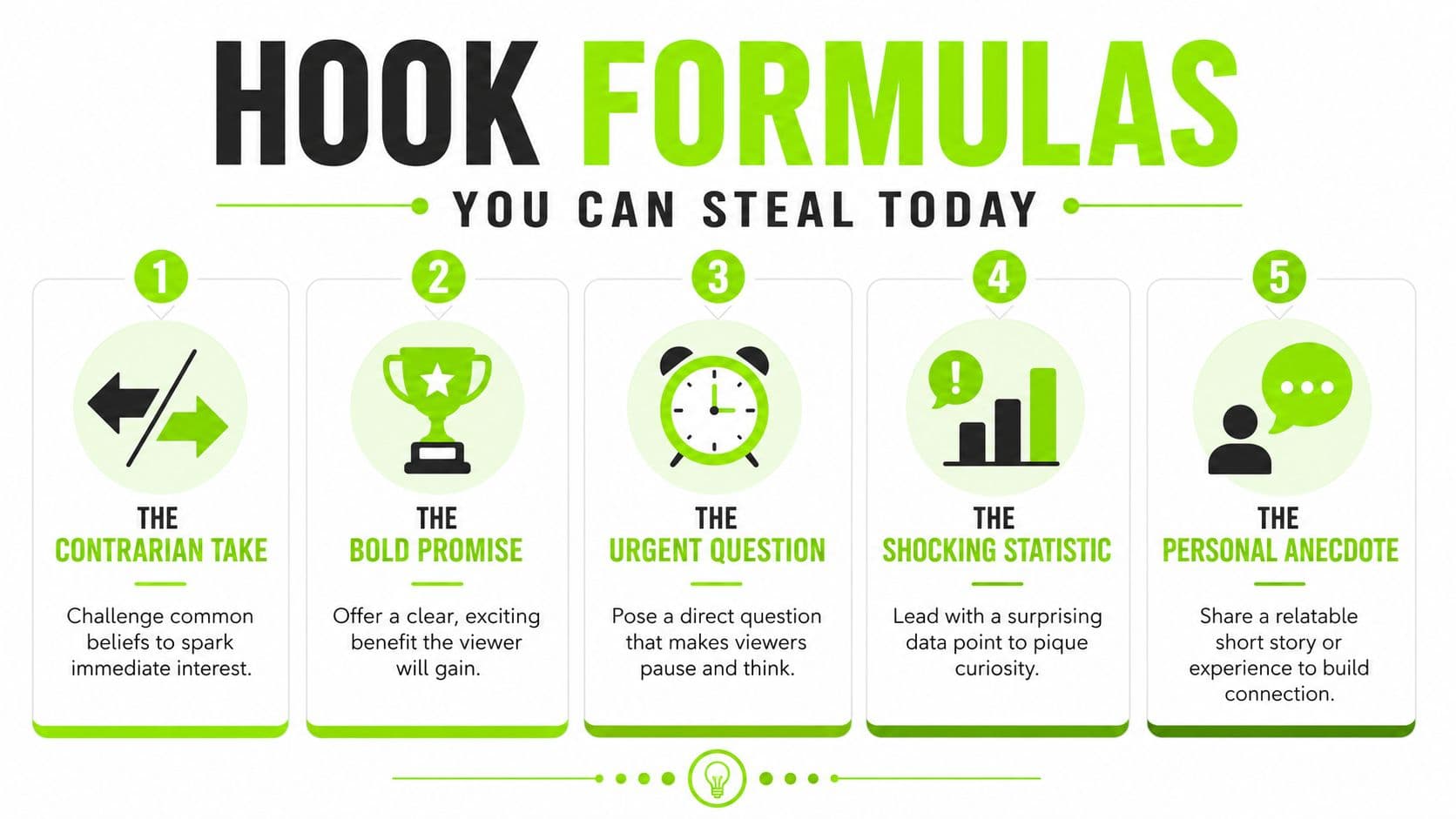
The Contrarian Take
This formula works by pushing against a familiar belief.
Structure: “Everyone says X, but Y is truer because Z.”
A gaming channel might say, “Everyone says this weapon is overpowered, but it is making you worse.” A finance creator could open with, “Everyone tells beginners to start with stocks, but that is not where they should begin.” A DIY channel might say, “Everyone thinks expensive tools save time, but cheap mistakes cost more.” The point is not to sound abrasive. The point is to create immediate friction so the viewer wants the reasoning behind it.
That friction matters because it gives the brain something to settle. A contrarian opening sets up a small argument in the viewer's mind, and that pause is often enough to keep the scroll from continuing.
The Bold Promise
This formula is built around a clear payoff.
Structure: “In this video, you'll get X without Y.”
A gaming creator might say, “By the end of this, you'll know how to win more fights without changing your build.” A finance creator could open with, “You'll learn how to cut spending without feeling miserable.” A DIY creator might say, “You'll fix this problem without buying a new tool.” The value is immediate, which is exactly why the opening works.
Good promise hooks reduce ambiguity fast. Viewers do not need a long setup if they can see the outcome, the cost, and the relevance in the first breath.
The Urgent Question
Questions work best when they are specific.
Structure: “Why does X happen when Y?”
For gaming, “Why do you lose every close-range fight even when your aim is fine?” For finance, “Why do people save money for months and still feel broke?” For DIY, “Why does this joint fail even when the measurements look right?” A strong question creates a closed loop in the viewer's head. They stay because the answer feels unfinished.
Question openings are also worth testing because they often outperform plain declarative openings in hook research. That does not mean every video should open with a question. It means questions are useful when the audience already feels the problem and wants the reason behind it.
The Common Mistake
This is the cleanest way to make the opening feel relevant.
Structure: “Stop doing X if you want Y.”
A gaming hook might be, “Stop looting this area first if you want better early-game wins.” A finance hook could be, “Stop checking your balance this way if you want to spend less.” A DIY hook might be, “Stop using this shortcut if you want cleaner cuts.” The viewer knows who the video is for, what habit is under attack, and what result is at stake.
That directness gives the hook utility. It feels less like theater and more like advice that can change the next attempt.
The Story Question
Stories work when the problem is tangible.
Structure: “I was trying to X when Y happened, so I had to figure out Z.”
A gaming creator could say, “I was trying to rank up when one small mistake kept killing every run, so I tested a different opening.” A finance creator might open, “I was trying to save for a trip when my budget kept collapsing, so I rebuilt the whole system.” A DIY creator could say, “I was halfway through a shelf build when the whole thing started wobbling, so I had to trace the underlying problem.” The story matters because it adds motion. It gives the viewer a problem, pressure, and a reason to keep watching.
If you want a faster drafting pass, use Satura's hook generator to build several first-line options before you narrow them down. That works especially well when you are comparing angles and want to see which version sounds sharpest before you test it on real viewers.
What are the common questions?
What is the short answer for How to Create a Hook: The 3-Second Rule to Viral Video?
Learn how to create a hook that grabs attention in 3 seconds. Our guide covers proven formulas, psychological tricks, and data-driven testing for viral video.
What should creators do first?
Use data to pressure-test the opening
Who is this guide for?
This guide is for YouTube creators, faceless channel operators, agencies, and teams using AI tools to improve video production and growth.
Action checklist
Apply this to your channel today.
- 1Use data to pressure-test the opening
- 2Common Hook Mistakes and Questions
- 3What separates a strong hook from clickbait
- 4Should hooks change by format
- 5What if the hook works but the rest of the video drops off
Sources & methodology
- Satura editorial guide based on the source video, topic cluster, and article sections.
- Source video reviewed for this article: https://www.outrank.so/