
What is the quick answer?
Tired of chasing dead-end trends? Learn how to find trending topics on YouTube & TikTok and, more importantly, how to validate them for your channel's success.
Key takeaways
- Beyond the Hype Why Most Trend Advice Fails
- The real failure point
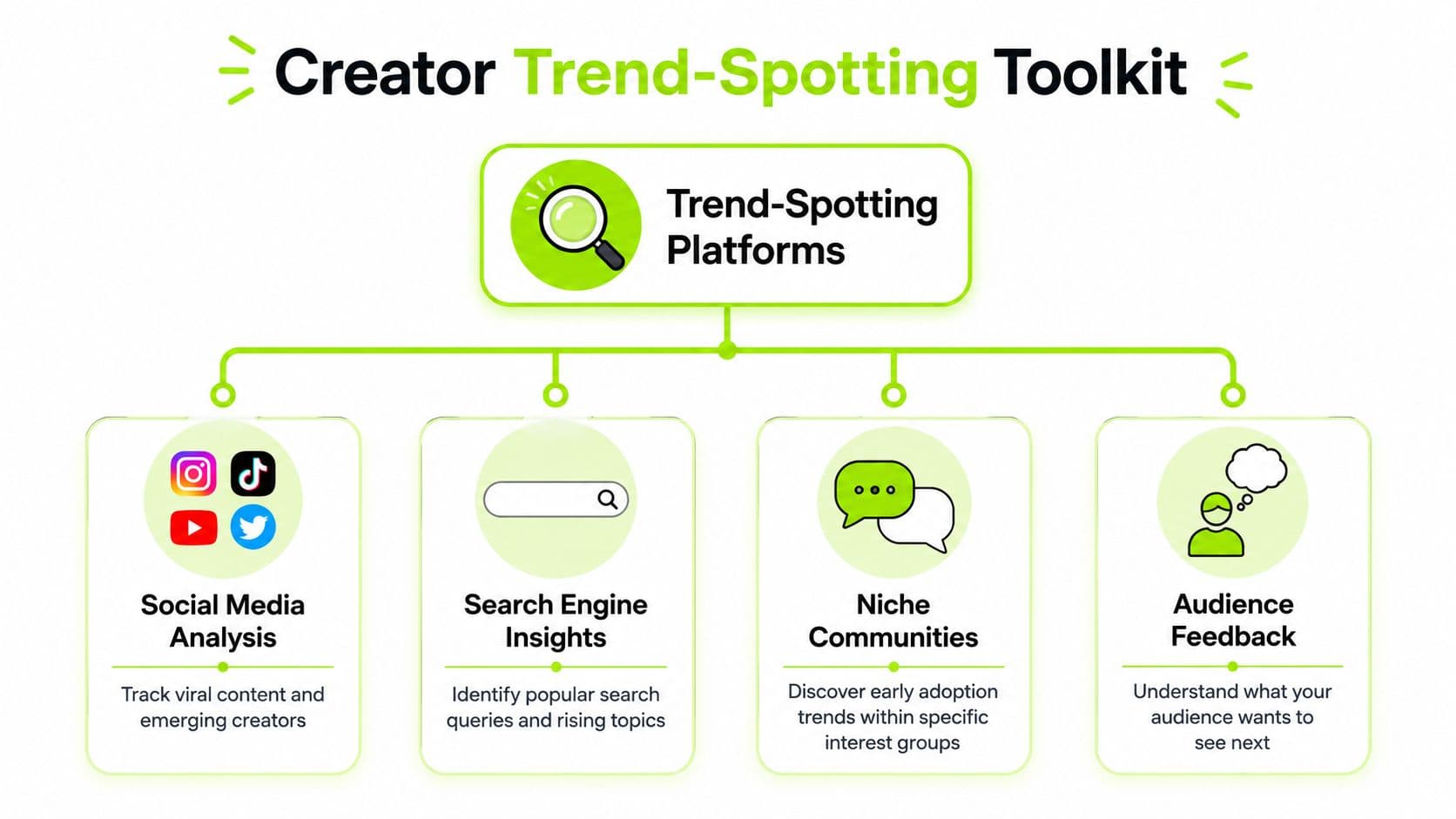
- Your Creator Trend-Spotting Toolkit
- Google Trends for video intent
- YouTube native signals
- Reddit for early language
Overview
Most advice on how to find trending topics is backwards. It tells you where to look, not whether the topic is winnable for your channel.
That's why creators keep burning hours on “hot” ideas that never move. They spot a breakout query, script a video fast, publish into a crowded feed, and then wonder why nothing sticks. The problem usually isn't discovery. It's validation.
A trend only matters if your channel can enter the conversation with a better angle, stronger packaging, or a clearer fit for the audience already looking for it. If you skip that part, “trending” becomes a distraction disguised as strategy.
Beyond the Hype Why Most Trend Advice Fails
The usual playbook sounds simple. Open Google Trends. Check the For You page. Search a few hashtags. Pick whatever looks hot.
If that worked on its own, every creator who spotted a trend early would get views. They don't.
The blind spot is obvious once you've done this enough. A trend can have momentum and still be a terrible fit for your channel. It can be too broad, too saturated, or already dominated by creators with better hooks, better storytelling, and better audience trust. In other words, the trend is real, but your opening isn't.
A lot of creators confuse visibility with opportunity. Those are not the same thing. Visibility means people are paying attention. Opportunity means there's still room for your version to win.
Practical rule: Never ask only “Is this trending?” Ask “Why would someone watch my version instead of the ten videos already getting pushed?”
Most trend advice falters when it treats trend discovery like the hard part and ignores the harder question of competitive fit. That's why generic volume metrics can lead you straight into dead ends. A big topic can still be unwinnable if the audience already has satisfying options.
The smarter move is to look for a gap, not just a spike. Sometimes that gap is format. Sometimes it's clarity. Sometimes it's that everyone covering the topic made a bloated eight-minute explainer when the audience really wanted a tight Short. If you want a sharper framework for that kind of opening, this guide on content gap analysis is worth reading.
The real failure point
Creators usually fail after discovery, not before it.
They find the topic, but they don't test whether:
That's the shift. Learning how to find trending topics is useful. Learning how to reject most of them is what gets actual views.
- The audience matches the people who already watch their channel
- The format fits the pace of the trend
- The competition is weak somewhere in hook, retention, clarity, or packaging
- The angle is fresh enough to earn a click
Your Creator Trend-Spotting Toolkit
Trend research falls apart when every source tells you the same thing at the same stage. By the time a topic is obvious on one platform, the key question is whether there is still room for your channel to win. A useful toolkit does not just surface spikes. It helps you spot audience language early, measure intent, and see where existing coverage is still weak.
Google Trends for video intent
Google Trends is a filter, not a green light. Its value is comparison. Google explains that Trends uses a normalized index, where 100 represents a term's peak popularity within the selected region and time range, so the tool is better for judging relative momentum than estimating raw demand, according to Google's Trends documentation.
Use it with more discipline than most creators do.
The mistake is treating a rising query as proof you should make the video. It only proves attention exists.
- Switch to YouTube Search: This cuts out a lot of blog-style intent and gets you closer to video demand.
- Compare close variants: Test the actual phrasing people might click, not just the broad topic. “CapCut update” and “CapCut new features” can move differently.
- Shrink the time range: A topic that looks dead over 12 months can still be worth posting on this week.
- Check related queries: This is often where title language shows up before creators start repeating the same packaging.
YouTube native signals
YouTube itself is your fastest read on what the platform is already distributing. The homepage, search autocomplete, suggested videos, and niche browse behavior usually tell you more than generic trend lists.
A public walkthrough of YouTube's trending categories shows creators can browse the platform's Trending area and filter into categories such as Gaming or Music to see what is currently surfacing inside those verticals, as described in this guide to YouTube's trending categories.
Use those surfaces for pattern recognition.
I trust YouTube signals more than social chatter when the goal is views, because they show what people are already clicking inside the platform where your video has to perform.
- Study title structure: Is the winning frame a tutorial, a reaction, a test, or a strong opinion?
- Look at packaging repetition: If every thumbnail uses the same visual, entering with the same look makes you easier to ignore.
- Map adjacent videos: Three related uploads from different creators usually matter more than one giant hit.
- Read comments for missing context: If viewers keep asking the same follow-up question, there may be a better angle than the one already ranking.
Reddit for early language
Reddit is useful before the topic gets cleaned up. People describe problems badly there. That is exactly why it helps.
Search subreddits in your niche for recurring questions, repeated complaints, and arguments that keep resurfacing. Those threads expose the wording real viewers use before creators polish it into generic titles. If you want to speed up that research, tools that discover Reddit content for LLM SEO can help surface clusters of relevant discussions faster.
What matters here is not volume. It is repetition with emotion. If multiple people ask the same question in slightly different ways, there is usually a video opportunity.
X and TikTok for live momentum
X gives you fast reaction. TikTok gives you fast format feedback. Both are useful, but neither should make the final call on its own.
On X, watch for recurring phrases around product launches, creator drama, platform changes, or breaking niche news. On TikTok, pay attention to opening hooks, repeated edits, and comment sections full of “what happened?” or “part 2?” responses. That tells you where curiosity is forming and what format the audience already accepts.
Some trends are topic-driven and some are format-driven. If the topic is hot but the successful format is a 20-second explanation, forcing it into a long YouTube video can kill the opportunity.
Internal idea systems
A good toolkit saves more than topics. It saves evidence. Keep a running bank of titles, hooks, screenshots, search terms, comments, subreddit threads, and example videos so you can compare patterns instead of relying on memory.
The creators who move fastest usually have a simple system. One place to store raw signals. One place to score ideas. One place to track whether a trend fits their audience or just looks exciting for a day. If your workflow is spread across screenshots and open tabs, execution slows down. Teams that want a cleaner setup often borrow ideas from creator ops systems like the ones covered in this guide to YouTube automation tools.
The point of the toolkit is not finding more trends. It is finding the few worth testing on your channel.
How to Validate a Trend Before You Hit Record
This is the step that separates busy creators from growing ones.
A 2025 analysis of YouTube growth patterns found that 68% of creators who chase breakout trends without niche validation fail to gain traction because the trend is saturated with high-quality existing content, not just low-competition keywords, according to this YouTube analysis on trend validation. That same analysis points to two filters most creators miss: audience retention gap and competitor engagement deficit.
That's the game. Not “Is the trend real?” It usually is. The main question is whether the current videos leave enough on the table for your channel to take a meaningful share.
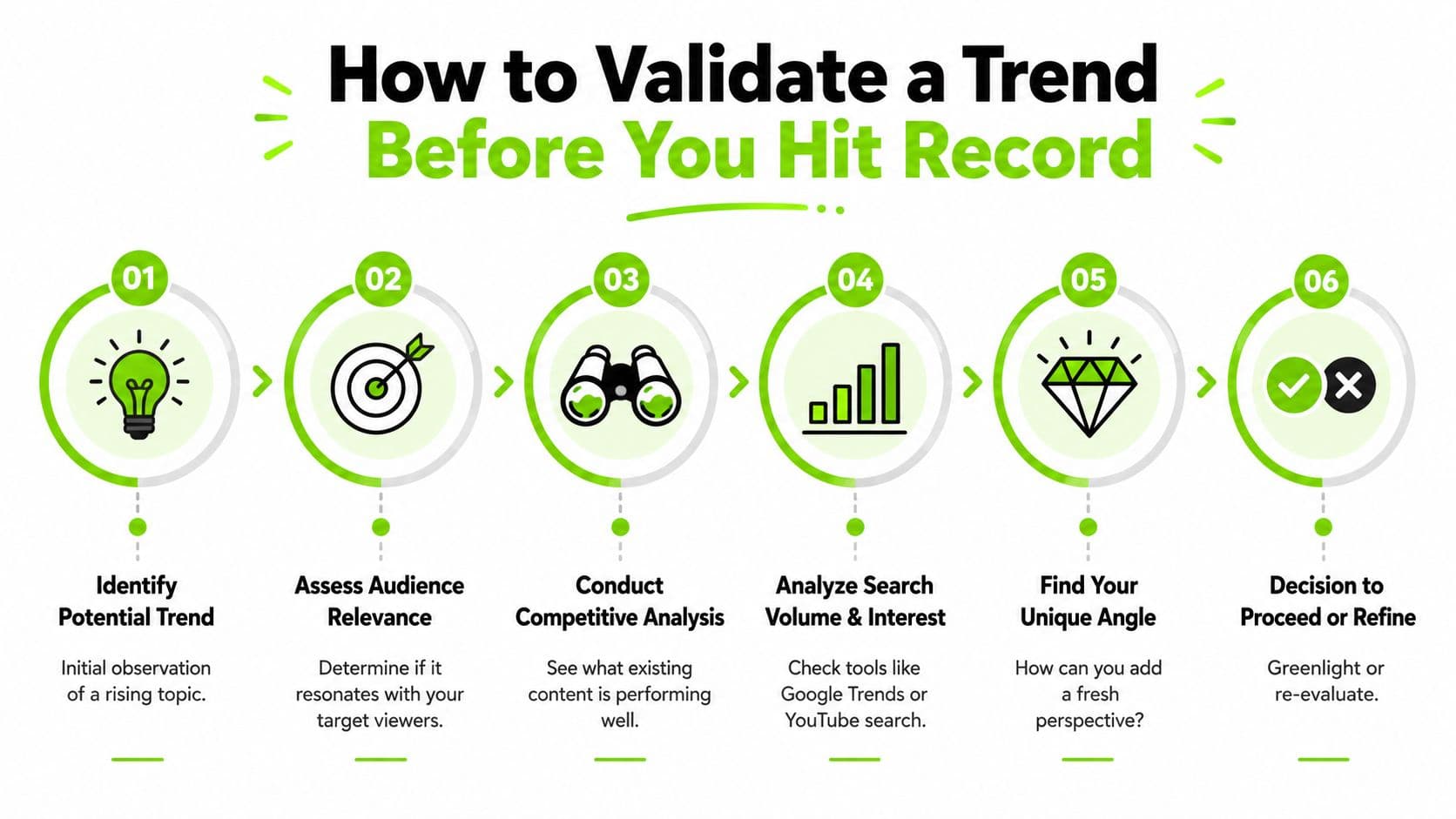
The validation questions that matter
Before you script anything, pressure-test the topic with a few uncomfortable questions.
A trend can be huge and still bring the wrong viewer. If your channel teaches editing workflows and the trend is celebrity gossip about an app launch, that mismatch will show up fast in retention.
Some topics work as Shorts because curiosity is immediate. The same topic might fall apart in long form if there isn't enough depth.
If the existing titles all sound interchangeable, that's your chance. If one title already nails the exact curiosity gap, your path is narrower.
Don't validate trends by asking whether people care. Validate them by asking whether current videos satisfy that care.
- Does this audience overlap with mine?
- Is the demand broad or format-specific?
- Can I add a sharper promise?
What to look for in competing videos
Competitive analysis gets misused all the time. Creators copy what performed instead of diagnosing what's missing.
Look at the top videos around the trend and inspect them like an editor:
Those flaws are openings. If viewers wanted the topic but didn't love the execution, you've found a real opportunity.
- Weak hooks: Do they take too long to explain why the topic matters?
- Bloated middles: Are they repeating obvious points or padding for watch time?
- Confusing packaging: Does the thumbnail promise one thing while the video delivers another?
- Bad audience fit: Are the comments full of people asking for a simpler, faster, or more practical version?
What are the common questions?
What is the short answer for How to Find Trending Topics That Actually Get Views?
Tired of chasing dead-end trends? Learn how to find trending topics on YouTube & TikTok and, more importantly, how to validate them for your channel's success.
What should creators do first?
Did comments point toward a narrower subtopic?
Who is this guide for?
This guide is for YouTube creators, faceless channel operators, agencies, and teams using AI tools to improve video production and growth.
Action checklist
Apply this to your channel today.
- 1Did comments point toward a narrower subtopic?
- 2Did the trend attract the wrong audience?
- 3Did the topic work, but the format need changing?