
What is the quick answer?
Stop guessing what videos to make. Learn a practical content gap analysis framework for creators to find untapped ideas your audience is already searching for.
Key takeaways
- Why Your YouTube Channel Is Stuck and How to Fix It
- What creators usually get wrong
- What to do instead
- Define Your Battlefield and Identify Your Real Rivals
- Build narrower topic clusters
- Find search rivals, not ego rivals
Overview
You're probably in the same loop a lot of creators get trapped in. You publish on schedule, try new thumbnails, maybe even copy a trend or two, and the channel still feels glued to the floor. A few videos pop, most don't, and nothing looks stable enough to build on.
That usually isn't an effort problem. It's a content gap analysis problem.
For video creators, this has nothing to do with making boring spreadsheets for the sake of SEO. It's about finding the gap between what viewers already want and what the current video market is failing to give them. Sometimes the gap is a missing topic. Sometimes it's a better format. Sometimes it's the same topic with stronger packaging, sharper structure, and better retention.
If your next breakout video feels random right now, that's fixable.
Why Your YouTube Channel Is Stuck and How to Fix It
A stuck channel usually sends mixed signals. One video is a tutorial. The next is commentary. Then a trend reaction. Then a broad “tips” video with no clear audience. YouTube can't confidently place the channel, and viewers can't quickly tell why they should come back.
Creators often blame the algorithm when the underlying issue is weaker strategic targeting. Posting more doesn't solve that. Better guesses don't solve it either.
A real content gap analysis starts with audience demand and competitive reality. According to Heretto's content gap analysis guide, effective analysis follows a six-step process that starts by defining goals and understanding users, then analyzing existing content, comparing it against competitors, creating new content, and measuring results. The same guide notes that modern strategies also analyze search and AI tool results to find topics a site hasn't covered at all.
For video creators, translate that into simple language. Stop asking, “What do I want to upload next?” Start asking, “What is my audience trying to solve, watch, compare, or learn that my channel still doesn't serve well?”
What creators usually get wrong
Most stalled channels miss in one of these ways:
Practical rule: If you can't explain why this specific video should win against what already exists, you're still guessing.
- They create from taste, not demand. Loving a topic doesn't mean viewers are searching for it or clicking it.
- They chase broad niches. “Productivity,” “fitness,” or “gaming” is too vague to guide strong programming.
- They ignore execution gaps. A topic may be right, but the hook, pacing, and thumbnail can still kill it.
- They never review the losers. Failed uploads usually reveal more than the occasional hit.
What to do instead
Treat your channel like a programming slate, not a content diary.
Start with the audience problem. Then look at the videos already winning that topic. Then look for the opening. Maybe the winning videos are old. Maybe they're too long. Maybe they answer the wrong question. Maybe they rank but don't satisfy.
That's where growth starts. If you want a broader framework for tightening channel positioning before doing deeper topic research, this guide to YouTube channel optimization is a useful companion.
Define Your Battlefield and Identify Your Real Rivals
Most creators sabotage themselves before research even starts. They say their niche is “finance” or “self-improvement” and then wonder why every content idea feels crowded. That's too wide to be useful.
You need a battlefield, not a genre label.
According to Penmo's guide to finding critical content gaps, a strong strategy starts by defining 5–10 core topic clusters tied directly to business goals, then identifying 3–5 companies that consistently outrank you on those priority topics. For creators, swap “business goals” for channel goals. If you want sponsorships, authority, leads, affiliate revenue, or a loyal viewer base, your topic clusters should support that.
Here's the kind of visual mapping that makes this easier:
Build narrower topic clusters
A strong battlefield is specific enough that you can win attention inside it.
If you run a filmmaking channel, your clusters might be:
That's already more useful than “video production.”
If you run a faceless automation channel, the clusters might center on story niches, upload systems, packaging tests, monetization models, and workflow breakdowns. The point is focus. A viewer should see a pattern in your uploads before YouTube ever does.
- Beginner camera setup
- Lighting for small spaces
- Cheap gear comparisons
- Editing workflow fixes
- Freelance client mistakes
Find search rivals, not ego rivals
A lot of creators pick the wrong competitors. They choose the biggest channel in the niche, or someone they personally admire. That's not always who you're fighting for attention against.
Your real rivals are the channels that keep appearing around the topics you want to own. Those are the channels shaping viewer expectations for title style, pacing, depth, and format.
A useful side practice is to improve AI visibility through benchmarking so you're not just tracking who exists, but who repeatedly wins attention across similar conversations and surfaces.
The creator who steals your clicks usually isn't your favorite creator. It's the one YouTube keeps placing next to your target topic.
One more layer matters here. Search rivals change by cluster. The channels dominating “beginner tutorial” may not be the same ones owning “gear breakdown” or “reaction format.”
If you want a practical example of how adjacent recommendations shape discovery, this breakdown of the YouTube related videos feature strategy helps clarify why topic overlap matters so much.
A simple test for your battlefield
Before moving on, check your list against three questions:
If the answer is no, the battlefield is still too fuzzy.
- Would a new viewer instantly understand what problem this cluster solves?
- Can you name the channels repeatedly winning in that cluster?
- Would success in that cluster help the channel's bigger goal?
Audit Your Library and Your Competitors' Greatest Hits
Once the battlefield is clear, the next move is blunt and a little uncomfortable. Audit your own library before you obsess over everyone else's. Most creators have more usable data inside their back catalog than they realize.
Start with a simple inventory. Brafton's content gap analysis guidance recommends tracking every content asset in a spreadsheet or keyword tool and noting the primary keywords targeted, hyperlinking structures, original publication dates, and classification by target persona. For YouTube, the same logic applies even if the fields shift slightly. Track the core topic, intended viewer, format, title style, packaging angle, retention outcome, and whether the video still reflects what viewers need now.
This process works better when you can see it clearly:
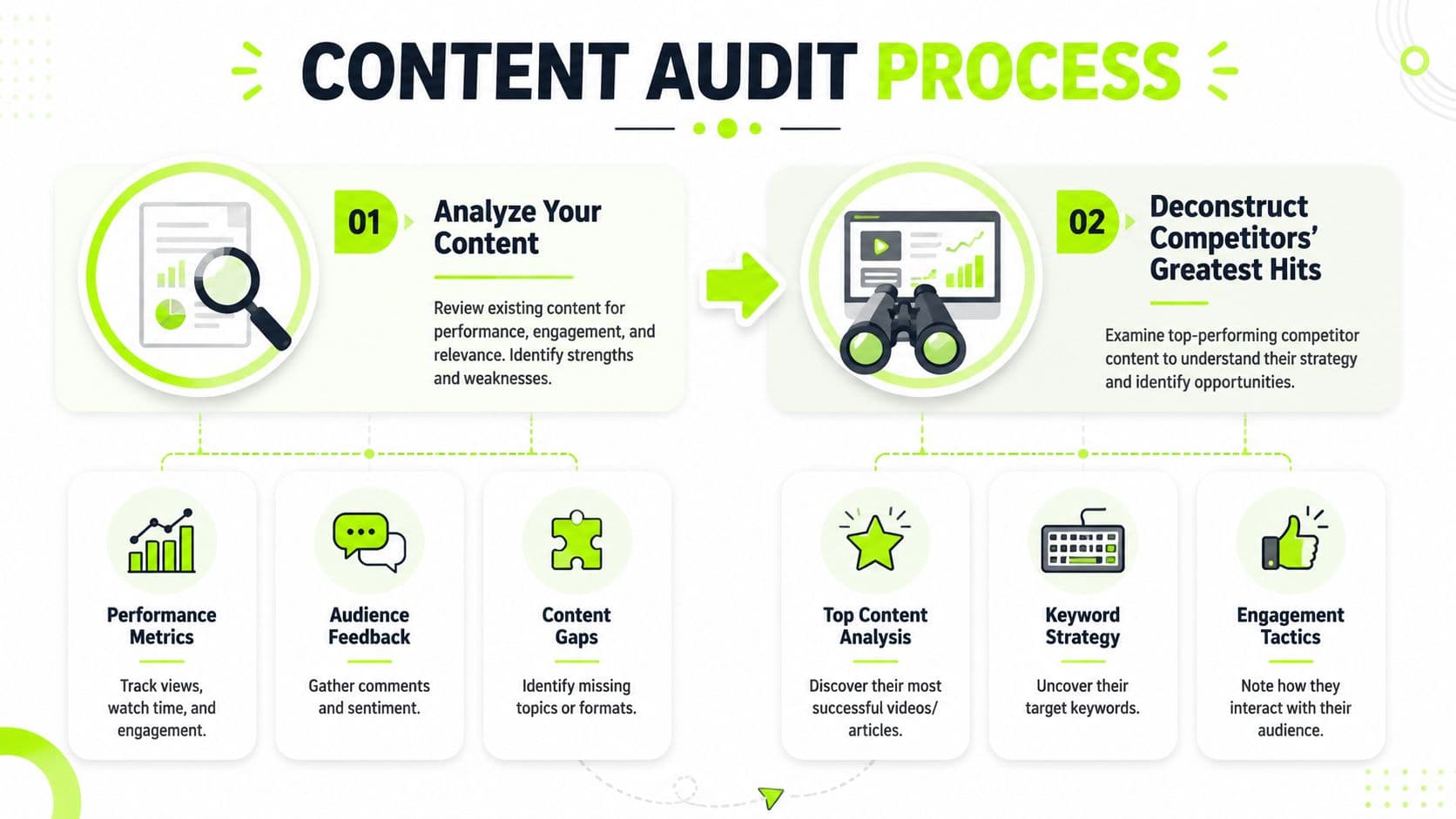
Audit your own channel first
Don't just label videos “good” or “bad.” Look for patterns.
A weak library often reveals itself in clusters:
Creators usually miss the easiest opportunities. They rush to new production when they already own unfinished business in old uploads. Sometimes the problem isn't missing content. It's underdeveloped content.
If you need faster review of long videos to locate reusable moments, Clip Finder can help speed up that analysis process.
- Strong topics, weak packaging. Good subjects with titles nobody wants to click.
- Good clicks, weak satisfaction. The idea sells, but the video doesn't keep attention.
- One-off wins with no follow-up. You found a promising lane and never expanded it.
- Aging videos with stale framing. The topic still matters, but your delivery feels old.
Deconstruct competitor hits like a producer
Now move to the channels that own attention in your battlefield. Don't study their whole catalog equally. Study their repeat winners and the videos that still look alive long after publish day.
According to Nightwatch's explanation of content gap analysis, a thorough audit with specialized tools can reveal hundreds or thousands of missing keywords in a single analysis, with the main opportunity often found where competitors rank in positions 1–10 while your site sits outside the top 20. The same source points to another high-value opening: competitor content that's outdated or lacking recency.
For video creators, that maps cleanly to channel research:
- A competitor may own the topic, but only with an old upload.
- Their top video may answer the question partially, not fully.
- Their framing may be built for a previous viewer mindset.
- Their comments may reveal confusion they never addressed in a follow-up.
What to look for inside their best videos
A useful competitor review doesn't stop at topic labels. Pull apart the mechanics.
| What to inspect | What it tells you |
|---|---|
| Title pattern | What promise gets the click |
| Thumbnail style | What emotion or curiosity gets encoded visually |
| Opening structure | How fast they establish stakes |
| Video length and pacing | What the audience appears willing to tolerate |
| Comment themes | What viewers still want answered |
| Age of the video | Whether recency is now an opening |
A competitor's best video is rarely a blueprint to copy. It's evidence of what demand already exists.
The best opportunities usually sit in the overlap between proven demand and weak execution. If a rival's tutorial rambles, the market may want a tighter version. If their explainer is useful but ugly, better visual clarity can become your edge. If they rank with a forum-level answer in video form, a clean, structured piece can take that attention.
What are the common questions?
What is the short answer for Content Gap Analysis: Find Your Next Breakout Video Idea?
Stop guessing what videos to make. Learn a practical content gap analysis framework for creators to find untapped ideas your audience is already searching for.
What should creators do first?
Can I execute it well enough to deserve the click?
Who is this guide for?
This guide is for YouTube creators, faceless channel operators, agencies, and teams using AI tools to improve video production and growth.
Action checklist
Apply this to your channel today.
- 1Can I execute it well enough to deserve the click?
- 2Click-through rate tells you whether packaging earned the first yes.
- 3Audience retention curves show where the promise held or broke.
- 4Average view duration helps you judge whether pacing matched intent.
- 5Average views per viewer gives a stronger sense of repeat pull than raw views alone.
Sources & methodology
- Satura editorial guide based on the source video, topic cluster, and article sections.
- Source video reviewed for this article: https://www.outrank.so/