What is the quick answer?
Unlock growth with our 2026 YouTube channel optimization guide. Learn actionable steps for SEO, thumbnails, retention, and faceless channel strategies.
Key takeaways
- Why Most YouTube Optimization Advice Fails
- Why hooks beat keyword obsession
- What actually works now
- First Impressions Your Channel Brand and Setup
- Make the channel promise obvious
- Build a thumbnail system not one-off art
Overview
Most YouTube advice still sounds like it's 2018. Pick a keyword. Add tags. Stuff the description. Pray.
That's backward now.
Modern YouTube channel optimization starts with the viewer, not the metadata field. Metadata still matters. Packaging still matters. But channels don't stall because the fifth tag was wrong. They stall because the first impression is weak, the opening is slow, and the channel gives people no clear reason to trust what they're seeing.
The shift is simple. Old optimization tried to satisfy search. Current optimization has to satisfy attention. If your title gets the click but your intro loses the viewer, the algorithm gets a negative answer fast. If your channel looks generic, your thumbnails blur together, or your faceless videos feel disposable, strong keyword placement won't save you.
Why Most YouTube Optimization Advice Fails
The biggest myth in YouTube growth is that optimization is mostly a metadata problem. It isn't.
A lot of creators still spend most of their effort tuning descriptions, tags, and keyword placement while the actual video opens with a slow greeting, vague setup, or a bloated intro. That's why “optimized” videos often get no momentum. The packaging may be decent, but the audience signal is weak.
The more useful way to think about optimization is this: metadata earns a chance, retention earns distribution.
Data in the underserved angle makes that clear. It states that YouTube's 2025 algorithm prioritizes first-30-second retention and click-through rate above metadata signals, while creators still spend 80% of their time on SEO descriptions instead of scripting hooks. It also notes that videos with under 40% retention in the first 30 seconds had a 73% lower chance of being suggested, regardless of keyword optimization, according to the cited material in this viewer retention discussion.
Practical rule: If a video underperforms, audit the first 30 seconds before you touch the tags.
This is why old checklist advice falls apart. Tags are not the engine. They're labels. Titles and descriptions help YouTube understand your topic, but they don't force viewers to stay. A good operator treats optimization as a chain: thumbnail earns the click, opening justifies it, pacing protects retention, then the rest of the channel extends the session.
For creators trying to build smarter systems around this, Samuel Woods' breakdown of AI-powered video growth methods is useful because it frames growth around acquisition and activation, not just publishing.
There's also a trust layer most creators ignore. If your channel packaging, upload behavior, and title-thumb alignment feel inconsistent, viewers hesitate before they even click. That's part of why channel-level diagnostics matter. A deeper explanation of that idea shows up in this guide to YouTube trust score.
Why hooks beat keyword obsession
Creators love what feels measurable. Character counts. tags. checklists. The problem is that easy-to-measure tasks often have lower upside than hard creative work.
Hook writing is harder. It forces you to answer uncomfortable questions. What's the payoff? Why now? Why should a stranger trust this video in the first few seconds? Most weak videos fail there.
A strong title with a weak intro creates disappointment. A decent title with a sharp intro can still recover because the viewer gets immediate value and keeps watching.
What actually works now
Three habits usually outperform “more SEO work”:
YouTube channel optimization still includes technical SEO. It just no longer starts there.
- Rewrite openings before rewriting descriptions. The opening determines whether the impression becomes watch time.
- Match the thumbnail promise fast. If the thumbnail suggests a result, show proof or direction immediately.
- Reduce channel ambiguity. Viewers subscribe to channels that feel coherent, not random.
First Impressions Your Channel Brand and Setup
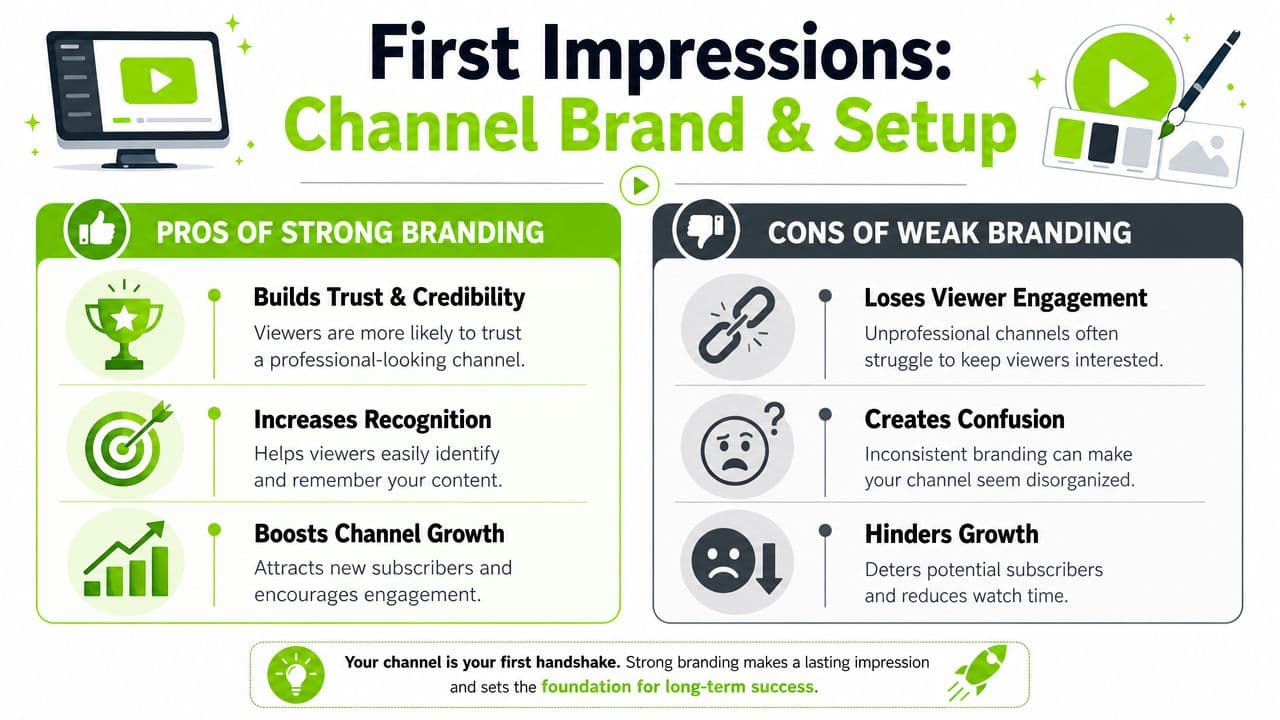
A messy channel can make good videos look untrustworthy. Viewers decide fast whether your channel feels intentional or accidental, and that judgment starts before they hit play.
Strong branding isn't about looking corporate. It's about making your promise obvious. A new visitor should understand who the content is for, what problem it solves, and what kind of videos they'll get next.
Make the channel promise obvious
Start with the basics most creators treat as decoration.
Your channel name, banner, profile image, and About section should point in one direction. If your banner says one thing, your thumbnails say another, and your uploads jump between unrelated topics, viewers can't build confidence in what you do.
Use this quick audit:
Channels grow faster when the viewer doesn't have to interpret the brand.
If you're filming in a controlled environment, setup quality matters here too. Many solo creators improve consistency by studying how professional studios for YouTube content handle lighting, framing, and set design, then adapting those principles at home instead of chasing expensive gear blindly.
- Channel name: Make it memorable and niche-relevant. Don't make people decode it.
- Banner: State the value proposition in plain English. A visitor should know the topic instantly.
- Profile image: Choose one visual identity and keep it consistent across uploads.
- About section: Write for humans first. Say who the channel helps and what they'll learn or get.
Build a thumbnail system not one-off art
Most channels don't have a thumbnail strategy. They have a folder full of unrelated designs.
That hurts recognition. It also hurts clicks. According to Impact's thumbnail guidance, thumbnails optimized for CTR should use bold contrast and no more than four words of text so they stay readable on small screens. That rule alone fixes a lot of bad thumbnails.
A practical system usually includes:
| Element | Good choice | Bad choice |
|---|---|---|
| Text | 1 to 4 clear words | Tiny sentence blocks |
| Contrast | Light on dark, or dark on light | Muddy mid-tone backgrounds |
| Layout | One focal point | Five competing ideas |
| Style | Repeatable template | New random look every upload |
Use language that carries outcome or tension. “Quick Fix.” “Cost Breakdown.” “Beginner Setup.” Those work because the viewer understands them instantly.
Your channel homepage should reinforce that same clarity. Put videos into sections by problem or audience, not by upload date alone. “Start Here,” “Beginner Tutorials,” or “Case Breakdowns” gives a visitor a path. Random chronology doesn't.
Smart SEO Your Video Metadata Playbook
Metadata still matters. It just has to be done precisely, not ritualistically.
Most creators either underdo it or drown the video in clutter. The middle ground is a clean structure that helps YouTube understand the topic without looking spammy to the viewer.
Use a metadata structure that actually helps ranking
The strongest hard rule set in the provided data comes from this technical metadata configuration reference. It reports a 14.2% average CTR increase when creators follow strict limits. The key points are specific:
That last part is underused. If the title, description, captions, and spoken words all align, the topic signal gets much clearer. I think of it as semantic consistency rather than “SEO tricks.”
There's another important placement rule in this YouTube ranking guide. To rank effectively for Tier 1 keywords, the primary target keyword should appear in the title, in the first 3 lines of the description, and at the first chapter marker, with the first 150 characters acting as the critical indexing threshold.
A practical publishing checklist looks like this:
For captions, review them. Don't leave them sloppy. If you want to tighten that part of the workflow, this resource on auto-generated captions is relevant because caption quality affects how well that audio-to-text signal lines up.
- Title length: cap it at 70 characters
- Description length: write 250+ words
- Keyword placement: put the primary keyword in the first 25 words
- First tag: make it an exact match to the primary keyword
- Audio alignment: say the keyword in the video itself, which the same source says can boost search ranking by 31%
- Draft a title with the keyword early, then cut fluff until it fits cleanly.
- Open the description with a natural sentence containing the primary term.
- Expand the description beyond a thin paragraph. Give context, timestamps, and related context.
- Set the first tag to the exact keyword.
- Add chapters starting at 00:00 and make sure the first chapter supports the topic phrasing.
- Say the core phrase clearly in your spoken intro.
The mistakes that quietly weaken discovery
Most metadata problems aren't dramatic. They're small trust leaks.
Here are the common ones:
Good metadata should clarify the video, not read like it was written for a machine.
Tools can help you audit these fields faster. Satura AI, for example, includes creator workflow features around captions, packaging, and growth analysis, which makes it easier to spot mismatch between metadata and the actual content.
- Truncated titles: A crowded title loses clarity before the viewer even reads it.
- Keyword delay: If the topic appears too late in the description, the signal gets weaker.
- Weak first tag: Generic tagging wastes the most important tag slot.
- Silent keyword mismatch: If the metadata says one thing and the spoken intro says another, relevance gets fuzzy.
- Shortened URLs: The same BU source notes that shortened links can reduce trust and hurt click behavior in feeds.
The First 15 Seconds Engineering Viewer Retention
The first 15 seconds decide whether your video gets a real chance.
Most channels bleed momentum not because the topic is bad, but because the opening spends too long “starting.” A cold viewer doesn't care about your intro animation, your life story, or a broad setup sentence. They care about whether the click was worth it.
Why hooks outperform polish
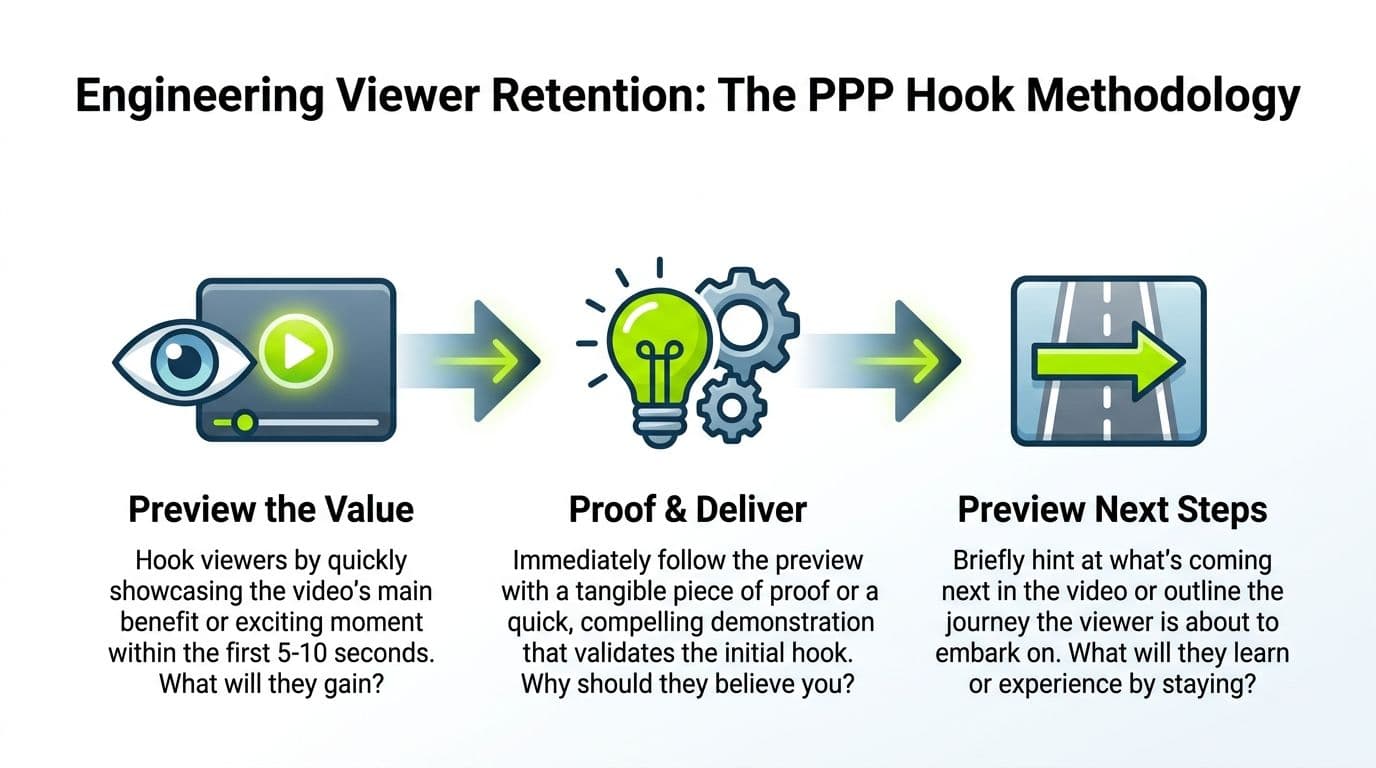
The most useful framework in the provided data is the PPP method. According to this Brafton reference on YouTube optimization, Preview-Proof-Preview drives a 28% increase in average view duration when executed in the first 15 seconds. The same source says videos that fail to grab attention in that window see a swipe-away rate exceeding 65%, while channels using PPP get a 35% higher retention curve at the 30-second mark.
That aligns with what strong channels do instinctively. They don't “introduce the topic.” They deliver an immediate reason to continue.
PPP works because it answers the viewer's three silent questions fast:
This short demo is worth studying for pacing and structure:
- What am I getting?
- Why should I believe you?
- Why should I keep watching?
What are the common questions?
What is the short answer for YouTube Channel Optimization: A 2026 Playbook?
Unlock growth with our 2026 YouTube channel optimization guide. Learn actionable steps for SEO, thumbnails, retention, and faceless channel strategies.
What should creators do first?
Match end screens to playlist logic: The end-screen recommendation should continue the same journey.
Who is this guide for?
This guide is for YouTube creators, faceless channel operators, agencies, and teams using AI tools to improve video production and growth.
Action checklist
Apply this to your channel today.
- 1Match end screens to playlist logic: The end-screen recommendation should continue the same journey.
- 2Rename playlists like products: A playlist title should make sense even to a first-time visitor.
- 3Clip one idea, not the whole video. Shorts should create curiosity around a precise moment.
- 4Bridge into the long-form topic. The Short and the main video should feel like part of one content arc.
- 5Keep playlist context tight. Don't mix unrelated Shorts and long-form videos just because the topic is vaguely similar.
Sources & methodology
- Satura editorial guide based on the source video, topic cluster, and article sections.
- Source video reviewed for this article: https://www.outrank.so/