
What is the quick answer?
Master your trust score youtube in 2026 to unlock channel growth. Discover key signals, learn how to improve them, & boost your views. Get started today!
Key takeaways
- The Secret Score That Haunts Every Creator
- The Truth About the YouTube Trust Score
- Composite signals drive distribution
- The Five Key Signals That Build Your Trust Score
- Signal one and two
- Signal three, four, and five
Overview
Most advice about a YouTube trust score starts in the wrong place. It treats growth like there's one hidden number in some back room at YouTube deciding whether your channel lives or dies.
That's a bad model. It sends creators chasing folklore instead of fixing the signals that shape reach.
A better way to think about trust score YouTube discussions is this. You're not hunting for a secret dashboard. You're trying to understand the bundle of observable signals that tell YouTube whether a specific video deserves more distribution. If you want a cleaner mental model for how engagement and ranking signals connect, this breakdown of the YouTube algorithm point system and engagement ranking is a useful companion read.
The Secret Score That Haunts Every Creator
Creators usually ask the same question when views stall. “Did YouTube stop trusting my channel?”
That question makes sense. The platform feels unpredictable from the outside. One upload gets momentum. The next dies fast. After a while, “trust score” becomes the label creators slap on that confusion.
The problem is the label pushes people toward the wrong fix. They start looking for hacks, resets, upload rituals, and weird channel superstitions. They change posting times, rewrite descriptions, or obsess over subscriber count when the core issue sits inside the video itself.
Your channel usually isn't being punished by a mysterious number. More often, a specific video isn't earning enough confidence to keep getting shown.
That distinction matters. If the problem is video-level performance, the solution gets more practical. You can inspect the hook, the topic choice, the packaging, the audience fit, and the reaction from viewers. Those are things you can improve.
Many creators lose months. They try to “repair channel trust” when they should be diagnosing why one batch of videos gets ignored and another gets tested.
The Truth About the YouTube Trust Score
Creators waste a lot of time chasing a score YouTube does not publicly expose. There is no documented channel-level meter you can check in Studio. What creators call a "trust score" is better understood as a bundle of observable performance signals that affect how confidently YouTube keeps testing and recommending a video.
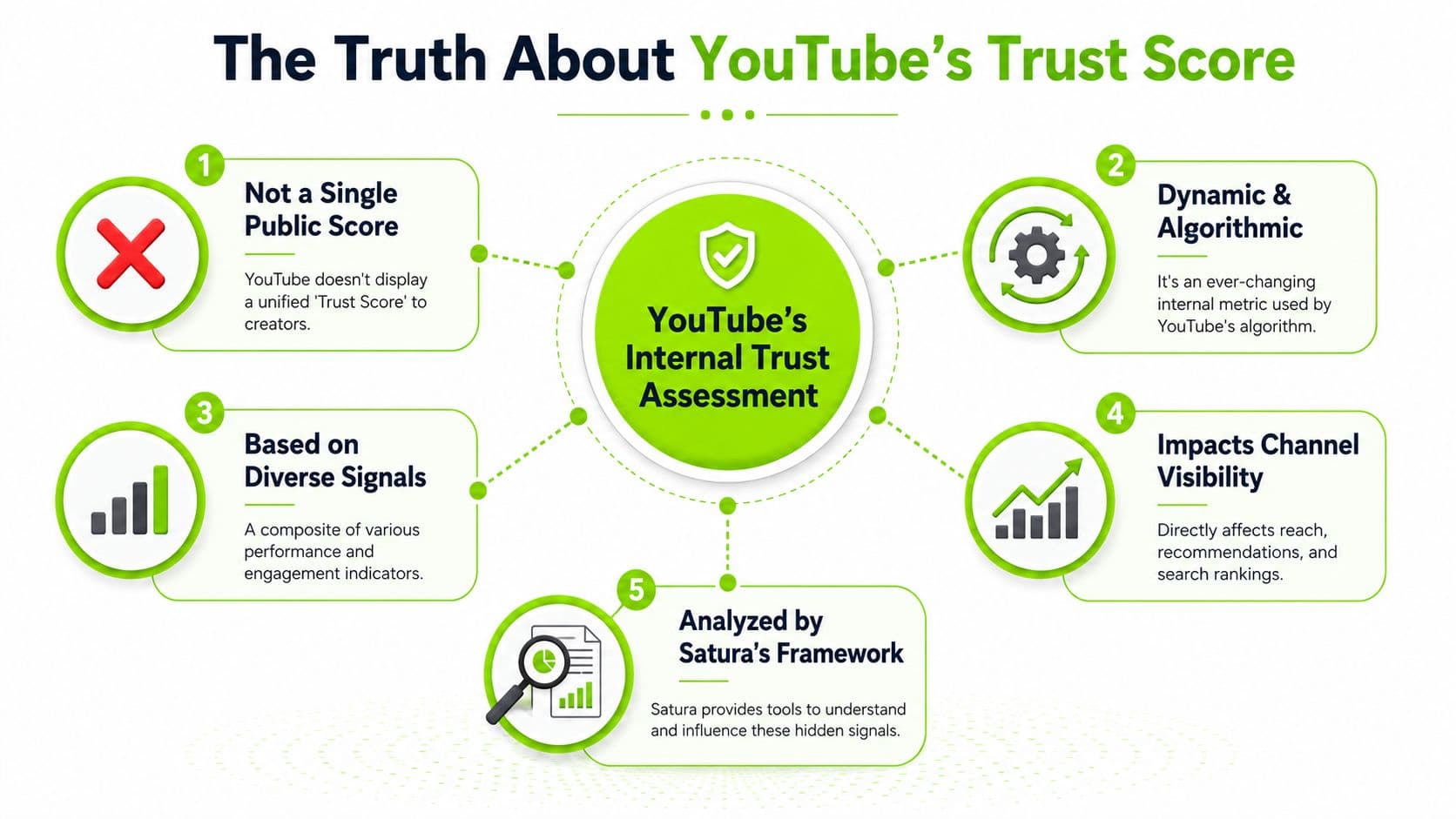
Composite signals drive distribution
The useful way to frame trust is operationally. You are not trying to raise a hidden number. You are trying to improve the signals that make YouTube more willing to show your content to more people.
Those signals usually show up in a few places:
That framing changes the job. Instead of asking, "What is my trust score?" ask, "Which signal broke first?"
I see this constantly with stalled channels. A creator assumes the whole channel lost trust, but the core problem is usually narrower. Weak packaging gets fewer clicks. A strong thumbnail gets clicks but the intro burns trust because it drags. A good video gets tested to the wrong audience first and never finds the right pocket. Different failure point, different fix.
YouTube keeps much of that system opaque on purpose. Creators see outcomes, not the full decision tree. The truth is more annoying. Reach changes because several inputs interact at once, and those inputs can improve or slip on every upload.
That logic is not unique to YouTube. Platforms often use clusters of quality and risk signals instead of one neat label. The same pattern shows up in broader platform operations and trust and safety strategy work.
If you want a cleaner mental model, use trust score as shorthand for repeatable signals, not a secret badge. That also makes diagnosis easier. You can review retention, packaging, audience fit, and satisfaction patterns, including the viewer satisfaction signals YouTube actually responds to, instead of guessing whether the algorithm "likes" your channel this week.
Practical rule: Stop hunting for a hidden number. Audit the signals you can observe, then fix the one that is limiting distribution first.
- Click response: viewers choose the video when it appears
- Viewer satisfaction: they keep watching, respond well, and do not bounce fast
- Promise delivery: the video matches the expectation set by the title and thumbnail
- Audience alignment: the topic fits the viewers who get the first test
- Channel reliability: the content looks original, consistent, and policy-safe
The Five Key Signals That Build Your Trust Score
If you want to improve trust score YouTube performance, you need working leplays, not mythology. I break it into five signals.
Right near the top, think of this as a system, not a single metric.
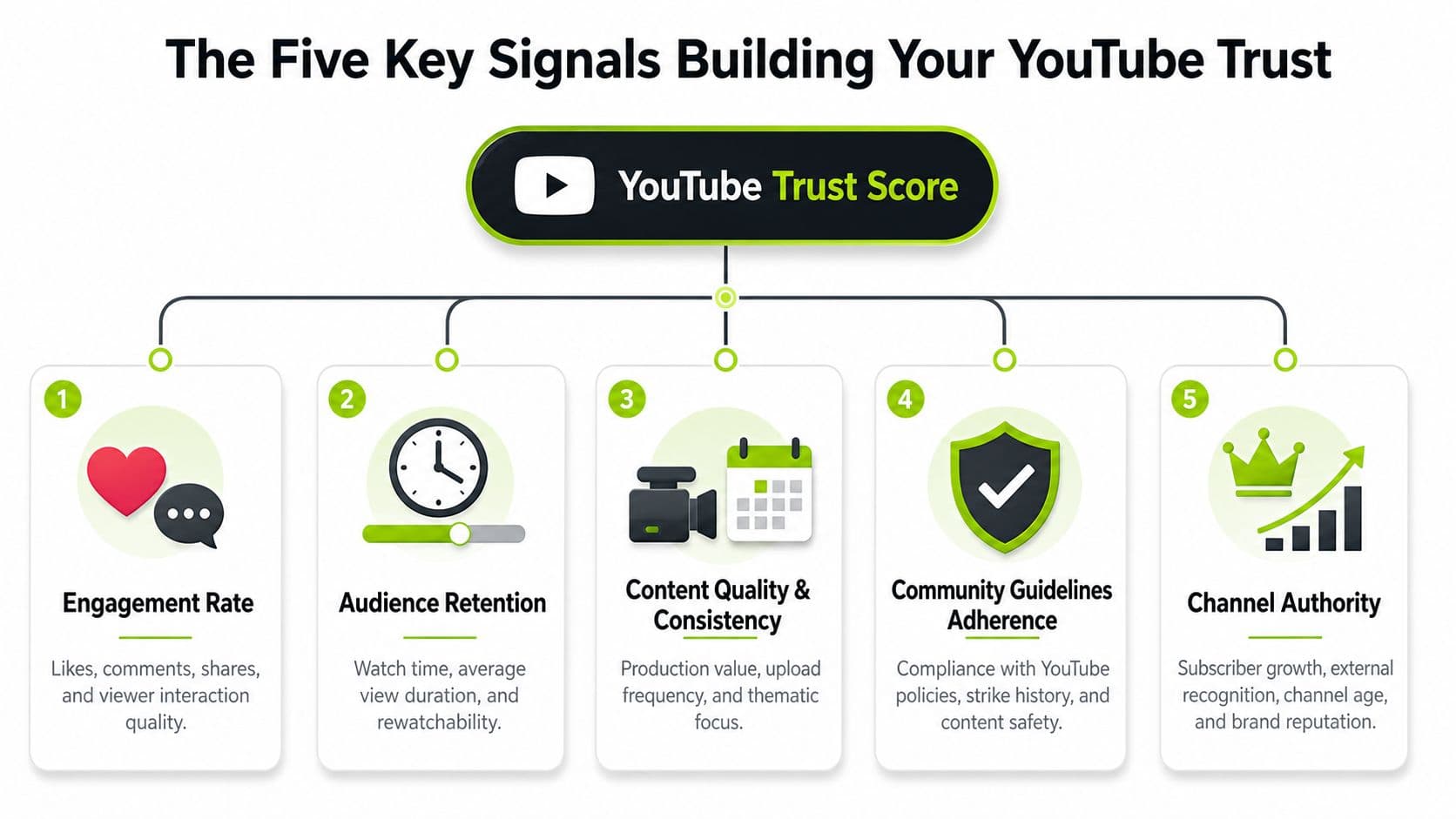
Signal one and two
Audience retention comes first because it answers the simplest question. Did the video hold attention after the click? Creator guidance in the provided material stresses retention diagnostics, and for short-form it notes that view duration needs to exceed clip length to signal strength. If you want a plain-English refresher on the core concept, this guide on what watch time means is helpful.
Packaging integrity comes next. A title and thumbnail can win the click, but if the opening seconds don't deliver the promise, the system gets a negative quality signal. Independent creator analysis commonly cites that half of all channels have click-through rates between 2% and 10%, with 4% to 5% described as the average, while 4% to 6% engagement is considered strong and 6%+ exceptional in that same creator education context, according to this creator analysis video on CTR and engagement benchmarks.
A common mistake is celebrating CTR in isolation. If the package oversells, the click can rise while viewer satisfaction drops. That's not trust. That's bait.
Signal three, four, and five
A lot of channels also underestimate topic-to-audience fit. You can have decent metrics and still get weak reach if the video doesn't map cleanly to the audience cluster YouTube expected. In such instances, creators often misread their own analytics. They think “good numbers” should automatically produce scale, but the wrong topic for the wrong viewer group can stall distribution.
The creator guidance below is worth watching because it gets into retention and topic fit in a practical way.
Then there's originality and policy safety. Rehashed content, low-effort reuse, or recurring moderation issues make a channel look less dependable. YouTube doesn't expose that as a neat public score, but creators ignore this at their own risk. Platforms reward content they can confidently recommend.
The last signal is audience relationship. Good comments matter more than empty activity. Returning viewers matter more than vanity spikes. If your videos create the right expectation and then satisfy it repeatedly, you build a stronger pattern over time. For a related breakdown of how satisfaction signals influence performance, see this article on the YouTube satisfaction metric and emotional response.
| Signal | What It Measures | Why It Matters for Trust |
|---|---|---|
| Audience retention | How long viewers keep watching and whether the opening holds | Strong retention tells YouTube the video satisfied initial interest |
| Packaging integrity | Title and thumbnail promise versus actual payoff | Honest packaging creates clicks that convert into watch time, not disappointment |
| Topic-to-audience fit | Whether the subject matches the viewers who receive the test | Good fit improves the odds that recommendations reach the right people |
| Originality and policy safety | Content distinctiveness, compliance, and reliability | Safer, more original content is easier for YouTube to recommend confidently |
| Audience relationship | Comment quality, repeat interest, and community response | Healthy viewer response suggests the channel creates lasting value |
Good trust signals work together. Great thumbnails without retention don't help much. Strong retention on the wrong topic doesn't scale much either.
Why Your Trust Score Is Your Most Important Asset
Views don't grow in a straight line on YouTube. Distribution compounds when the system sees enough proof to keep widening the test.
That's why these trust signals are business assets, not just analytics trivia. If your videos repeatedly earn stronger confidence, you get more chances to appear in recommendations, more chances to reach new viewers, and more chances to build a stable audience that can monetize.
Most videos never get meaningful distribution
A foundational reality of YouTube is that 70% of platform traffic comes from recommendation algorithms, not direct search, according to this YouTube ecosystem research summary. The same source shows how uneven visibility is. 93% of videos get fewer than 1,000 views, while the top 3.67% account for 93.61% of all views.
That should change how you think about growth. The game isn't “how do I upload more?” The game is “how do I produce videos the system wants to keep distributing?”
Why this affects revenue too
A channel with healthier trust signals usually has a cleaner path to monetization because the audience experience is stronger. Better topic fit can raise qualified views. Better packaging can improve the quality of clicks. Better retention can produce more total watch time from the same impression base.
That doesn't guarantee revenue on its own. It does improve the conditions that make revenue possible.
If you're trying to connect that to monetization strategy, especially on shorter formats, this guide to YouTube Shorts monetization requirements helps put the platform side in perspective.
The fastest way to stay small is to treat low reach like a posting-frequency problem when it's really a trust-signal problem.
How to Diagnose and Fix Your Trust Score with Satura
Most creators don't need more raw data. They need cleaner diagnosis.
If a video underperforms, there are only a few useful questions. Was the hook weak? Did the thumbnail attract the wrong click? Did the topic miss the audience? Did viewers drop because the structure drifted? Without that layer, analytics turn into noise.
What a useful diagnostic workflow looks like
The practical way to improve this kind of inferred trust is through retention and packaging diagnostics, and creator guidance in the provided sources notes that weak reach can continue even when the surface metrics look good if topic-to-audience fit is poor. It also recommends looking at audience data, past popular topics, search predictions, and similar-channel patterns to align with viewer intent, as discussed in this creator guidance on retention and packaging.
A solid workflow looks like this:
Check whether the opening matches the promise of the title and thumbnail. If viewers click and then bail, fix the setup before changing anything else.
Look for where attention drops. A sharp early fall usually points to a weak hook, a slow opening, or a mismatch between packaging and content.
If the video seems strong but reach stayed weak, the issue may be audience alignment, not execution. Some topics attract curiosity from the wrong viewers and confuse the recommendation test.
Your best recent videos often reveal what your audience wants from you. Topic pattern matters. Format pattern matters. Framing matters.
- Start with the first seconds
- Review retention shape
- Inspect topic fit
- Compare against your own winners
What are the common questions?
What is the short answer for Boost Your Trust Score Youtube: Guide for 2026?
Master your trust score youtube in 2026 to unlock channel growth. Discover key signals, learn how to improve them, & boost your views. Get started today!
What should creators do first?
Choose topics with evidence
Who is this guide for?
This guide is for YouTube creators, faceless channel operators, agencies, and teams using AI tools to improve video production and growth.
Action checklist
Apply this to your channel today.
- 1Choose topics with evidence
- 2Package accurately
- 3Tighten the opening
- 4Review comments for signal, not ego
- 5Build toward monetizable trust
Sources & methodology
- Satura editorial guide based on the source video, topic cluster, and article sections.
- Source video reviewed for this article: https://www.outrank.so/