What is the quick answer?
A practical 2026 playbook for YouTube channel monetization — eligibility, AdSense setup, growth tactics, and diversified revenue beyond ads.
Key takeaways
- Why YouTube Channel Monetization Starts Earlier Than You Think
- The right way to think about the first tier
- What changes when you think in layers
- Meeting the YouTube Partner Program Requirements
- Pick the route that matches your format
- The approval process has a boring but important trap
Overview
Most advice about YouTube Channel Monetization starts in the wrong place. It tells creators to chase 1,000 subscribers like that number is a finish line, when the game is building a revenue stack early, then widening it as the channel matures.
That matters because YouTube's monetization system isn't a single switch anymore. There's a lower-access tier for fan funding and a full ad-revenue tier for bigger reach, and the difference between them shapes how you should build, package, and sell your content from day one.
Why YouTube Channel Monetization Starts Earlier Than You Think
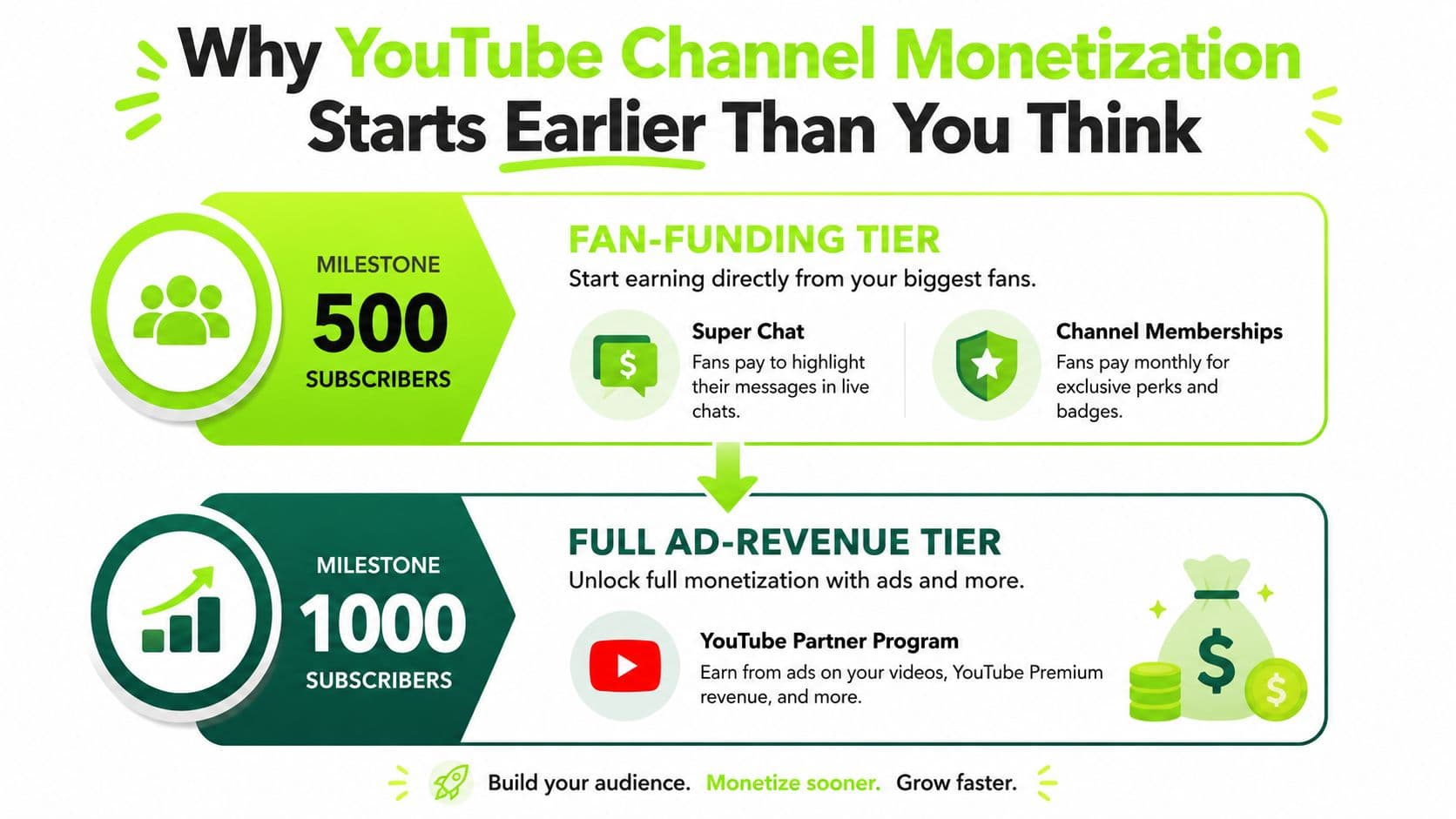
The biggest mistake creators make is waiting for 1,000 subscribers before they think about earning. That's the full ad-revenue milestone, but it's not the start of monetization. Since June 13, 2023, YouTube has made entry materially more accessible by lowering the earlier threshold to 500 subscribers, 3,000 watch hours, or 3 million Shorts views. YouTube's creator guide separates that earlier access from the full ad path, so creators who wait too long are leaving money on the table. YouTube's earn overview lays out the tiered setup, and the early-access rules are widely summarized in creator guides like this one on monetization requirements.
The right way to think about the first tier
Fan funding is the warm-up lap, not the victory lap. If your channel can activate memberships, Super Chat, or other eligible support features earlier, you can start testing what your audience will pay for before ads ever enter the picture. That's a huge advantage for creators in niches where loyalty is stronger than raw scale.
The practical move is simple. Build content that creates recurring viewers, then give them a way to support you when the channel crosses the earlier threshold. If you're making faceless or utility-driven content, this is especially useful because a small but motivated audience can outperform a bigger, passive one in cash terms.
Practical rule: Stop treating monetization as one event. Treat it like a ladder, where fan funding comes first, ads come second, and diversified income sits beside both.
A smart early roadmap is to plan content and packaging for the lower tier while you're still growing. That way, the channel doesn't sit idle at 500 subscribers waiting for the next milestone. One useful perspective on that early-build phase is this guide to monetizing a new faceless YouTube channel, which fits the same basic idea, earn as soon as the channel has enough trust and audience fit to support it.
What changes when you think in layers
Once you stop obsessing over the full ad tier, your decisions get sharper. You start asking, “What can this audience support now?” instead of “How do I wait until the platform lets me earn?” That question leads to better sequencing, especially for newer channels with small but engaged communities.
It also changes how you interpret growth. A channel can be too small for full ads and still be ready for support features, affiliate offers, or product sales. That's the right mindset for youtube channel monetization in 2026, because the channels that win usually don't rely on a single payout stream.
Meeting the YouTube Partner Program Requirements
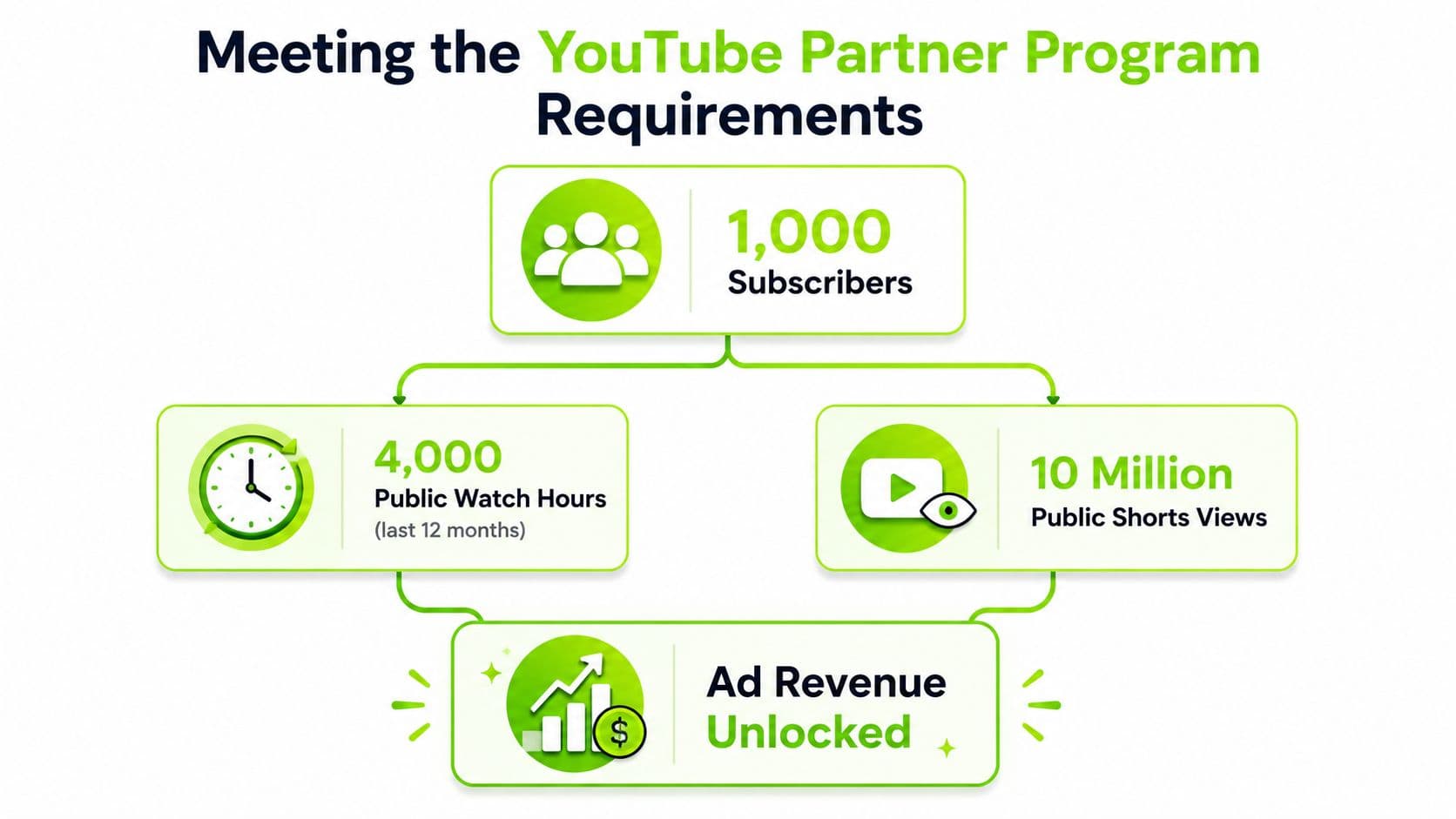
The full ad-revenue path is concrete, and it is unforgiving. You need 1,000 subscribers plus either 4,000 valid public watch hours in the last 12 months or 10 million valid public Shorts views in the last 90 days. Those are two different routes into the same program, so choose the one your format can support without forcing the wrong behavior. Creator-facing breakdowns like TubeBuddy's monetization requirements guide lay out the same basic requirements.
Pick the route that matches your format
Long-form creators should build for watch time. That means videos that hold attention, keep people watching, and give YouTube a reason to keep recommending the channel. Shorts-first creators need recent view velocity, which demands steady output and tight packaging.
Mixing both formats without a plan usually weakens the channel. You end up with long-form videos that do not hold viewers and Shorts that do not support the deeper viewing behavior needed for stronger monetization.
YouTube's setup flow is simple enough. Go to YouTube Studio > Earn, accept the Base Terms, link or create an AdSense account, then wait for review. After approval, the part many creators miss is the per-video setup in Content > Edit > Monetization, because approval does not automatically turn ads on across the whole library. YouTube's own creator earnings overview covers that workflow.
The approval process has a boring but important trap
Creators love the application milestone and ignore the catalog. That is a mistake. If you have a back catalog worth monetizing, audit it after approval and switch monetization on where eligible. Otherwise, you will have a monetized channel on paper and an under-monetized library in practice.
Do this first: after approval, check your oldest videos, newest uploads, and best-performing catalog pieces, then confirm monetization settings one by one.
The review itself is not instant. Guides commonly describe the process as taking days to a few weeks, so keep every upload policy-safe while the channel is under review. No risky reused clips, no sketchy metadata tricks, and no sudden pivot into content that does not match the channel theme you have already built. YouTube reviewers look at the channel as a whole, not just the one video that pushed you over the line, so consistency is the safe move.
For Shorts-heavy creators, the path looks different enough that you should study the details in this Shorts monetization guide. Shorts can help you qualify, but only if they fit the route you are targeting instead of chasing views in isolation.
A clean eligibility mindset beats panic uploading
There is a reason channels stall here. They chase the threshold without building a channel structure that can survive review. If your best-performing content is original, your descriptions are clean, and your upload history looks consistent, you have already done the hard part. The application is administrative. The work is in the channel itself.
The RPM Reality and Why Ad Revenue Alone Won't Cut It
YouTube ad revenue sounds bigger than it usually feels once you're inside the numbers. Independent 2026 creator data from 300 channels found a median RPM of about $2.30 per 1,000 views, and the median channel monetized only 53% of its views. In plain English, nearly half the traffic didn't earn because no ad was served. That's why ad revenue is useful, but unreliable as a solo plan. The underlying channel data is the cleanest reality check most creators never get.
The revenue pool is huge, your slice is usually thin
The macro picture is impressive. YouTube generated more than $60 billion in total revenue in 2025, with one estimate putting ad revenue at $40.4 billion and implying roughly $22 billion available for creator payouts under the platform's 55/45 split for long-form content. Neal Mohan also said in his 2026 letter that YouTube has paid over $100 billion to creators over the past four years. The platform is swimming in money, but the median individual channel is still in a low-RPM environment. RevenueMemo's YouTube marketing statistics captures that tension well.
Channel size doesn't magically fix RPM
The same 2026 channel-level data shows median RPMs of about $2.14 for small channels and $2.04 for medium channels. That's the part creators don't want to hear. Bigger isn't automatically better on a per-view basis, so chasing size without improving audience fit, retention, and ad fill rate can be a waste of time.
| Channel Tier | Median RPM | Typical Monetization Rate |
|---|---|---|
| Small channels | $2.14 | Often below full fill, per the 2026 sample |
| Medium channels | $2.04 | Often below full fill, per the 2026 sample |
| All channels in the sample | $2.30 | 53% of views monetized |
If you want a better benchmark for strategy, think in terms of viewer quality, not just view count. A million views with poor monetization is a disappointment. A smaller audience with strong watch time, better geography, and better ad fill can outperform it in actual dollars.
Bottom line: “Get more views” is incomplete advice. Get more eligible views, keep people watching, and build a channel advertisers actually want to appear beside.
For a more tactical angle on the revenue side, I'd also read this RPM targeting strategy guide for new creators. The useful lesson is simple, RPM is not random, and it isn't fixed.
Content and Growth Tactics That Actually Clear the Thresholds
Eligibility is the gate. Packaging is the key. If your niche is fuzzy, your hooks are lazy, and your intros drag, you'll never reach the thresholds fast enough to matter. The creators who move are the ones who design for either watch time or Shorts velocity from the start.
What are the common questions?
What is the short answer for YouTube Channel Monetization: The 2026 Playbook?
A practical 2026 playbook for YouTube channel monetization — eligibility, AdSense setup, growth tactics, and diversified revenue beyond ads.
What should creators do first?
Reinvest instead of extracting too early
Who is this guide for?
This guide is for YouTube creators, faceless channel operators, agencies, and teams using AI tools to improve video production and growth.
Action checklist
Apply this to your channel today.
- 1Reinvest instead of extracting too early
- 2Support layer: memberships, Super Chat, Super Thanks.
- 3Conversion layer: affiliates, shopping, merch.
- 4Authority layer: sponsorships and brand deals.
- 5Asset layer: digital products, licensing, and cross-platform offers.
Sources & methodology
- Satura editorial guide based on the source video, topic cluster, and article sections.
- Source video reviewed for this article: https://www.outrank.so/