Descript vs CapCut
Descript vs CapCut: which is better for your video workflow?
Choose Descript when spoken words and transcript cleanup drive the edit. Choose CapCut when visual timing, effects, templates, and mobile production drive it. Use both when dialogue and visual finishing are separate jobs, or consider Satura when the workflow must continue into YouTube growth.
Fact-checked against official Descript and CapCut product, pricing, and help pages on August 2, 2026.
Descript
Best for editing spoken video by text
Start here when transcripts, speakers, dialogue cleanup, podcasts, interviews, and recorded explanations define the repeatable job.
CapCut
Best for visual social editing
Start here when effects, templates, music, motion, text styling, detailed timing, and editing across phone, desktop, and web matter most.
Satura
Best for the YouTube operating loop
Start here when the edit must connect to research, thumbnails, metadata, CTR, retention, RPM, channel health, and the next upload.
Feature and workflow comparison
Descript vs CapCut at a glance
Both products can edit, transcribe, caption, clip, collaborate, and export. The useful differences are the editing model, visual breadth, dialogue workflow, supported devices, and what happens after export.
| Decision | Descript | CapCut | Verdict |
|---|---|---|---|
| Primary editing model | Transcript-first editing backed by scenes, media layers, a visual timeline, and precision audio and video controls. | Visual timeline editing built around clips, tracks, text, music, transitions, effects, filters, templates, and direct manipulation. | Choose Descript when spoken words drive most cuts. Choose CapCut when visual timing, effects, and hands-on assembly drive them. |
| Dialogue and podcasts | Studio Sound, filler and retake removal, speaker detection, AI speech, voice cloning, recording, and transcript navigation are central workflows. | Noise reduction, captions, transcription, voice tools, music, effects, and timeline editing can finish podcasts and talking-head video. | Descript is the clearer first test for dialogue-heavy production. Compare cleanup quality and correction time on the same recording. |
| Visual and social editing | Layouts, scenes, B-roll, stock media, templates, captions, backgrounds, eye contact, and AI-generated assets support polished video. | A large library of templates, transitions, filters, effects, stickers, music, text styles, tracking, resizing, and platform-ready formats. | CapCut is the stronger starting point for dense visual styling and trend-led social edits. Descript favors spoken-message efficiency. |
| Captions and transcription | Automatic transcription powers text editing, speaker-aware navigation, animated captions, subtitle workflows, and translation. | Auto captions work across web, desktop, and mobile with editable text, timing, placement, styles, animations, and export workflows. | Descript makes the transcript the editing interface. CapCut treats captions as one flexible layer inside a broader visual edit. |
| Long video to clips | Create Clips can select highlights, use custom criteria, produce multiple durations and aspect ratios, and apply social layouts. | AI Clip Maker identifies highlights, trims clips, tracks subjects, reframes 16:9 to 9:16, generates captions, and opens results for editing. | Both can repurpose long video. Score usable clips after manual correction instead of comparing only the number generated. |
| Devices | Editing is available through supported Chromium browsers and desktop apps for current macOS and Windows systems; mobile editing is not supported. | Editing spans web, Windows, macOS, iOS, and Android, with plan and feature availability varying by platform and region. | CapCut is the practical choice when phone and tablet editing are required. Descript is a desktop and supported-browser workflow. |
| Teams and review | Supports shared projects, live collaboration, comments, project access, drives, editor seats, and plan-dependent AI-credit permissions. | Cloud projects, storage, collaboration, team templates, brand libraries, and review features are available with plan-dependent limits. | Model the exact editors, reviewers, storage, brand controls, devices, and paid seats before comparing the word collaboration. |
| Publishing and YouTube | Exports local files and share links, can publish through integrations, and supports YouTube descriptions, clips, captions, and spoken-video cleanup. | Customizes export resolution, quality, frame rate, and format, then downloads or shares finished videos to social platforms. | Both can finish publishable video. Neither product centers its workflow on thumbnail testing, CTR, retention, RPM, or channel health. |
| Best overall fit | Podcasters, interviewers, educators, marketers, and teams whose repeatable edit begins with recorded speech and a transcript. | Social creators and visual editors who need cross-device access, hands-on timeline control, templates, effects, and fast platform formatting. | There is no universal winner. Match the primary editing model and device requirement to the job repeated every week. |
Decision paths
Choose around the job the team repeats
Choose Descript
Best starting point for transcript-first spoken media.
- Podcasts, interviews, webinars, tutorials, and talking-head videos dominate the workload.
- Deleting words, removing filler and retakes, repairing dialogue, and navigating speakers should drive the edit.
- Studio Sound, AI speech, screen recording, comments, and desktop production matter more than mobile editing.
Choose CapCut
Best starting point for visual and cross-device editing.
- Phone, tablet, desktop, and browser workflows need to coexist.
- Templates, effects, transitions, music, text animation, tracking, and detailed visual timing are central.
- Short-form social output and fast platform formatting matter more than a transcript-led editing model.
Use both
Best when dialogue cleanup and visual finishing are separate jobs.
- Cut and clean the spoken master in Descript, then export it for visual finishing in CapCut.
- Keep captions in one editor to avoid duplicated correction and timing work.
- Test whether the handoff saves more time than it adds through exports, versions, storage, and two subscriptions.
Consider Satura
Best when the actual job is operating a YouTube channel.
- Research, assets, editing, clips, voiceovers, thumbnails, metadata, and upload planning should connect.
- CTR, retention, TrustScore, RPM, and channel diagnostics need to shape the next video.
- A YouTube production and learning loop matters more than podcast specialization or general social-editing breadth.
Two-editor workflow
Can Descript and CapCut work together?
Yes. The defensible reason to use both is not feature count. It is a clean handoff between spoken-story editing and visual finishing that reduces total correction time.
Clean the spoken master
Transcribe in Descript, make story cuts, remove filler and retakes, repair audio, and approve the final spoken sequence.
Choose one caption owner
Either finish captions before export or generate them in CapCut. Avoid correcting and styling two independent subtitle tracks.
Finish the visual edit
Use CapCut for detailed motion, effects, music, transitions, visual pacing, trend-led styling, and platform variants.
Pricing context
Compare the cost of one publishable workflow
Entry prices hide media hours, AI credits, devices, premium assets, storage, seats, export resolution, and whether a second editor is still required. Price the normal monthly workload and verify checkout.
| Product | Free access | Paid access | Cost check |
|---|---|---|---|
| Descript | Free includes 1 media hour and 100 AI credits per month, 720p watermark-free export, limited Underlord access, and a limited AI Speech trial. | Hobbyist is currently $16 per person per month billed annually or $24 monthly; Creator is $24 annually or $35 monthly. The plans raise media hours, AI credits, export resolution, and AI access. | Media hours, AI credits, top-ups, export resolution, stock access, and paid seats vary by plan. Verify the official checkout for the exact team and usage pattern. |
| CapCut | Free editing tools and templates are available, with some assets and capabilities reserved for paid plans. | CapCut offers Standard and Pro subscriptions; available plans and benefits can differ by platform. | CapCut states that current checkout pricing varies by region, device, and promotion, so a fixed global price would be misleading. |
| Satura | Free account with browser editing and limited exports; no credit card is required to start. | Starter is $29/month, with an annual equivalent from $17/month. | Paid plans bundle AI credits, export minutes, connected YouTube channels, and the wider production and growth toolset. |
The YouTube third option
Connect the edit to the next content decision
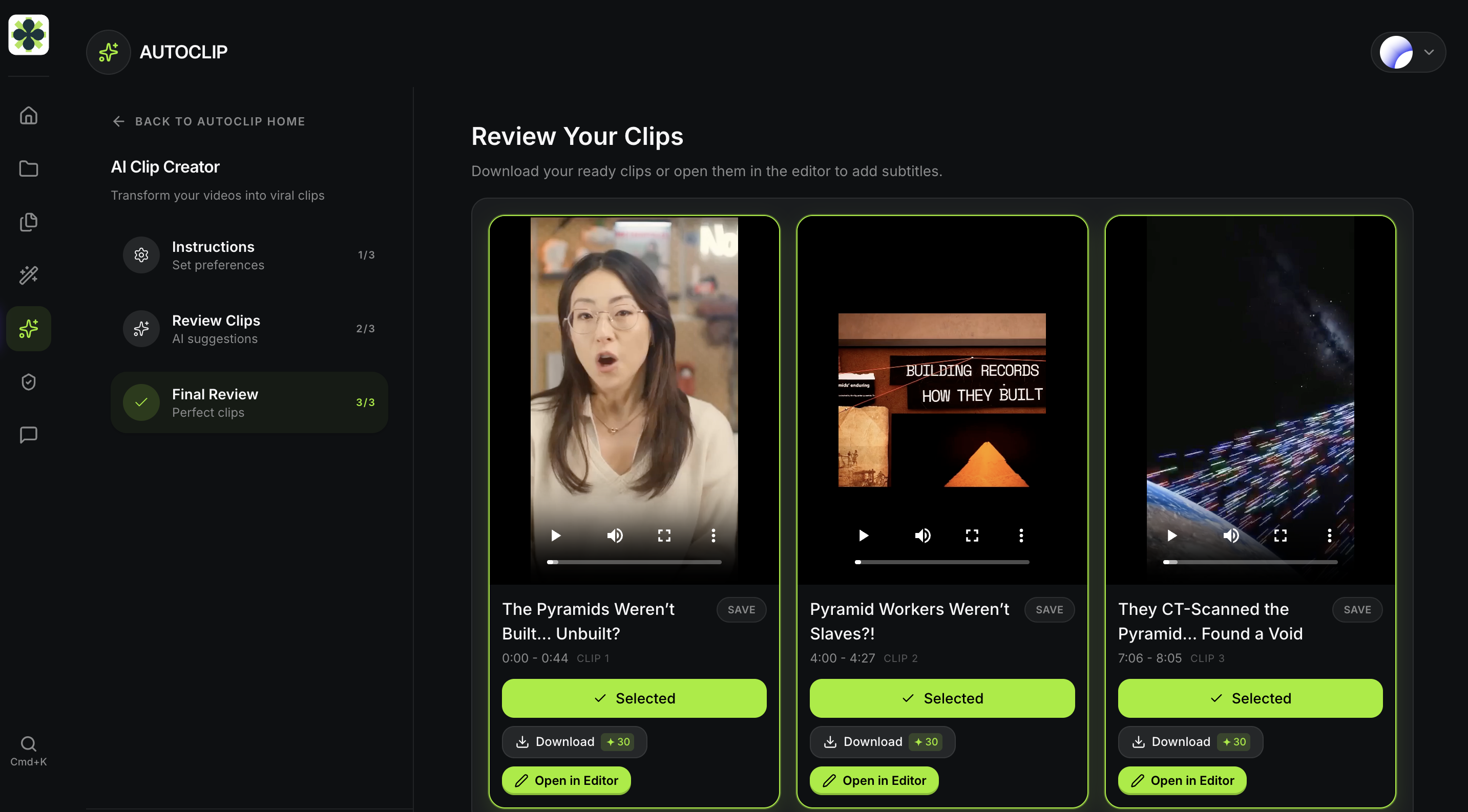
Descript and CapCut are capable editors. Satura is the alternative when the team wants production connected to research, clips, thumbnails, metadata, CTR, retention, RPM, channel health, and what to create next.
Fair product test
Test the output, not the feature list
Use one representative source
Choose a normal podcast, interview, tutorial, talking-head video, or social edit instead of a short demo file.
Finish the same deliverables
Produce one long edit and three short clips with corrected captions, clean audio, finished visuals, and final export settings.
Count correction minutes
Measure transcript fixes, visual adjustments, reframing, caption timing, brand work, exports, handoffs, and review rounds.
Price the real workflow
Include media hours, AI credits, premium assets, storage, seats, devices, export requirements, and any second editor.
Official sources
Verify both products before choosing
Descript vs CapCut FAQ
Questions creators ask before choosing
Which is better, CapCut or Descript?
Descript is usually better for transcript-first podcasts, interviews, webinars, tutorials, and talking-head videos. CapCut is usually better for visual timeline editing, mobile workflows, templates, effects, music, and trend-led short-form content. The best choice depends on whether spoken words or visual assembly drive most editing decisions.
What is the main difference between Descript and CapCut?
Descript makes the transcript the primary editing interface, with spoken-media cleanup and AI assistance around it. CapCut makes the visual timeline the primary workspace, with broad effects, templates, music, text, motion, and cross-device editing. Both can caption, transcribe, clip, collaborate, and export video.
Is Descript or CapCut better for podcasts?
Descript is the clearer first test for podcasts because transcript editing, speaker navigation, Studio Sound, filler and retake removal, AI speech, and spoken-content production are central to the product. CapCut can still caption, clean, style, clip, and visually finish a podcast inside its timeline.
Is Descript or CapCut better for short-form video?
CapCut is usually the stronger starting point for visually dense TikTok, Reels, and Shorts edits because of its cross-device workflow, templates, effects, transitions, music, text styles, and detailed visual control. Descript is strong when short clips begin as highlights from a podcast, interview, webinar, or other spoken source.
Can I use Descript and CapCut together?
Yes. A practical workflow is to cut and clean the spoken master in Descript, export it, then finish visual pacing, effects, music, motion, and platform variants in CapCut. Decide which product owns captions and measure whether the handoff saves enough correction time to justify two tools and subscriptions.
Are Descript and CapCut free?
Both offer free access with limits. Descript currently includes 1 media hour, 100 AI credits, and 720p watermark-free export. CapCut provides free editing tools and templates, while selected assets and capabilities require paid access. CapCut states that Pro pricing varies by region, device, and promotion.
Does Descript or CapCut work better on mobile?
CapCut is the better mobile choice because it supports editing across iOS, Android, web, Windows, and macOS. Descript documents editing through supported desktop apps and Chromium browsers and states that mobile and tablet editing are not supported, although a mobile upload feature is available.
Is Descript or CapCut better for YouTube?
Descript fits YouTube videos built around speech, interviews, podcasts, tutorials, and screen recordings. CapCut fits creators who prioritize cross-device visual editing and fast social variants. Satura is the third option when thumbnails, metadata, CTR, retention, RPM, TrustScore, and channel diagnostics need to connect to production.
Related comparisons
Continue comparing the editing workflow
Descript alternative
Compare Descript directly with Satura across transcript editing, clips, captions, pricing, and YouTube workflow depth.
Read comparisonCapCut alternative
Compare CapCut directly with Satura across devices, visual editing, captions, templates, pricing, packaging, and analytics.
Read comparisonDescript vs VEED
Compare transcript-first editing with a broader browser platform across captions, AI video, teams, and pricing.
Read comparisonVEED vs CapCut
Compare browser-first team production with cross-platform visual editing, captions, AI tools, clips, and pricing.
Read comparisonOpusClip vs CapCut
Compare specialist long-video clipping with broad cross-platform editing and visual finishing.
Read comparisonRun one real test
Finish the whole workflow before choosing
Compare spoken-story editing, visual finishing, captions, clips, devices, review, export, packaging, performance diagnosis, and the next content decision.