Descript vs VEED
Descript vs VEED: which video editor fits your workflow?
Choose Descript for transcript-first podcasts and spoken video. Choose VEED for broad browser editing, multilingual video, avatars, and team production. Consider Satura when the real job is running a complete YouTube production and performance loop.
Fact-checked against official Descript and VEED product, pricing, and help pages on August 2, 2026.
Descript
Best for editing by transcript
Start here when words, speakers, dialogue cleanup, podcasts, and recorded conversations define the repeatable job.
VEED
Best for broad browser video
Start here when visual editing, translation, avatars, brand assets, formats, and team review need one general-purpose platform.
Satura
Best for the YouTube operating loop
Start here when the edit must connect to research, thumbnails, metadata, CTR, retention, RPM, channel health, and the next upload.
Feature and workflow comparison
Descript vs VEED at a glance
Both products can edit, caption, clip, clean audio, collaborate, and export. The useful differences are the primary editing model, multilingual breadth, AI workflow, and what happens after the video is finished.
| Decision | Descript | VEED | Verdict |
|---|---|---|---|
| Editing model | Transcript-first editing backed by a visual timeline, scenes, media layers, and precision controls for audio and video. | Browser timeline and transcript editing with Auto Edits, stock media, effects, brand tools, captions, and broad video formats. | Choose Descript when words and speakers drive the edit. Choose VEED when visual assembly and broad business-video formats drive it. |
| Podcast and dialogue work | Studio Sound, filler and retake removal, speaker detection, AI speech, voice cloning, podcast tools, and screen recording are core workflows. | Audio cleanup, filler and silence removal, voice tools, recording, captions, and video editing support spoken content inside a broader suite. | Descript is the clearer first test for podcasts, interviews, and dialogue-heavy edits. Compare cleanup quality on the same recording. |
| AI video and avatars | Underlord can direct editing, create clips, generate or regenerate video and speech, clone voices, and understand uploaded media. | Offers prompt and script generation, multiple video models, avatars, voice cloning, talking videos, image-to-video, and scene tools. | VEED documents the broader avatar and model workflow. Descript centers AI more tightly on editing recorded spoken content. |
| Captions and languages | Creates captions from transcripts and documents automatic transcription in 26 languages, with some script and English-only tool limits. | Creates styled subtitles, hardcoded captions, subtitle-file downloads, dubbing, and translation across more than 125 languages. | VEED is the stronger documented multilingual option. Test accuracy, correction time, file output, and dubbing on representative audio. |
| Long video to clips | Create Clips can produce 1-20 clips, use custom selection criteria, target 10-second to 5-minute durations, and apply social layouts. | Finds highlights, auto-frames speakers, removes filler and silence, adds captions, rates clips, and supports transcript trimming. | Both are credible repurposing options. Compare usable clips after manual review, not only the number generated. |
| Teams and review | Supports project editors, commenters, shared drives, live collaboration, scoped project access, and paid drive-level editor seats. | Supports shared workspaces, timestamped feedback, brand assets, project access, and paid collaborators with plan-dependent limits. | Model the exact reviewer, commenter, editor, AI-credit, and seat permissions rather than comparing the word collaboration. |
| YouTube workflow | Creates and repurposes YouTube-ready video with transcripts, clips, captions, descriptions, stock media, audio cleanup, and exports. | Creates YouTube-ready video with scripts, AI scenes, captions, translations, clips, avatars, brand tools, team review, and exports. | Both finish video assets. Neither public product workflow centers on thumbnail testing, CTR, retention, RPM, or channel health. |
| Best overall fit | Spoken-word creators and teams that want to edit podcasts, interviews, webinars, and talking-head video through the transcript. | Teams that need a broad browser platform for marketing, training, social, avatar, multilingual, and creator video. | There is no universal winner. The better product is the one whose primary editing model matches the repeatable job. |
Decision paths
Choose around the job the team repeats
Choose Descript
Best starting point for transcript-first spoken media.
- Podcasts, interviews, webinars, screen recordings, and talking-head videos dominate the workload.
- Deleting words, removing filler, repairing dialogue, and navigating by transcript are the fastest editing model.
- Studio Sound, AI speech, voice regeneration, and speaker-aware workflows matter more than avatar breadth.
Choose VEED
Best starting point for broad browser video production.
- Marketing, training, social, sales, creator, and internal video share the same workspace.
- Multilingual subtitles, dubbing, avatars, multiple AI models, templates, and brand tools are central.
- The team wants a broad visual editor and stakeholder-review workflow rather than a podcast-first editor.
Consider Satura
Best fit when the actual job is operating a YouTube channel.
- Research, AI assets, timeline editing, captions, clips, voiceovers, thumbnails, and upload metadata should connect.
- CTR, retention, TrustScore, RPM planning, and channel diagnostics need to shape the next upload.
- A YouTube production and learning loop matters more than podcast editing or general business video breadth.
Pricing context
Compare the cost of one publishable workflow
Entry prices hide media-hour limits, AI credits, seats, export resolution, watermarks, translation, stock access, and separate creator tools. Price the actual monthly workload and verify checkout before buying.
| Product | Free access | Paid access | Cost check |
|---|---|---|---|
| Descript | Free includes 1 media hour and 100 AI credits per month, 720p watermark-free export, limited Underlord access, and a limited AI Speech trial. | Hobbyist is currently $16 per person per month billed annually or $24 monthly; Creator is $24 annually or $35 monthly. The plans raise media hours, AI credits, export resolution, and AI access. | Media hours, AI credits, top-ups, export resolution, stock access, and paid seats vary by plan. Verify the official checkout for the exact team and usage pattern. |
| VEED | Free users can access basic editing and export at 720p with a VEED watermark; selected AI editing tools are offered as one-time trials. | VEED's editor page currently says paid plans start at $9/month billed yearly or $19/month billed monthly for watermark-free exports and more features. | AI generations use model-specific credits, some capabilities and allowances depend on plan, and added collaborators can create additional seat charges. Verify the official checkout for the exact workspace. |
| Satura | Free account with browser editing and limited exports; no credit card is required to start. | Starter is $29/month, with an annual equivalent from $17/month. | Paid plans bundle AI credits, export minutes, connected YouTube channels, and the wider production and growth toolset. |
The YouTube third option
When neither editor covers the whole job
Descript and VEED are capable editors. Satura is the alternative when the team wants the video asset connected to research, packaging, CTR, retention, revenue planning, channel health, and the next content decision.
Explore the YouTube workflow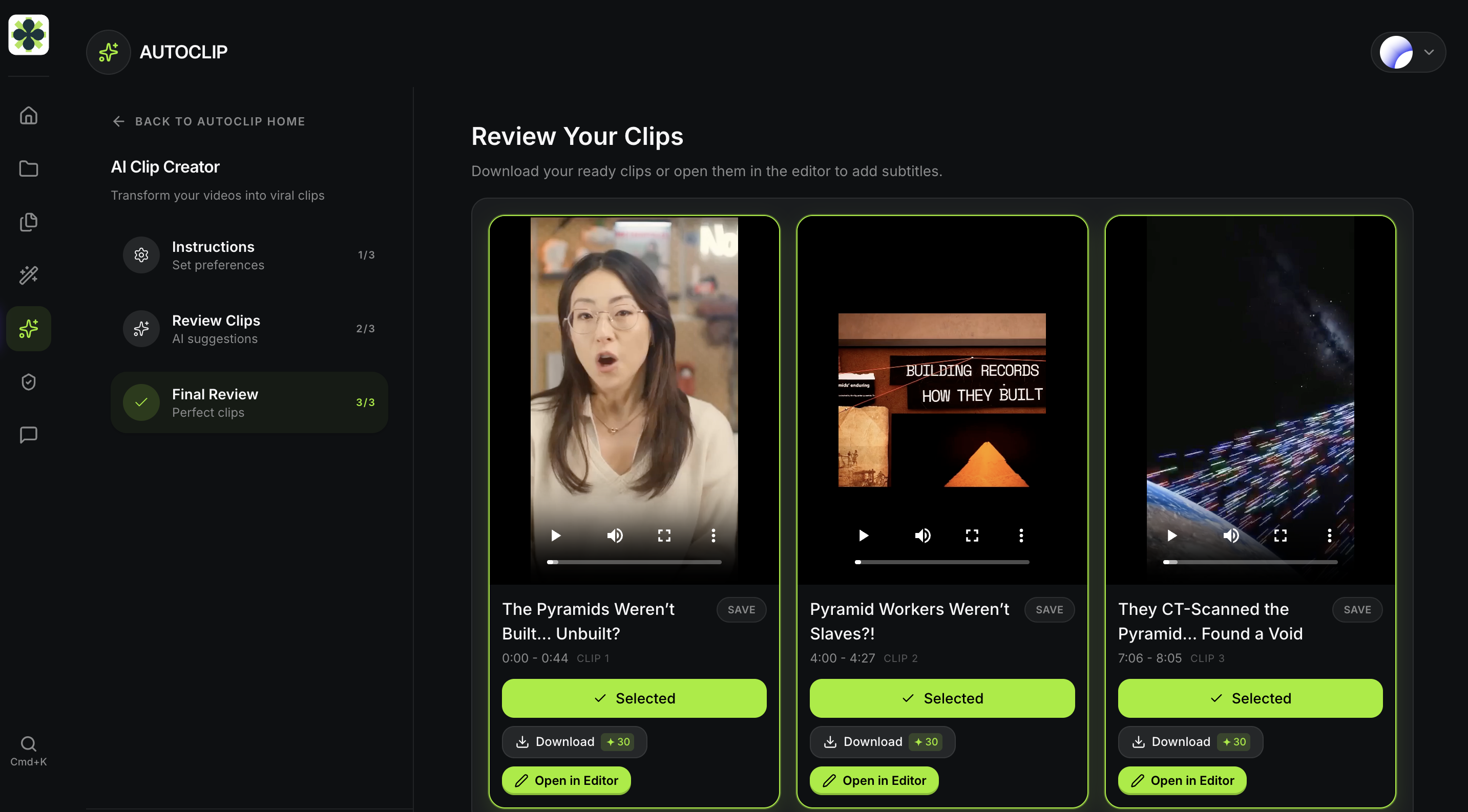
Satura workflow
What the third option adds around editing
Create and edit
Generate video, image, script, and voice assets, then assemble them in a visual browser timeline.
Clip and caption
Turn long videos into reviewable Shorts and add word-timed creator caption styles.
Package the upload
Create and analyze thumbnails, titles, descriptions, tags, hashtags, and chapter metadata.
Learn from performance
Use CTR, retention, TrustScore, channel analytics, and RPM planning to decide what to improve next.
Official sources
Verify both products before choosing
Descript vs VEED FAQ
Questions creators ask before choosing
Is Descript or VEED better?
Descript is usually the better starting point for transcript-first podcast, interview, webinar, and talking-head editing. VEED is usually the better starting point for broad browser video production, multilingual subtitles and dubbing, avatars, templates, and business-video workflows. Test one representative project before choosing.
What is the main difference between Descript and VEED?
Descript organizes editing around the transcript and spoken media. VEED organizes a broader browser video suite around timeline editing, AI generation, avatars, translation, clips, brand tools, and team review. Both overlap in captions, AI assistance, clips, audio cleanup, and export.
Which is better for podcasts, Descript or VEED?
Descript is the clearer first test for podcasts because transcript editing, Studio Sound, filler and retake removal, speaker detection, AI speech, and podcast production are central to its product. VEED can still record, clean, caption, clip, and edit spoken content inside a broader video suite.
Which is better for captions and translation?
VEED documents the broader multilingual workflow, including styled subtitles, subtitle-file downloads, dubbing, and translation across more than 125 languages. Descript documents automatic transcription in 26 languages and transcript-based captions, with some script and English-only tool limitations.
Are Descript and VEED free?
Both offer free access with limits. Descript currently includes 1 media hour, 100 AI credits, and 720p watermark-free export. VEED currently provides basic editing and 720p export with a VEED watermark, with selected AI tools offered as trials. Verify current checkout and allowance details before deciding.
Is Descript or VEED better for YouTube?
Descript fits YouTube creators whose videos begin with interviews, podcasts, webinars, screen recordings, or dialogue. VEED fits creators who need broader visual editing, AI generation, avatars, translation, and team review. Satura is the third option when thumbnails, metadata, CTR, retention, RPM, and channel diagnostics need to connect to production.
How is Satura different from Descript and VEED?
Satura is narrower around YouTube operations. It connects research, AI assets, timeline editing, AutoClip, captions, voiceovers, thumbnails, upload metadata, CTR, retention, TrustScore, RPM planning, and growth coaching. Descript is stronger for transcript-first spoken media, while VEED is broader across general browser video production.
Related comparisons
Compare each editor against Satura
Descript vs CapCut
Compare transcript-first spoken-video editing with visual cross-platform editing, mobile workflows, clips, and social finishing.
Read comparisonDescript alternative
Compare Descript directly with Satura across transcript editing, clips, captions, pricing, and YouTube workflow depth.
Read comparisonVEED alternative
Compare VEED directly with Satura across browser editing, AI video, translation, teams, and YouTube performance tools.
Read comparisonVEED vs CapCut
Compare browser-first team production with cross-platform visual editing, captions, AI tools, clips, and pricing.
Read comparisonCapCut alternative
Compare cross-platform social editing, templates, mobile workflows, and the complete YouTube operating loop.
Read comparisonRun a fair test
Use the same source and finish the whole workflow
Compare correction time, usable clips, caption accuracy, export quality, team review, packaging, performance diagnosis, and the next content decision.