OpusClip vs Submagic
OpusClip vs Submagic: discovery or finishing first?
Choose OpusClip when finding the right moments inside long or visually varied footage is the hard part. Choose Submagic when animated captions, B-roll, pacing, audio, and short-form polish consume the most time. Include Magic Clips before comparing long-video cost.
Fact-checked against official OpusClip and Submagic product, pricing, help, and API pages on August 3, 2026.
OpusClip
Best for moment discovery
Start here when a long source must become a ranked candidate queue and visual, audio, speech, scene, emotion, or prompt signals should shape selection.
Submagic
Best for short-form finishing
Start here when captions, B-roll, trim, zoom, audio, effects, hooks, and brand styling must turn a selected short into a polished social post.
Satura
Best for the YouTube operating loop
Start here when AutoClip must connect to browser editing, captions, thumbnails, metadata, CTR, retention, RPM, channel health, and the next upload decision.
Feature and workflow comparison
OpusClip vs Submagic at a glance
Both can participate in a long-video-to-short workflow, but they begin from different operating assumptions. Compare the work before and after moment selection, not overlapping feature names.
| Decision | OpusClip | Submagic | Verdict |
|---|---|---|---|
| Primary job | Repurposing-first: import long footage, find and score moments, reframe candidates, edit clips, and publish or hand them to a professional editor. | Finish-first: turn an existing short video into a polished post with animated captions, B-roll, zoom, trimming, audio, effects, and brand styling. Magic Clips adds long-video discovery. | Choose around the first expensive step. OpusClip starts with finding moments; Submagic starts with making a chosen moment look finished unless the Magic Clips add-on is included. |
| Long-video discovery | ClipAnything documents visual, audio, sentiment, object, action, scene, sound, emotion, speech, and prompt signals for finding specific moments. | Magic Clips generates short candidates from uploads or YouTube URLs for podcasts, interviews, webinars, and other long-form content, then routes selected clips into the editor. | OpusClip publishes a clearer multimodal discovery model. Submagic can still win when its generated moments require less caption, B-roll, pacing, and visual cleanup after selection. |
| Inputs and duration | Official guidance covers uploaded files and multiple source integrations across podcasts, interviews, vlogs, sports, news, shows, music, tutorials, and low-dialogue footage. | The editor accepts uploads or YouTube links. Pricing lists regular-project limits of 2, 5, or 30 minutes by plan, while another official editor page says videos up to two hours are accepted. | Treat the Submagic duration discrepancy as an account check, not a promise. Test the actual source length, import method, and Magic Clips entitlement before annual purchase. |
| Captions and languages | The current pricing page lists animated captions in 20+ languages, with highlighted words, emojis, speaker styling, fonts, censoring, and plan-dependent translation. | Official pages advertise animated caption templates, inline corrections, SRT downloads, translation, brand controls, and language totals that vary between 50+ and 123. | Submagic emphasizes caption styling more heavily, but its own language totals are inconsistent. Test the required language, names, jargon, timing, line breaks, and correction time. |
| Editing and visual finish | Paid editing includes text and timeline controls, trimming, reframing, layouts, captions, B-roll, audio, hooks, uploaded assets, and plan-dependent enhancement tools. | The editor emphasizes transcript cuts, silence and bad-take removal, automatic B-roll, zoom, transitions, music, sound effects, audio cleanup, eye contact, hooks, and descriptions. | Submagic is the clearer first test when visual polish is the bottleneck. Compare intervention count and correction minutes rather than feature-list length. |
| Publishing and handoff | Eligible plans add direct posting, scheduling, multiple social connections, bulk export, social copy, and XML export to Adobe Premiere Pro and DaVinci Resolve. | The current Pro plan lists publishing to TikTok, YouTube, and Instagram. Exports vary by plan from 1080p and 30 FPS to 4K and 60 FPS. | OpusClip is the clearer choice for external NLE handoff. Compare both when the workflow ends with a finished social export or direct post. |
| Teams and API | Pro and Business add workspace, seats, storage, social connections, shared credits, limited or custom API access, integrations, security, and tailored capacity. | Paid plans list per-member usage and API minutes. The public API covers projects, captions, B-roll, music, effects, webhooks, and a Magic Clips endpoint for YouTube URLs. | Both support automation, but entitlements differ. Validate API minutes, rate limits, templates, webhooks, long-video access, seats, and unit economics with a real integration trace. |
| Pricing meter | Plans primarily meter imported source-video minutes through credits, with differences in editing, storage, teams, integrations, exports, scheduling, and rollover. | Plans meter videos, per-video duration, AI credits, API minutes, export quality, and members. Long-video Magic Clips is separately priced at the current monthly or annual add-on rate. | Sticker prices are not comparable until Magic Clips, rejected candidates, caption correction, B-roll cleanup, seats, API minutes, and exports are included. |
| Best overall fit | Creators and teams that need repeat long-to-short discovery, broad source handling, prompt-led search, social distribution, and Premiere Pro or DaVinci Resolve handoff. | Creators, editors, agencies, and product teams that prioritize animated captions, short-form polish, automatic visual enhancements, brand templates, or a caption-and-editing API. | There is no universal winner. Select the workflow that produces more approved posts per hour from representative source footage at the lower fully loaded cost. |
Decision paths
Buy around the first expensive step
Choose OpusClip
Best starting point when discovering the right moment is the expensive step.
- Long podcasts, interviews, webinars, sports, vlogs, tutorials, or low-dialogue footage must become a reviewable candidate queue.
- Multimodal prompts, clip scoring, broad imports, auto reframe, scheduling, or bulk export matter.
- Premiere Pro or DaVinci Resolve is the normal finishing destination.
Choose Submagic
Best starting point when making a selected short look finished is the expensive step.
- The team already records or cuts short videos and needs animated captions, B-roll, zoom, trimming, audio, effects, and hooks quickly.
- Brand templates, caption downloads, direct social publishing, or a caption-and-editing API define the workflow.
- Magic Clips is included in the budget when long-video discovery is required.
Use both selectively
Best when discovery and finishing are separate recurring production stages.
- Run OpusClip on the long source, export only approved candidates, and send those candidates to Submagic for caption-led finishing.
- Measure handoff time, duplicate transcription, quality loss, upload friction, and the cost of two subscriptions.
- Keep the two-stage stack only when extra approved output pays for the extra queue.
Consider Satura
Best when clipping must improve the wider YouTube operation.
- Clips must connect to browser editing, captions, voiceovers, AI assets, thumbnails, titles, and metadata.
- CTR, retention, TrustScore, RPM, channel diagnostics, and the next upload decision matter after export.
- The bottleneck is operating and improving a YouTube channel, not one isolated post-production step.
Controlled workflow test
Test discovery and finish as separate jobs
A single polished demo hides whether the model found the moment or an editor supplied it. Use one long source, one already-cut short, and one deliberately difficult transcript sample.
One imperfect long source
Use a real episode with crosstalk, jargon, weak sections, multiple speakers, visual moments, and three valuable moments identified before processing.
One already-cut short
Use a 60-90 second clip that needs captions, pacing, B-roll, zoom, audio cleanup, and brand styling but no moment discovery.
One difficult language sample
Use names, domain terms, an accent, mixed-language phrases, numbers, and a noisy passage to expose transcript and line-break repair work.
Approved-post scorecard
Measure the hand work each workflow leaves behind
Clip count rewards overproduction and template demos reward ideal inputs. These four measures compare discovery, caption repair, finishing intervention, and real cost through posts that reach approval.
Known-moment recall
Known valuable moments recovered / known valuable moments
Tests discovery without rewarding a large pile of irrelevant candidates.
Caption repair time
Transcript, timing, and style correction seconds / final video minute
Exposes errors in names, jargon, punctuation, line breaks, animation, and safe areas.
Finish intervention count
Crop, cut, B-roll, zoom, audio, brand, and pacing fixes / approved post
Shows how much human editing remains after each product says the clip is ready.
Fully loaded post cost
Plans, add-ons, API, review, correction, and handoff cost / approved posts
Makes source credits and Submagic's combined video, add-on, AI, and API units comparable.
Pricing context
Add Magic Clips before comparing long-video cost
OpusClip centers source-video credits. Submagic combines video count, duration, AI credits, API minutes, member pricing, and a separate Magic Clips add-on. Verify live checkout before buying.
| Product | Starting access | Published paid access | Cost check |
|---|---|---|---|
| OpusClip | $0/month; 60 monthly credits, watermark, no editing, and a three-day export window | Starter is $15/month; Pro is $29/month. | The current annual Pro equivalent is $14.50 per month. Compare source-minute credits, rollover, editing, storage, social connections, teams, XML handoff, integrations, and API access. |
| Submagic | $0/month; 3 videos, 200 MB and 1:30 maximum per video, with a watermark | Starter: $19/member/month. Pro: $39/member/month. Business + API: $69/member/month. | Annual equivalents are $12, $23, and $41 per member per month. Magic Clips is +$19/member/month monthly or +$12/member/month billed yearly. |
| Satura | Free account with AutoClip, browser editing, and limited exports; no credit card is required to start. | Starter is $29/month, with an annual equivalent from $17/month. | Paid plans bundle AI credits, export minutes, connected YouTube channels, and the wider production, packaging, analytics, and growth toolset. |
Where OpusClip is strong
A multimodal specialist clipping pipeline
- Purpose-built long-video clipping with clip scoring and automatic reframing
- Direct scheduling and publishing to multiple social platforms on eligible plans
- Premiere Pro and DaVinci Resolve export on the Pro plan
- Team, API, and integration options for larger clipping operations
Check before buying: The free plan adds a watermark and limits how long projects remain exportable. Starter and Pro differ materially on scheduling, bulk export, team access, storage, and integrations. A clipping workflow may still need separate tools for idea research, full video generation, thumbnails, and channel diagnostics.
Where Submagic is strong
A caption-led short-form finishing system
- Caption-first short-form finishing with animated styles, inline text edits, brand controls, and subtitle downloads
- One-click B-roll, silence and bad-take removal, zoom, audio cleanup, music, sound effects, hooks, and descriptions
- AI Actors Studio for generating presenter clips from text with selectable avatars and voices, then finishing them with captions, B-roll, and effects
- Magic Clips add-on for extracting short candidates from long podcasts, interviews, webinars, uploads, or YouTube URLs
- Direct publishing on eligible plans and a documented API for automated caption and editing workflows
Check before buying: Magic Clips is listed as a separate paid add-on, so include it when comparing long-video clipping cost. Current official pages publish different caption-language totals and different practical duration claims; verify the live account limits for the exact workflow. The official translator page describes translated subtitles while retaining the original audio, so do not assume voice dubbing or lip-sync from the translator label alone. Video allowances, duration, export resolution, API minutes, AI credits, custom templates, and publishing vary materially by plan.
The YouTube third option
Connect approved clips to channel decisions
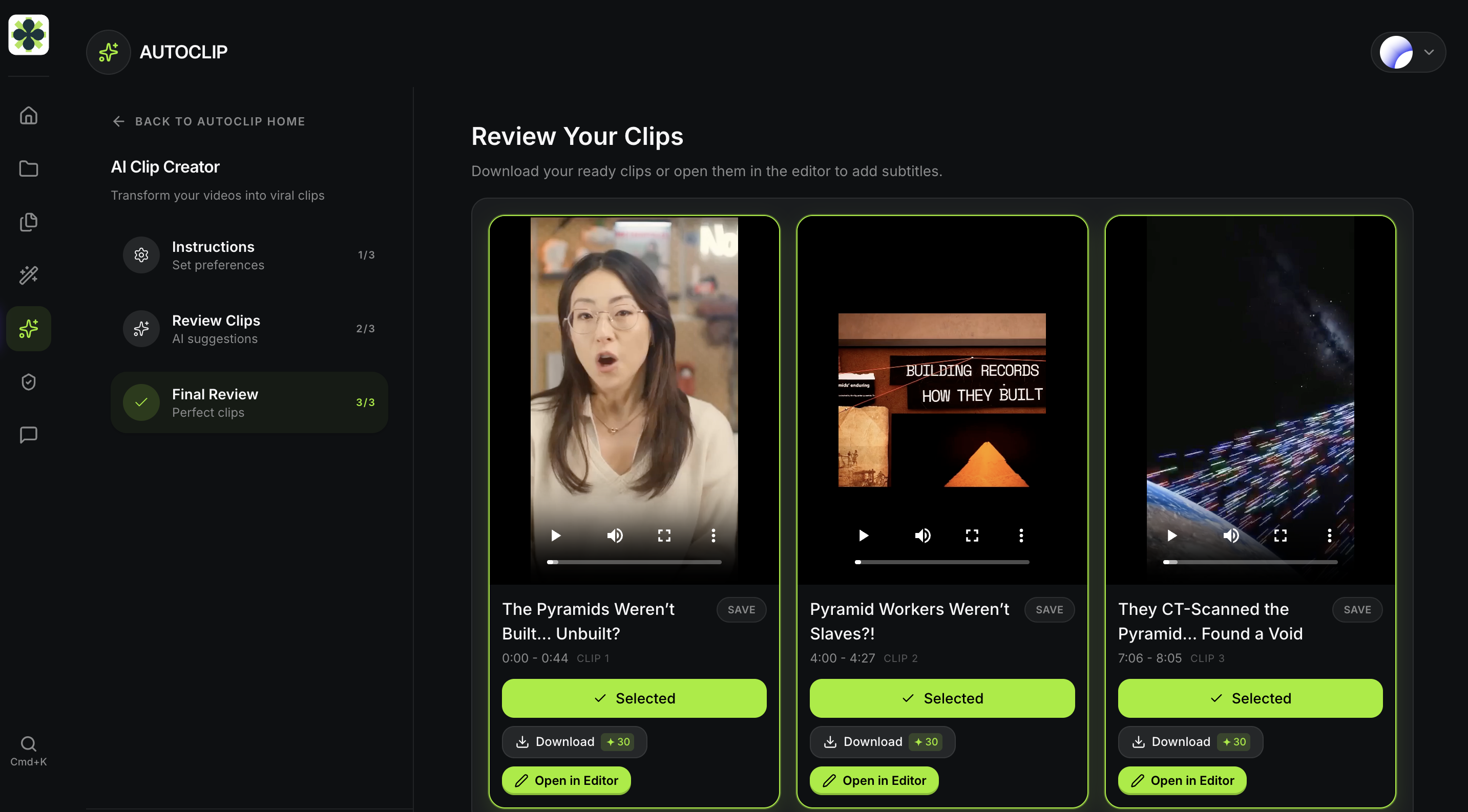
OpusClip specializes in finding moments and Submagic emphasizes making short posts look finished. Satura is the alternative when those moments must connect to browser editing, captions, voiceovers, thumbnails, metadata, CTR, retention, RPM, channel diagnostics, and what to make next.
Documentation consistency check
Verify language and duration in the account
Submagic's current official pages publish different caption-language totals, and its feature and pricing pages describe different duration ceilings. That does not invalidate the product, but it does make the live account, plan, source type, and export path the authoritative purchase test.
Language test
Confirm transcription, translation, templates, SRT export, names, accents, and correction time.
Limit test
Confirm upload length, Magic Clips access, monthly source count, output length, and export quality.
Official sources
Claims checked against first-party documentation
Models, prices, allowances, language counts, source limits, captions, exports, publishing, teams, and APIs change. These official pages were reviewed for this comparison; verify live checkout and account limits.
OpusClip vs Submagic FAQ
Common comparison questions
Which is better, OpusClip or Submagic?
OpusClip is usually the better first test when the main job is finding and reframing valuable moments inside long or visually varied footage. Submagic is usually the better first test when the team already has a chosen short and needs animated captions, B-roll, zoom, trimming, audio cleanup, effects, and brand polish. Include Submagic's separate Magic Clips add-on when comparing long-video workflows.
What is the main difference between OpusClip and Submagic?
OpusClip is repurposing-first: long source in, ranked short candidates out. Submagic is finishing-first: selected footage in, captioned and visually enhanced short out. Submagic also offers Magic Clips for long-video extraction, but the current pricing page lists it as a separate paid add-on. The best product depends on whether discovery or finishing consumes more human time.
Is OpusClip or Submagic better for podcasts?
OpusClip is the clearer first test when the podcast needs automatic moment discovery, multimodal prompts, reframing, scheduling, or external-editor handoff. Submagic is compelling when the podcast team already knows the moments or wants Magic Clips plus stronger emphasis on animated captions, B-roll, zoom, trimming, and audio polish. Run the same imperfect episode through both and score context-complete yield and correction time.
Is OpusClip or Submagic better for captions?
Submagic positions caption styling as a core workflow and documents animated templates, inline text edits, brand controls, translation, and subtitle downloads. OpusClip includes animated captions and plan-dependent styling and translation inside its clipping workflow. Do not choose from language counts alone because Submagic's current official pages publish different totals. Test the required languages, names, timing, line breaks, and correction time.
Does Submagic turn long videos into short clips?
Yes. Submagic's Magic Clips can generate short candidates from uploaded long video or a YouTube URL. The current pricing page lists Magic Clips as a separate add-on at $19 per member per month on monthly billing or $12 per member per month with annual billing. Verify the source-duration and monthly long-video limits shown in the live account before purchasing.
Is OpusClip or Submagic better for videos without much dialogue?
OpusClip is the clearer first test because ClipAnything explicitly documents visual, audio, action, scene, emotion, and other multimodal signals, including footage with little or no dialogue. Submagic's public workflow is more heavily centered on transcript-led captions, B-roll, trimming, and finishing. Representative sports, gameplay, music, product, and screen-heavy footage is still required to establish a winner.
Is OpusClip or Submagic cheaper?
Their published pricing units differ. OpusClip primarily meters imported source-video minutes through credits. Submagic meters video count, per-video duration, AI credits, API minutes, export quality, and members, while Magic Clips costs extra for long-video extraction. Compare fully loaded cost per approved post after rejected candidates, correction time, add-ons, seats, API use, and handoffs.
Does OpusClip or Submagic have an API?
Both document API access. OpusClip includes limited API access on Pro and broader custom access on Business. Submagic publishes an API for projects, captions, B-roll, music, effects, webhooks, and Magic Clips, while its pricing page lists plan-dependent API minutes. Confirm entitlement, rate limits, templates, input limits, and actual processing cost before building an integration.
Can I use OpusClip and Submagic together?
Yes. A defensible two-stage workflow uses OpusClip to discover and approve moments from long footage, then sends only approved shorts to Submagic for caption-led finishing. Measure duplicate transcription, re-upload time, export quality, handoff friction, and two-subscription cost. Keep both only if the extra approved output exceeds the added operating cost.
How is Satura different from OpusClip and Submagic?
Satura connects AutoClip and browser editing to the broader YouTube operating loop: captions, voiceovers, AI assets, thumbnails, titles, metadata, CTR, retention, TrustScore, RPM planning, and channel diagnostics. OpusClip specializes more deeply in long-video moment discovery, while Submagic specializes more heavily in short-form caption and visual finishing.
Related comparisons
Continue the short-form workflow comparison
OpusClip alternative
Compare OpusClip directly with Satura across clipping, editing, publishing, pricing, handoff, and YouTube workflow depth.
Read comparisonOpusClip vs Vizard
Compare multimodal discovery with a speech-led transcript, team workspace, social scheduling, and API workflow.
Read comparisonOpusClip vs Klap
Compare two long-video clippers across multimodal and speech-led discovery, prompts, captions, APIs, and approved yield.
Read comparisonOpusClip vs CapCut
Compare specialist long-video clipping with broad cross-platform editing, effects, templates, captions, and manual control.
Read comparisonSubmagic alternative
Compare Submagic directly with Satura across captions, Magic Clips, editing, YouTube packaging, analytics, pricing, and complete workflow fit.
Read comparison