OpusClip vs Klap
OpusClip vs Klap: which produces more approved clips?
Choose OpusClip when multimodal discovery, low-dialogue footage, or professional-editor handoff defines the job. Choose Klap when speech-led clips, speaker tracking, multilingual captions, or a public REST workflow matter most. Compare approved output, not generated clip count.
Fact-checked against official OpusClip and Klap product, pricing, help, and API pages on August 3, 2026.
OpusClip
Best for multimodal discovery
Start here when visual action, sound, emotion, speech, broad source imports, or Premiere Pro and DaVinci Resolve handoff should shape the clipping workflow.
Klap
Best for speech-led clip operations
Start here when transcript prompts, speaker tracking, multi-person layouts, broad caption languages, social scheduling, or a public usage-priced API define the job.
Satura
Best for the YouTube operating loop
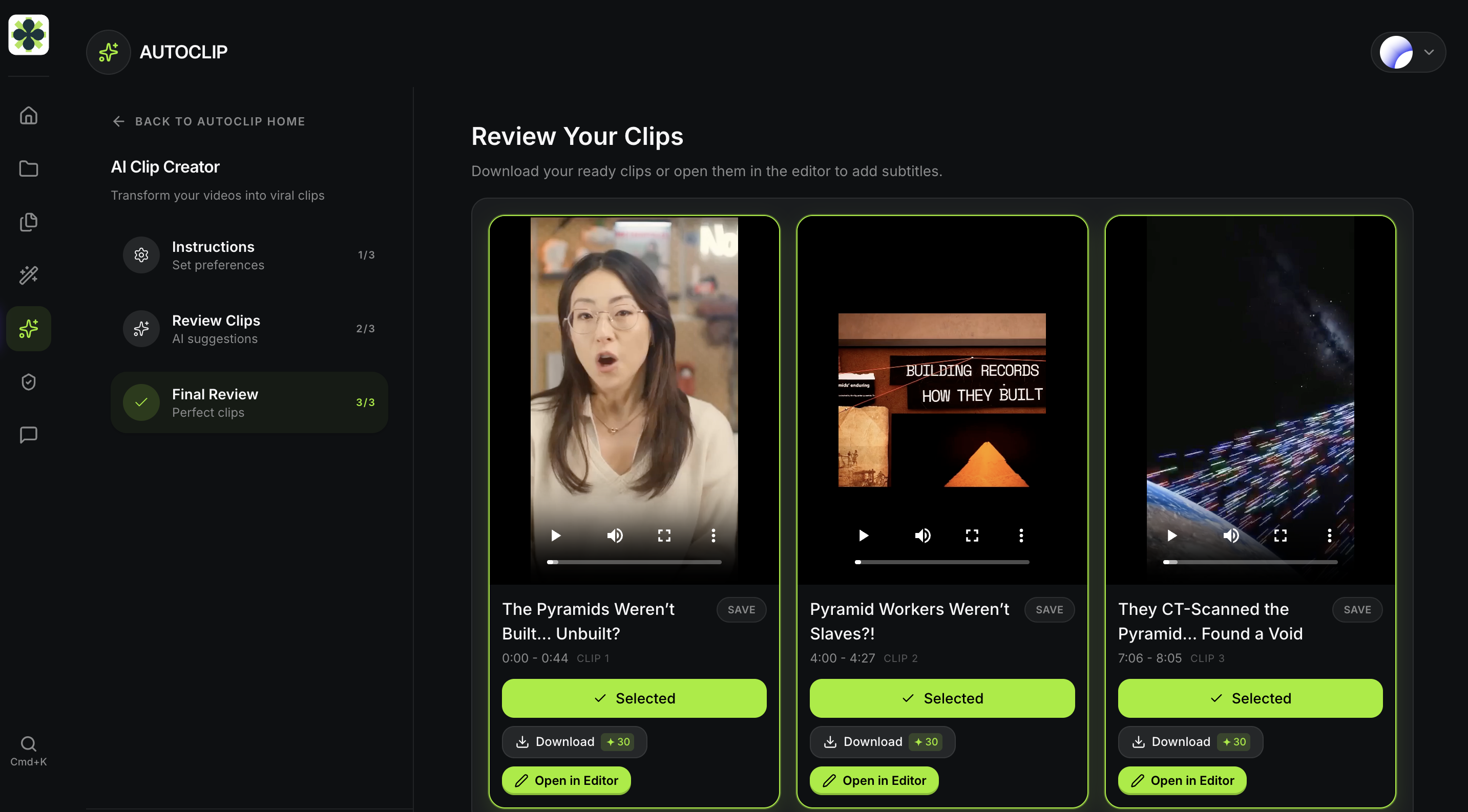
Start here when AutoClip must connect to browser editing, captions, thumbnails, metadata, CTR, retention, RPM, channel health, and the next upload decision.
Feature and workflow comparison
OpusClip vs Klap at a glance
Both products find, score, caption, reframe, edit, and distribute short clips from long video. The important differences appear in source understanding, repair work, pricing units, and the final handoff.
| Decision | OpusClip | Klap | Verdict |
|---|---|---|---|
| Primary workflow | A specialist repurposing system that finds moments in long video, scores candidates, reframes them, edits the result, and supports social or professional-editor handoff. | A focused long-video-to-shorts system that generates ranked clips, tracks speakers, adds captions, supports transcript edits, and publishes or schedules social output. | Both automate clipping. The useful distinction is the source footage each model understands best and the handoff the team needs after approval. |
| Moment discovery | ClipAnything documents visual, audio, sentiment, object, action, scene, sound, emotion, and text signals, with prompts for finding specific moments. | Klap documents hook, topic, pacing, speech, visual, and relevance signals, a 0-100 Virality Score, transcript editing, and custom prompts for requested moments. | OpusClip is the clearer first test for mixed or low-dialogue footage. Klap is a strong first test when spoken hooks and quotable moments dominate the source library. |
| Source footage | Official guidance covers podcasts, interviews, vlogs, sports, news, shows, music, tutorials, and videos with little or no dialogue. | Klap accepts uploads and multiple video URLs, supports long sources, and says its model works best for speaking formats such as podcasts, interviews, education, reviews, and training. | Use the actual queue in a trial. A talking-head demo cannot prove performance on sports, gameplay, music, screen recordings, or scene-heavy footage. |
| Editing and reframing | Paid editing includes text and timeline controls, trimming, reframing, layouts, captions, B-roll, audio, hooks, uploaded assets, and plan-dependent enhancement tools. | The browser editor supports transcript cuts, clip trimming, caption changes, layouts, speaker tracking, manual reframe adjustments, brand styling, and final publishing steps. | Measure correction minutes for bad boundaries, lost context, speaker switches, crops, captions, pacing, and brand work. Feature labels do not reveal repair cost. |
| Captions and languages | The current pricing page lists animated captions in 20+ languages, with highlighted words, emojis, speaker styling, custom fonts, censoring, and translation varying by plan. | Klap documents captions in 52 languages, animated keyword highlights, transcript corrections, speaker-aware layouts, translation tools, and brand styling. | Klap documents a broader language count. Still test names, jargon, accents, timing, line breaks, safe areas, and the time required to correct one approved clip. |
| Publishing and handoff | Eligible plans add direct posting, a scheduler, multiple social connections, bulk export, social copy, and XML export to Adobe Premiere Pro and DaVinci Resolve. | Klap documents direct publishing and scheduling to YouTube, TikTok, Instagram, and LinkedIn, with unlimited social accounts and analytics listed across paid plans. | Choose OpusClip first when NLE handoff is required. Compare both when the job ends at a recurring multi-network social calendar. |
| Teams and API | Pro and Business add workspace, seats, storage, social connections, shared credits, limited or custom API access, integrations, security, and tailored capacity. | Klap positions Pro+ for teams and publishes a REST API for generating shorts, captioning, reframing, projects, exports, managed users, and embedded editor workflows. | Klap publishes operation-level API pricing. OpusClip packages limited API access in Pro and broader custom access in Business, so model the integration before comparing sticker prices. |
| Pricing meter | Plans primarily meter imported source-video minutes through credits, with material differences in editing, storage, teams, integrations, exports, and scheduling. | The current paid plans primarily meter generated clips: 100, 300, or 1,000 per month at annual prices, while API work is charged per input, generation, and export operation. | Source-minute and generated-clip allowances are not directly comparable. Calculate cost per approved clip after rejected candidates, corrections, exports, seats, and distribution. |
| Best overall fit | Creators and teams that value multimodal discovery, broad source handling, repeat repurposing, editor depth, social distribution, and Premiere Pro or DaVinci Resolve handoff. | Creators, podcasters, agencies, and product teams that value speech-led clipping, speaker tracking, transcript prompts, broad caption languages, social scheduling, or a public API. | There is no universal winner. Select the product that creates more approved output from representative footage with less human correction and lower fully loaded cost. |
Decision paths
Choose around the source and final handoff
Choose OpusClip
Best starting point for multimodal sources and professional-editor handoff.
- The source queue includes sports, vlogs, gameplay, music, demonstrations, or low-dialogue footage where visuals and sound define the moment.
- ClipAnything prompts, broad source integrations, B-roll, speech cleanup, multiple ratios, and a specialist result queue matter.
- Premiere Pro or DaVinci Resolve is the normal finishing destination.
Choose Klap
Best starting point for speech-led clips and a direct REST workflow.
- Podcasts, interviews, education, reviews, webinars, and multi-speaker talking formats dominate the source library.
- Transcript prompts, speaker tracking, multi-person layouts, 52 documented caption languages, and clip-based allowances fit the operation.
- A public usage-priced API, managed users, or an embedded clipping workflow is a purchase criterion.
Run a bake-off
Best when selection quality is still an assumption.
- Process the same speech-led, mixed, and low-dialogue source videos with matching target lengths and prompts.
- Approve a fixed number of clips and log every boundary, context, crop, transcript, caption, and brand correction.
- Keep one product unless the second owns a distinct recurring source type or handoff that justifies another review queue.
Consider Satura
Best when clipping must improve the broader YouTube operation.
- Clip selection must connect to browser editing, captions, voiceovers, AI assets, thumbnails, titles, and metadata.
- CTR, retention, TrustScore, RPM, channel diagnostics, and the next upload decision matter after export.
- The bottleneck is running and improving a YouTube channel rather than maximizing clip throughput alone.
The three-source test
Test what each model must understand
A polished demo cannot reveal boundary errors, context loss, speaker mistakes, or failed visual moments. Use three sources that expose the important difference between the products.
Multi-speaker episode
Use a real podcast or interview with interruptions, speaker switches, jargon, filler, weak audio, and one known quotable exchange.
Visual or low-dialogue source
Use sports, gameplay, a product demonstration, a vlog, music, or screen-heavy footage where the important event is not fully described by speech.
Known-moment prompt
Write three target moments before processing. Compare whether automatic selection and custom prompts recover each moment with enough surrounding context.
Approved-output scorecard
Turn clip quality into four measurable checks
Generated clip count rewards overproduction. These measures score discovery, context, reframing, correction work, and unlike pricing units through the output that actually reaches approval.
Known-moment recall
Known target moments recovered / known target moments
Shows whether the system can find moments the reviewer already knows are valuable.
Context-complete yield
Candidates with a clean hook, body, and ending / candidates reviewed
Penalizes clips that look relevant but require surrounding footage to make sense.
Reframe intervention rate
Clips needing manual crop or layout repair / clips approved
Exposes speaker, object, gameplay, screen-share, and safe-area failures hidden by a demo reel.
Fully loaded clip cost
Subscription, API, review, correction, and export cost / approved clips
Makes unlike credit and generated-clip pricing units comparable through actual usable output.
Pricing context
Do not compare unlike allowances at face value
OpusClip centers source-video credits. Klap centers generated clips on paid web plans and operations in its API. Convert both into approved output and verify current checkout before buying.
| Product | Starting access | Published paid access | Cost check |
|---|---|---|---|
| OpusClip | $0/month; 60 monthly credits, watermark, no editing, and a three-day export window | Starter is $15/month; Pro is $29/month. | The current annual Pro equivalent is $14.50 per month. Compare source-minute credits, rollover, storage, editing, integrations, social connections, teams, XML handoff, and API access. |
| Klap | One source video free; the current tool page advertises no credit card and no watermark | Basic: $14/month billed yearly; 100 clips/month. Pro: $39/month billed yearly; 300 clips/month. Pro+: $94/month billed yearly; 1,000 clips/month. | The public prices shown are billed yearly. API pricing is separate: $0.44 per input, $0.32 per generated short, and $0.48 per export. Verify account limits and live checkout. |
| Satura | Free account with AutoClip, browser editing, and limited exports; no credit card is required to start. | Starter is $29/month, with an annual equivalent from $17/month. | Paid plans bundle AI credits, export minutes, connected YouTube channels, and the wider production, packaging, analytics, and growth toolset. |
Where OpusClip is strong
A multimodal specialist clipping pipeline
- Purpose-built long-video clipping with clip scoring and automatic reframing
- Direct scheduling and publishing to multiple social platforms on eligible plans
- Premiere Pro and DaVinci Resolve export on the Pro plan
- Team, API, and integration options for larger clipping operations
Check before buying: The free plan adds a watermark and limits how long projects remain exportable. Starter and Pro differ materially on scheduling, bulk export, team access, storage, and integrations. A clipping workflow may still need separate tools for idea research, full video generation, thumbnails, and channel diagnostics.
Where Klap is strong
A speech-led clipping and API workflow
- Focused long-video-to-shorts workflow with automatic moment selection, virality scoring, reframing, captions, and browser editing
- Custom clipping prompts, transcript editing, speaker tracking, multi-person layouts, and captions across 52 documented languages
- Direct publishing and scheduling to major social networks, with unlimited social accounts and analytics listed across paid plans
- Public REST API for short generation, captioning, reframing, exports, managed users, and embedded workflows
Check before buying: The current public plan prices are annual equivalents and use generated clips rather than source-video minutes as the main allowance. Klap says the model works best with speaking content, so low-dialogue, sports, music, and action-heavy footage need a representative trial. The pricing page and free tool pages describe paid plans and free access separately; verify current export, watermark, and source limits inside the account.
The YouTube third option
Connect approved clips to the next upload decision
OpusClip and Klap specialize in extracting and distributing short clips from existing video. Satura is the alternative when those moments must connect to browser editing, captions, voiceovers, thumbnails, metadata, CTR, retention, RPM, channel diagnostics, and what to make next.
Language and speaker check
Test the hard transcript, not the clean demo
Klap documents a wider caption-language count. OpusClip documents broader multimodal source understanding. Neither fact proves output quality on names, accents, crosstalk, jargon, music, mixed languages, or speakers moving between layouts.
Transcript test
Score proper nouns, jargon, accents, punctuation, timing, line breaks, and correction minutes.
Speaker test
Score active-speaker changes, split screens, picture-in-picture, screen shares, and manual fixes.
Official sources
Claims checked against first-party documentation
Models, prices, allowances, source limits, captions, exports, teams, publishing, and APIs change. These official pages were reviewed for this comparison; verify live checkout and account limits before buying.
OpusClip vs Klap FAQ
Common comparison questions
Which is better, OpusClip or Klap?
OpusClip is usually the better first test when multimodal discovery, low-dialogue footage, broad source handling, deeper plan-dependent finishing, or Premiere Pro and DaVinci Resolve handoff matter. Klap is usually the better first test for speech-led clips, speaker tracking, 52 documented caption languages, clip-based allowances, or a public usage-priced REST API. The reliable winner is the product that produces more approved clips with less correction on your footage.
What is the main difference between OpusClip and Klap?
Both automatically find, score, caption, reframe, edit, and publish short clips. OpusClip more explicitly documents multimodal discovery across visual, audio, sentiment, objects, actions, scenes, and low-dialogue video. Klap emphasizes speaking content, custom prompts, transcript editing, speaker tracking, multilingual captions, direct scheduling, and a public REST API. Their pricing meters also differ: source-video credits versus generated-clip allowances.
Is OpusClip or Klap better for podcasts?
Both are strong podcast-clipping candidates. Klap says its model works best with speaking content and documents multi-speaker layouts, transcript prompts, speaker tracking, and captions in 52 languages. OpusClip adds multimodal discovery, virality scoring, captions, reframing, filler removal, B-roll, scheduling, and professional-editor handoff. Test the same imperfect episode and compare context-complete yield after correction.
Is OpusClip or Klap better for videos without much dialogue?
OpusClip is the clearer first test because ClipAnything explicitly documents visual, audio, and sentiment understanding for footage with little or no dialogue. Klap says its model works best for video that includes speaking. That does not prove a winner for every genre, so use representative sports, gameplay, music, product, vlog, or screen-heavy footage before standardizing.
Does OpusClip or Klap have better captions?
Klap currently documents captions in 52 languages, while OpusClip's current pricing page lists animated captions in 20+ languages. Language count does not establish accuracy or styling quality. Compare names, jargon, accents, speaker changes, timing, line breaks, highlighted words, safe areas, fonts, and correction time on the same clips.
Does OpusClip or Klap have better AI prompts?
Both support prompt-guided clipping. OpusClip's ClipAnything prompts can target scenes, actions, characters, events, emotions, topics, and other multimodal signals. Klap documents custom prompts such as finding Q&A moments or product mentions inside a speech-led workflow. Test three known moments and score recall, context, and time to an approved clip.
Is OpusClip or Klap cheaper?
The published units are different. OpusClip primarily meters imported source-video minutes through credits. Klap's current paid plans list generated clips per month at annual prices, while its API charges separately for input, generation, and export operations. Compare fully loaded cost per approved clip after rejected candidates, correction time, seats, storage, exports, and distribution rather than comparing only entry prices.
Does OpusClip or Klap have an API?
Both document API access. OpusClip includes limited API access on Pro and broader API and custom integrations on Business, with separate qualification guidance for larger use. Klap publishes REST documentation for generating shorts, captioning, reframing, projects, exports, managed users, and embeds, plus operation-level public API pricing. Verify access and rate limits before committing an integration.
Can I use OpusClip and Klap together?
You can, but processing every source in both products usually duplicates compute, review, caption correction, and subscriptions. A two-product workflow is more defensible when OpusClip owns visual or low-dialogue footage and NLE handoff while Klap owns speech-led libraries or a specific API integration. Measure whether that split creates enough extra approved output to cover the additional operating cost.
How is Satura different from OpusClip and Klap?
Satura connects AutoClip to the wider YouTube operating loop: browser editing, captions, voiceovers, AI assets, thumbnails, titles, metadata, CTR, retention, TrustScore, RPM planning, and channel diagnostics. OpusClip and Klap are more specialized around turning existing long video into short clips and distributing those clips at scale.
Related comparisons
Continue the clipping workflow comparison
Klap alternative
Compare Klap directly with Satura across clipping, prompts, captions, scheduling, APIs, pricing, and complete YouTube workflow depth.
Read comparisonOpusClip alternative
Compare OpusClip directly with Satura across clipping, editing, publishing, pricing, handoff, and YouTube workflow depth.
Read comparisonOpusClip vs Vizard
Compare multimodal discovery with a speech-led transcript, team-workspace, social scheduling, and API workflow.
Read comparisonOpusClip vs Descript
Compare automated moment selection with transcript-led recording, audio cleanup, production, and detailed finishing.
Read comparisonOpusClip vs CapCut
Compare specialist long-video clipping with broad cross-platform editing, effects, templates, captions, and manual creative control.
Read comparisonOpusClip vs Submagic
Compare repurposing-first discovery with caption-led finishing, animated captions, B-roll, Magic Clips, and approved post cost.
Read comparison