OpusClip vs Descript
OpusClip vs Descript: automate selection or edit by transcript?
Choose OpusClip when the main job is finding moments across long or visually varied footage. Choose Descript when the transcript, spoken story, audio cleanup, and deeper production edit drive approval. Compare both on usable output and human correction time, not generated clip count.
Fact-checked against official OpusClip and Descript product, pricing, and help pages on August 2, 2026.
OpusClip
Best for automated moment discovery
Start here when large source libraries, multimodal understanding, prompt search, reframing, scheduling, or professional editor handoff define the repeated clipping job.
Descript
Best for transcript-led production
Start here when podcasts, interviews, tutorials, screen recordings, story cuts, audio cleanup, captions, and a deeper edit belong in one project.
Satura
Best for the YouTube operating loop
Start here when AutoClip must connect to browser editing, thumbnails, metadata, CTR, retention, RPM, channel health, and the next upload decision.
Selection versus production
OpusClip vs Descript at a glance
Both products can find, edit, caption, reframe, and export clips. The useful distinction is where automation stops and how much editorial work the normal source requires before approval.
| Decision | OpusClip | Descript | Verdict |
|---|---|---|---|
| Primary job | A specialist repurposing system that finds moments in long video, scores candidates, reframes them, and prepares clips for social distribution. | A broader audio and video production system where recording, transcription, text-based editing, timeline work, cleanup, and clip creation share one project. | Choose OpusClip when candidate discovery is the bottleneck. Choose Descript when editing the spoken master and finishing media are the larger job. |
| Clip discovery | ClipAnything analyzes visual, audio, sentiment, action, text, and scene signals; prompts can target a moment, character, event, emotion, or theme. | Create Clips and Underlord find promising moments from a recording, then keep the selected clips inside Descript's full editing environment. | OpusClip is the clearer first test for multimodal moment search. Descript is the clearer first test when discovery should flow directly into transcript editing. |
| Source footage | Official ClipAnything guidance covers talking heads, vlogs, sports, shows, news, music, and video with little or no dialogue. | Create Clips targets long-form video and podcasts, while the wider editor supports recorded or imported audio, video, screen recordings, and spoken media. | Use a visual or low-dialogue source in the trial. A talking-head demo alone will not reveal the products' most important difference. |
| Editing depth | The editor supports trimming, captions, reframing, layouts, B-roll, audio, text, branding, hooks, enhancement, and plan-dependent finishing features. | Transcript editing, scenes, media layers, a visual timeline, detailed audio and video controls, Underlord, stock, and AI media support longer production work. | OpusClip is optimized around finishing generated clips. Descript is stronger when the source episode and derivative clips need substantial editorial control. |
| Dialogue and audio | Paid capabilities include filler and silence removal, speech enhancement, bad-take cleanup, voiceover, dubbing, music, and sound tools with plan limits. | Studio Sound, filler and retake removal, speaker-aware transcripts, AI speech, voice cloning, regeneration, and podcast workflows are core product areas. | Descript is the stronger first test when spoken-audio repair and story edits define approval. Compare the same imperfect recording in both tools. |
| Captions and transcript | Automatic animated captions, language support, highlighted words, custom fonts, censoring, and transcript or text-based clip edits vary by plan. | The transcript is the editing interface, with speaker navigation, text corrections, styled captions, subtitle workflows, and translation features. | Choose one transcript and caption owner if the tools are combined. Correcting two independent versions adds avoidable review work. |
| Publishing and handoff | Eligible plans add social posting, scheduling, bulk export, multiple profiles, clip metadata, and Premiere Pro or DaVinci Resolve export. | Exports local files and share links, supports publishing integrations, and can generate social posts, show notes, and YouTube descriptions around a project. | OpusClip centers repeat social distribution and professional NLE handoff. Descript centers finishing and reusing one recorded-media project. |
| Teams, API, and scale | Pro and Business add team workspaces, shared credits, storage, social connections, APIs, integrations, security controls, and custom capacity. | Paid seats, shared drives, project access, comments, brand controls, AI-credit permissions, enterprise controls, and API or MCP access support teams. | Model editors, reviewers, source hours, credits, storage, integrations, and social accounts. The word team does not describe the same operating model. |
| Best fit | Creators and teams that repeatedly mine long video for social moments and value automated discovery, reframing, scoring, scheduling, or NLE handoff. | Podcasters, interviewers, educators, marketers, and teams that edit spoken media by transcript and need deeper audio and video production controls. | There is no universal winner. Decide whether selection or production consumes more human time in the workflow repeated every week. |
Decision paths
Choose around the most expensive human step
Choose OpusClip
Best starting point when finding moments is the main bottleneck.
- Long source videos need many social candidates with minimal initial review.
- Visual action, scenes, sound, emotion, or prompt-targeted moments matter beyond spoken keywords.
- Scheduling, bulk export, social connections, or Premiere Pro and DaVinci Resolve handoff shape the workflow.
Choose Descript
Best starting point when the transcript drives production.
- Podcasts, interviews, webinars, tutorials, and talking-head recordings dominate the workload.
- Story cuts, filler and retake removal, audio repair, captions, and detailed finishing happen in one project.
- The team needs to produce the long-form master as well as derivative clips.
Use both
Best when selection and finishing are genuinely separate jobs.
- Use OpusClip to surface hard-to-find or visually driven candidates from a large source library.
- Move only approved candidates into Descript when they need deeper spoken-story, audio, or visual correction.
- Measure whether the second tool reduces approval time after exports, captions, versions, and subscriptions are counted.
Consider Satura
Best when clipping must connect to YouTube decisions.
- Research, browser editing, clips, captions, voiceovers, thumbnails, and metadata should stay connected.
- CTR, retention, RPM, TrustScore, and channel diagnostics need to shape the next upload.
- The larger bottleneck is operating a YouTube channel, not only selecting or editing a clip.
Representative source test
Test footage that exposes the actual difference
A clean talking-head demo makes almost every clip tool look capable. Use three source conditions so the trial measures discovery, transcript production, and correction work instead of first-run polish.
Speech-led episode
Use a normal podcast, interview, webinar, or tutorial with multiple speakers, filler, retakes, and one known quotable moment.
Visual or mixed source
Use a vlog, sports sequence, product demo, event, or screen-heavy video where the best moment is not fully described by speech.
Known-moment search
Write three target moments before processing, then test whether prompts, transcript search, and automatic selection actually recover them.
Selection and finishing scorecard
Measure the route from source to approved clip
Generated clip count rewards overproduction. These four measurements reveal whether a tool finds the right moments and how much human work remains before the output can publish.
| Metric | Formula | Why it matters |
|---|---|---|
| Candidate recall | Known target moments found / known target moments | Shows whether the system can recover moments the reviewer already knows are valuable. |
| Selection precision | Approved candidates / generated candidates reviewed | Penalizes systems that create a large review queue without increasing usable output. |
| Edit-to-approval time | Correction and review minutes / approved clips | Captures transcript fixes, reframing, audio cleanup, captions, brand work, and review rounds. |
| Cost per approved clip | Tool, seat, credit, and labor cost / approved clips | Makes differently metered plans comparable against the deliverable the team can actually publish. |
Combined workflow
Use both only when the handoff removes work
OpusClip can operate upstream as a discovery system and Descript downstream as a production editor. The combination is defensible only when each tool has a clear owner and the handoff improves the scorecard.
Approve before handoff
Do not move every generated candidate into the finishing editor. Approve story value, context, hook, and source rights first.
Assign one transcript owner
Choose where dialogue corrections, speaker labels, captions, and timing are authoritative so reviewers do not fix the same text twice.
Export one finished master
Keep aspect ratio, audio loudness, caption safe areas, brand assets, filenames, and version status explicit at the final handoff.
Pricing context
Compare cost per approved clip
OpusClip meters processed source minutes through credits. Descript meters media hours, AI credits, and paid seats. Normalize both against the same monthly sources, approved output, and correction labor.
| Product | Free access | Paid access | Cost check |
|---|---|---|---|
| OpusClip | $0/month; 60 monthly credits, watermark, no editing, and a three-day export window are currently listed. | Starter is $15/month; Pro is $29/month or $14.50/month billed annually. | Credits track processed input minutes, while plans differ on sources, editor tools, storage, scheduling, teams, integrations, API access, and handoff. |
| Descript | Free includes 1 media hour and 100 AI credits per month, 720p watermark-free export, limited Underlord access, and a limited AI Speech trial. | Hobbyist is currently $16 per person per month billed annually or $24 monthly; Creator is $24 annually or $35 monthly. The plans raise media hours, AI credits, export resolution, and AI access. | Media hours, AI credits, top-ups, export resolution, stock access, and paid seats vary by plan. Verify the official checkout for the exact team and usage pattern. |
| Satura | Free account with browser editing and limited exports; no credit card is required to start. | Starter is $29/month, with an annual equivalent from $17/month. | Paid plans bundle AI credits, export minutes, connected YouTube channels, and the wider production and growth toolset. |
The YouTube third option
Connect clip review to the next upload decision
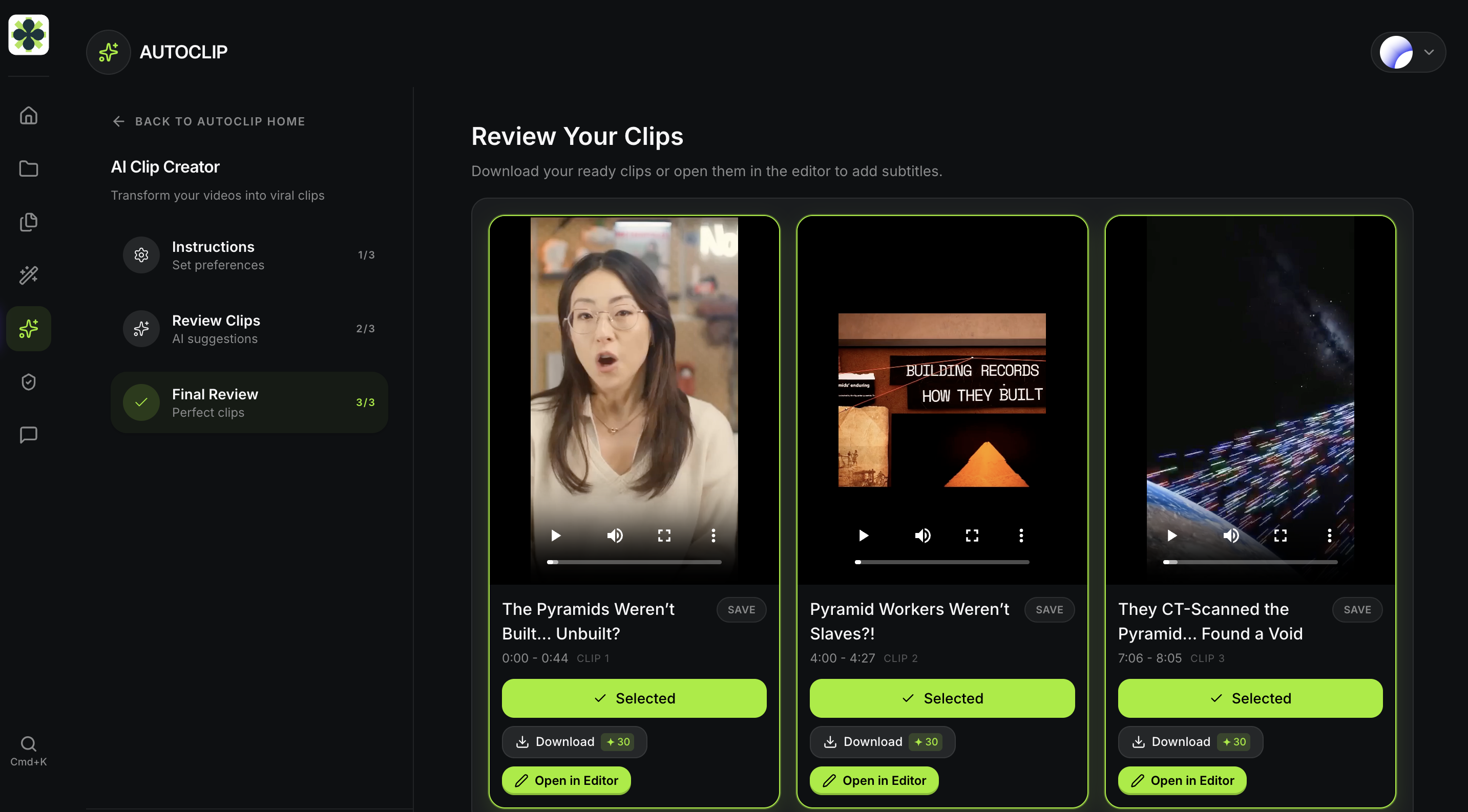
OpusClip specializes in discovery and Descript in transcript-led production. Satura is the alternative when selected moments must connect to browser editing, captions, voiceovers, thumbnails, metadata, CTR, retention, RPM, channel diagnostics, and what to make next.
Official sources
Claims checked against first-party documentation
Features, limits, and prices change. These official pages were used for the comparison; verify the current plan and checkout against the exact source volume, team, and export workflow.
OpusClip vs Descript FAQ
Questions creators ask before choosing
Which is better, OpusClip or Descript?
OpusClip is usually the better first test when automated moment discovery, visual or multimodal clipping, social scheduling, or professional editor handoff defines the job. Descript is usually the better first test when transcript editing, spoken-story production, audio cleanup, podcasts, and deeper finishing define it. Compare both on approved output and correction time rather than generated clip count.
What is the main difference between OpusClip and Descript?
OpusClip is a specialist long-video repurposing and clip-discovery platform. Descript is a broader transcript-first audio and video editor that also creates clips. The practical difference is whether the workflow begins with finding moments at scale or editing a recorded-media project in depth.
Is OpusClip or Descript better for making clips?
OpusClip has the clearer specialization in automated clip discovery, including visual, audio, sentiment, scene, action, and prompt signals. Descript is strong when clips should be found and then refined inside the same transcript-led production project. Test a speech-led source and a visual or low-dialogue source before choosing.
Is OpusClip or Descript better for podcasts?
Descript is usually the stronger first test for podcast production because recording, transcription, speaker navigation, Studio Sound, filler and retake removal, AI speech, and long-form editing are central workflows. OpusClip can be the better specialist when the finished episode already exists and the main job is finding and distributing social excerpts.
Can I use OpusClip and Descript together?
Yes. One defensible workflow is to use OpusClip to surface candidates, approve only the valuable moments, then use Descript for clips that need deeper transcript, story, audio, or visual correction. Assign one tool as the transcript and caption owner, and measure whether the handoff reduces total approval time.
Are OpusClip and Descript free?
Both currently offer free access with limits. OpusClip lists 60 monthly credits, a watermark, no editing, and a three-day export window on Free. Descript lists 1 media hour, 100 AI credits, 720p watermark-free export, limited Underlord access, and a limited AI Speech trial on Free. Verify current plan pages before buying.
How does OpusClip vs Descript pricing compare?
OpusClip currently lists Starter at $15 monthly and Pro at $29 monthly or $14.50 per month billed annually. Descript currently lists Hobbyist at $16 per person monthly on annual billing or $24 monthly, and Creator at $24 annually or $35 monthly. Their meters differ, so compare processed input minutes, media hours, AI credits, seats, storage, and correction labor.
Does OpusClip edit video like Descript?
OpusClip includes a capable editor for generated clips, with plan-dependent captions, reframing, trimming, layouts, B-roll, audio, text, branding, and cleanup. Descript provides a broader production editor built around transcripts, scenes, layers, a visual timeline, recording, detailed audio work, and long-form projects. The overlap is real, but the center of each workflow differs.
Is OpusClip or Descript better for YouTube?
OpusClip fits YouTube teams that mainly repurpose long uploads into Shorts and social clips. Descript fits YouTube videos built around podcasts, interviews, tutorials, screen recordings, and spoken-story editing. Satura is the third option when clips must connect to thumbnails, metadata, CTR, retention, RPM, TrustScore, and the next upload decision.
Related comparisons
Continue comparing the clipping workflow
OpusClip alternative
Compare specialist long-video clipping with Satura AutoClip and the wider YouTube production loop.
Read comparisonDescript alternative
Compare transcript-first production with Satura editing, packaging, analytics, and channel diagnostics.
Read comparisonOpusClip vs Vizard
Compare two specialist clippers across source understanding, transcripts, publishing, APIs, and usable yield.
Read comparisonOpusClip vs CapCut
Compare automated long-video clipping with broad visual editing across devices and social formats.
Read comparisonDescript vs CapCut
Compare transcript-first spoken-media editing with visual cross-platform editing and mobile workflows.
Read comparisonDescript vs VEED
Compare transcript-first editing with a broader browser video platform for teams and business content.
Read comparisonRun one representative test
Choose from approved output, not a demo
Compare candidate recall, selection precision, edit-to-approval time, cost per approved clip, publishing, packaging, performance diagnosis, and the next content decision.