What is the quick answer?
Wondering how can you refine your content distribution strategy? Stop guessing. Get a roadmap to audit, test, & master distribution for more views.
Key takeaways
- Introduction From Creator to Distributor
- Your No-BS Distribution Audit
- Track effort against outcomes
- Sort every channel by job
- Keep the audit brutally simple
- Pick Your Platforms and Win Your Battles
Overview
You spent days, maybe weeks, making a video you were proud of. The script was tight. The edit was clean. The thumbnail didn't look lazy. You hit publish and waited for the platform to do its thing.
Then nothing happened.
That's the moment most creators blame the algorithm, the niche, or their luck. Usually, the problem is simpler. You built content, but you didn't build distribution. A lot of creators still act like publishing is the finish line. It isn't. Publishing is the handoff.
The creators who keep growing treat distribution like part of the creative process, not a boring afterthought. They know one video can become a week of native content. They know each platform has a different job. They know weak posts shouldn't keep getting pushed just because they already exist. If you want to craft an effective social media strategy, you need a plan for where each idea lives, how it gets framed, and what signal it's supposed to generate.
That shift matters even more now because discovery isn't just search anymore. Feeds decide who sees your work. Recommendation systems test your packaging, your hook, your retention, and your shareability before they reward you. And if you're using tools to speed up production, this roundup of free AI tools for content creation is a practical place to sharpen the creation side while you tighten distribution.
Introduction From Creator to Distributor
Most creators are stuck in publish and pray mode. They pour everything into the asset and almost nothing into the release. That's backwards.
If you want a real answer to how can you refine your content distribution strategy, stop thinking like a person who makes videos and start thinking like a person who moves attention. Those are different jobs. The first job creates the thing. The second job gets it seen, clicked, watched, shared, and monetized.
A good distributor doesn't spam links. A good distributor matches format to platform, platform to audience behavior, and audience behavior to business outcome. On YouTube, that might mean optimizing for click and retention. On Shorts, it might mean opening harder and landing faster. On email, it might mean driving your warmest audience back to a core upload. On Instagram, it might mean using short, native edits to pull people into your world without asking for too much too early.
Practical rule: If a piece of content only works when people already know you, it needs a different distribution plan than content built for cold discovery.
This is also where a lot of creators waste effort. They post the same cut everywhere, write the same caption everywhere, then act surprised when every platform gives them mediocre results. Platforms aren't mirrors. They're different environments with different incentives.
The fix is straightforward. Audit what's working. Pick your priority channels. Repurpose with intent. Stop force-feeding underperformers. Test like a scientist, not like a gambler. That's how creators turn one good idea into sustained reach instead of one disappointing upload.
Your No-BS Distribution Audit
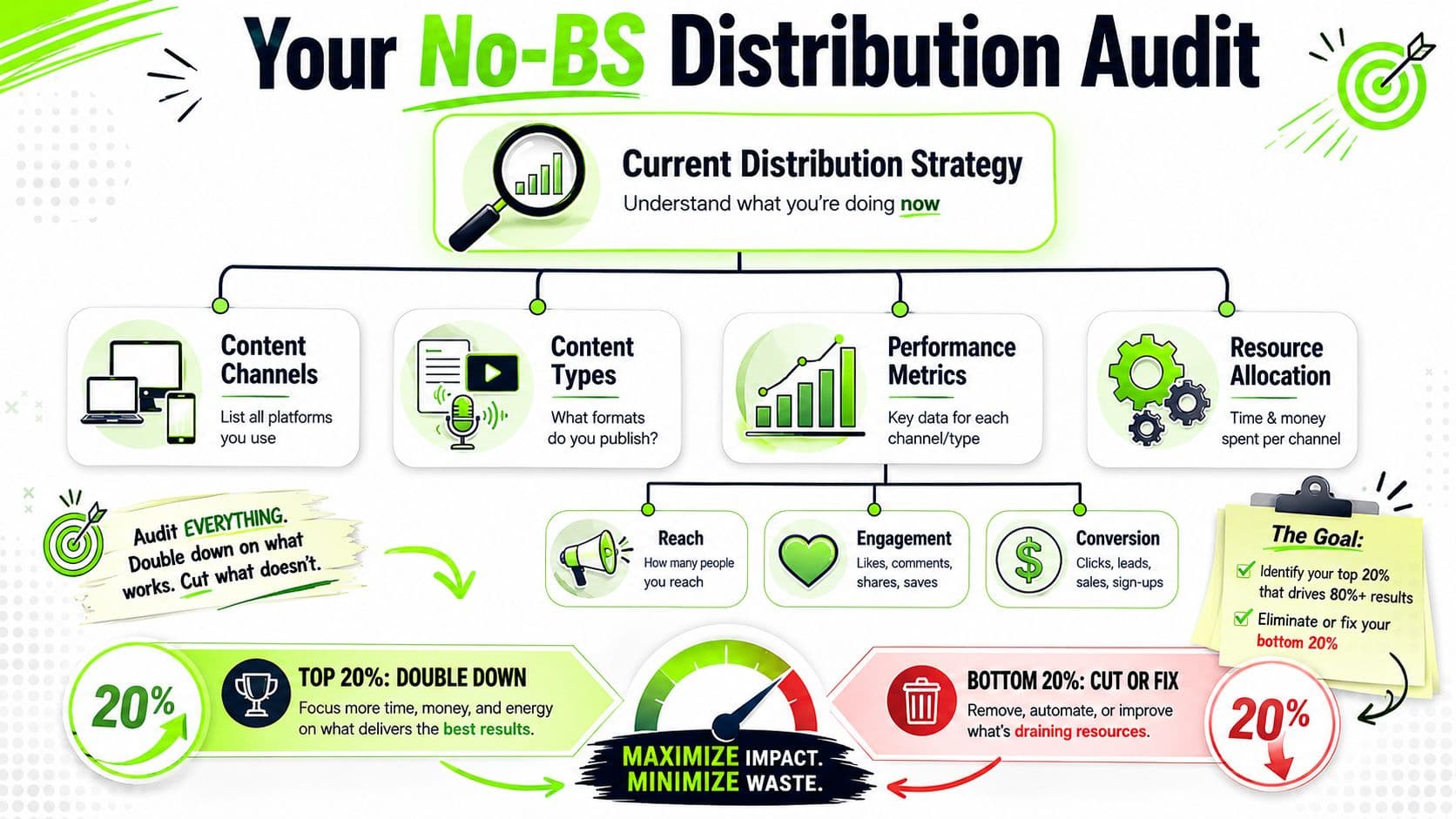
The fastest way to improve distribution is to get honest about where your time goes and what you get back. Most creators don't have a distribution problem. They have an allocation problem.
They spend hours cutting platform versions nobody watches, writing captions nobody reads, and posting into channels that don't move views, retention, or revenue. Then they neglect the one channel that has real impact.
Track effort against outcomes
Start with a plain list. No fancy dashboard. Just write down every place you distribute content right now.
Break it into four buckets:
Now put two things next to each one:
Meaningful return is not “it got some likes.” It's whether that channel contributes to views that hold, subscribers that stick, sessions that convert, or revenue paths you care about. If you need a sanity check on channel quality, tools that analyze creator credibility and performance signals can help. This guide on how to check YouTube channel trust score is useful when you want a cleaner read on whether a channel's output earns attention.
- Owned channels like your YouTube channel, newsletter, website, and community spaces
- Earned channels like shares, mentions, collaborations, and third-party coverage
- Paid pushes like small boosts or test campaigns
- Algorithmic feeds like YouTube Home, Shorts feed, Reels, and TikTok For You
- Time spent creating and posting for that channel
- Meaningful return from that channel
Sort every channel by job
A lot of creators blur channels together. That's a mistake. Guidance from Mimeo on content distribution strategy recommends defining primary and secondary KPIs by channel, tracking reach through impressions and traffic, tying results back to pipeline and revenue, and using owned, earned, and paid together rather than treating them as interchangeable.
That matters because channels do different jobs. Your email list is not your Shorts feed. A guest mention is not your website. A community post is not a homepage recommendation.
Use this quick filter:
| Channel | Main job | What to watch |
|---|---|---|
| YouTube long-form | Deep watch time and monetizable attention | Clicks, retention, conversions |
| Shorts or Reels | Cold discovery and idea testing | Swipe behavior, completion, shares |
| Reactivation and loyal audience distribution | Clicks, replies, return traffic | |
| Website or blog | Search intent and owned conversion path | Traffic quality, bounce, conversions |
If a channel has no clear job, it usually becomes a time sink.
Keep the audit brutally simple
You don't need twenty metrics. You need enough signal to make cuts.
Ask these questions:
Then do something uncomfortable. Mark your bottom performers. Not your least favorite. Your weakest performers.
That list is where your next gains come from. Not because you'll optimize everything on it, but because you'll stop wasting energy there.
- Which platform consistently sends quality attention?
- Which content format gets watched, not just shown?
- Which distribution task takes too long for too little return?
- Where are you posting out of habit instead of evidence?
Pick Your Platforms and Win Your Battles
“Be everywhere” is lazy advice. It sounds ambitious, but for most creators it just means diluted quality, slower learning, and worse content.
The better move is to pick a few battles you can win.
Stop treating every platform equally
A big shift happened in content distribution. General guides still focus on personas and channel selection, but they often miss the harder reality that discovery is moving toward recommendation systems on YouTube, Shorts, Reels, and TikTok, where the feed itself does the distributing, not the user searching for you. That gap is called out in Vaulted's take on refining content distribution.
That changes how you choose platforms.
Search-led channels reward intent. Feed-led channels reward packaging, hook strength, retention, and share behavior. If you make creator education content, for example, your long-form YouTube video might convert the deepest trust, while Shorts or Reels might be the top of funnel that proves your topic can stop the scroll.
That doesn't mean abandon everything else. It means every platform needs a role.
If you're a founder or solo operator juggling limited bandwidth, this breakdown of marketing channel management for startups is worth reading because the core principle applies to creators too. Fewer channels, managed well, usually beats scattered effort.
Use a three-tier platform map
Build your platform stack like this:
| Tier | Platform | My Goal | Core KPI |
|---|---|---|---|
| Primary | |||
| Secondary | |||
| Experimental |
Here's how I'd define the tiers.
Primary means your main growth engine. Your best ideas should land there first or your deepest attention compounds there. For many creators, that's YouTube long-form or one short-form feed.
Secondary means support. These channels extend the life of your best assets, warm your audience, or pull people toward the primary platform. Think newsletter, Instagram, or a niche community.
Experimental means you're allowed to test without overcommitting. New format, new platform, new angle. Useful, but not allowed to hijack your week.
Your primary platform should get your freshest thinking, not the leftovers after you've chopped it into five mediocre posts.
Also, platform fit is format fit. If you're distributing to Reels, runtime and pacing matter a lot more than creators think. This guide on how long an IG Reel should be is helpful when you're tuning distribution for short-form attention instead of just reposting vertical clips blindly.
Repurpose Like a Pro Not a Robot
Repurposing done badly looks like this: cut random snippets, dump them on every feed, recycle the same caption, hope one pops.
Repurposing done well feels native on every platform. Same idea. Different expression.
Start with one anchor asset
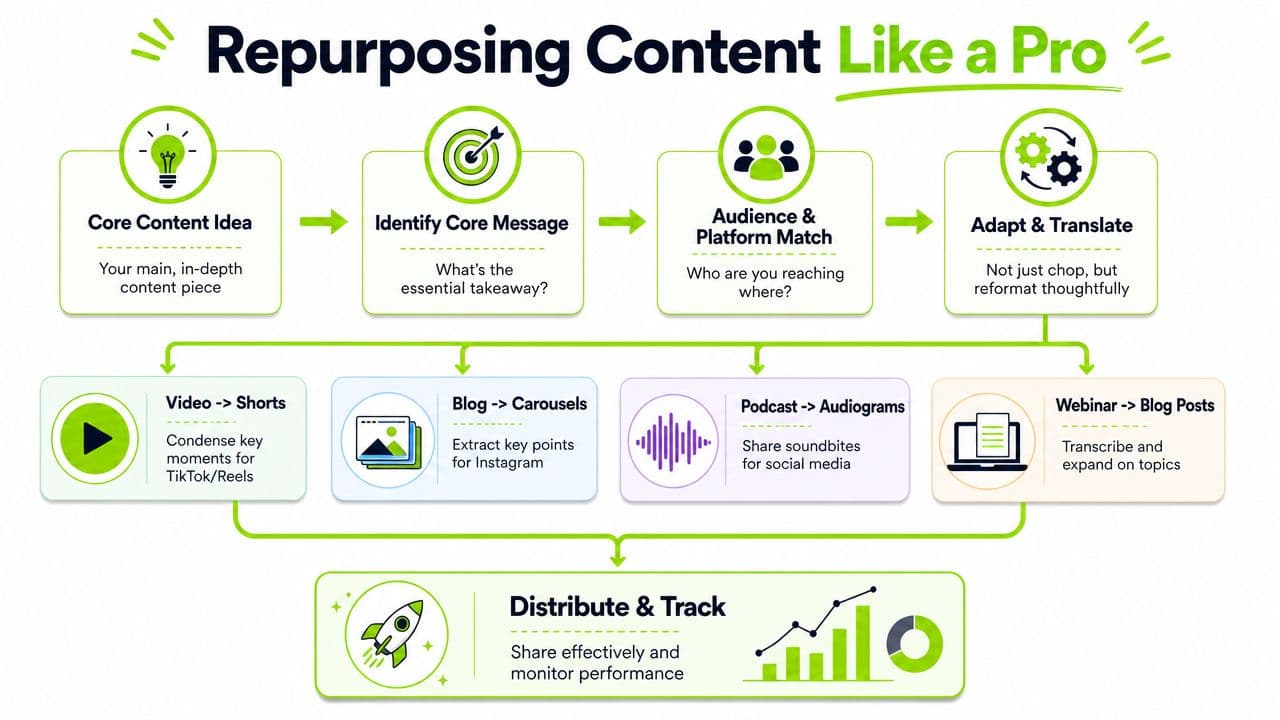
The cleanest workflow starts with a strong core piece. Mimeo's distribution guidance, referenced earlier, supports the idea of repurposing one anchor asset into multiple formats to extend its life while optimizing the message by channel.
Say your anchor asset is a ten-minute YouTube video about why most creators kill retention in the first thirty seconds.
From that single asset, you can create:
That's not duplication. That's translation.
- A YouTube Short built around the sharpest hook. Not the summary. The punchiest tension point.
- A TikTok that opens faster, cuts harder, and lands one clear lesson with zero intro fluff.
- An Instagram Reel using behind-the-scenes editing choices or a visual before-and-after from your intro sequence.
- An email that asks a provocative question and links back to the full video for the answer.
- A text post or thread turning the argument into a simple framework people can react to.
Translate the idea for each feed
Here's the mistake. Creators think repurposing means shrinking content.
No. It means reframing content.
A long-form YouTube viewer is willing to follow nuance. A TikTok viewer wants tension fast. An Instagram viewer often needs stronger visual rhythm. An email subscriber can handle a more direct ask because they already know you.
So for that same retention video:
YouTube Short version Open with: “Your intro isn't boring because it's too slow. It's boring because it answers the question too late.” Then show one fast example.
TikTok version Open with a harder claim: “Most creators don't have a content problem. They have an opening problem.” Keep it tighter and end before it feels complete enough to drag.
Instagram Reel version Use on-screen edits. Show timeline cuts. Let people see the first draft versus the final hook.
Newsletter version Write the contrarian angle. “The first few seconds don't need more energy. They need more clarity.” Then link to the deeper breakdown.
What are the common questions?
What is the short answer for How Can You Refine Your Content Distribution Strategy??
Wondering how can you refine your content distribution strategy? Stop guessing. Get a roadmap to audit, test, & master distribution for more views.
What should creators do first?
Timing test by posting proven concepts at different windows
Who is this guide for?
This guide is for YouTube creators, faceless channel operators, agencies, and teams using AI tools to improve video production and growth.
Action checklist
Apply this to your channel today.
- 1Timing test by posting proven concepts at different windows
- 2Pick your winners based on retention, engagement quality, and conversion path
- 3Identify one clear loser and write why it underperformed
- 4Extract one lesson about hook, format, pacing, or platform fit
- 5Apply that lesson to the next batch immediately
Sources & methodology
- Satura editorial guide based on the source video, topic cluster, and article sections.
- Source video reviewed for this article: https://www.outrank.so/