What is the quick answer?
Learn how to start content creation with a practical guide for 2026. This roadmap covers finding your niche, creating videos, and growing an audience.
Key takeaways
- Discovering Your Niche and Content Pillars
- Validate Your Ideas
- Define Your Content Pillars
- Building a Fast and Repeatable Video Workflow
- From Raw Footage to Polished Video
- Packaging and Repurposing Your Content for Growth
Overview
So, you want to be a content creator? Awesome. But you’ve probably got that nagging feeling of ‘where do I even begin?’ Trust me, every single creator has been there. The great news is you’re not just picking up a new hobby; you’re stepping into a booming industry, and getting your foot in the door is way simpler than you might think.
This guide isn’t about a long shopping list of fancy gear you don’t need. It’s about a critical mindset shift—from someone who consumes content to someone who creates it.

The opportunity right now is absolutely massive. The global digital content creation market was valued at $32.28 billion in 2026 and is on track to more than double, hitting a projected $69.80 billion by 2030. This isn't just a bunch of corporate jargon; this growth is being driven by solo creators just like you, using new tools to build entire media brands from their laptops.
The game plan is simple: pick something you’re genuinely into, figure out your unique angle, and just start making stuff with the phone that's already in your pocket. Your first video won't be a masterpiece. That’s not the point. The point is to get started.
Your first video is a permission slip, not a masterpiece. It's permission to learn, to experiment, and to find your voice in public. The goal isn't perfection; it's participation.
Think of this as your roadmap from a fuzzy idea to your very first published video. We're focusing on a solid plan, which is infinitely more valuable than an expensive camera. This is less about a daunting task and more about starting an exciting project.
As you start building, you'll want a home base online that you actually own. A simple website is crucial for this. For a great walkthrough on getting one set up, check out MeshBase's website setup guide.
Discovering Your Niche and Content Pillars
Okay, before you touch a camera or write a single script, you have to make one decision that determines pretty much everything that follows: what are you going to talk about? This is the step where most aspiring creators get it wrong. They pick a topic that’s too broad ("travel"), too boring ("the history of beige paint"), or has no real audience.
Finding your niche isn't just about "following your passion." Honestly, that's kind of bad advice. A real niche sits at the intersection of what you can talk about for years, what you actually know, and what people are desperately searching for. It needs to be authentic to you, but compelling to an audience that doesn't know you yet.
If you're starting from a blank slate, exploring the best content ideation tools can give you a clear view of what topics are actually getting traffic right now.
Validate Your Ideas
Never, ever guess. Once you have a handful of potential niches, you need to vet them like you're making an investment. Because you are—you're investing your time.
This is where a simple scorecard comes in handy. It forces you to be objective and score your ideas against the factors that actually matter.
Your Niche Scorecard
Use this scorecard to rate your potential niches. The one with the highest score is likely your best bet.
| Niche Idea | Passion Level (1-5) | Knowledge Level (1-5) | Audience Interest (1-5) | Monetization Potential (1-5) | Total Score |
|---|---|---|---|---|---|
Don't overthink the scores. Use your gut, do a few quick searches, and be honest with yourself. The idea with the highest score is your winner. It's the one with the best shot at long-term success.
Define Your Content Pillars
With a validated niche in hand, the next step is to break it down into 3-4 core content pillars. Think of these as the main categories or sub-topics you'll return to again and again. This isn't just about organizing your ideas; it's your best defense against burnout.
Your content pillars are the backbone of your strategy. They turn a broad topic into a repeatable system for creation, ensuring you never have to wonder, "What should I post today?"
Let's say your winning niche is "Budget-Friendly Home Cooking." That's a great start, but it's still pretty broad. Your content pillars create the structure.
They might be:
Suddenly, you have a clear roadmap. Every video idea will fit into one of these buckets. This keeps your channel focused, trains the algorithm on who your audience is, and tells viewers exactly what they can expect from you.
If you want to dig deeper and find what people are already searching for within those pillars, running a content gap analysis is the perfect next step. It will show you the exact questions your audience is asking that your competitors haven't answered yet.
- 30-Minute Meals
- Grocery Haul Savings
- Pantry Staple Recipes
Building a Fast and Repeatable Video Workflow
With your niche and pillars locked in, it's time to build the engine. This is where the real work happens, but it doesn't have to be a soul-crushing grind. The entire goal is to build a fast, repeatable system that gets you from a raw idea to a published video without the friction that makes most new creators burn out and quit.
The biggest mistake I see is people overcomplicating things right out of the gate. You don't need a Hollywood studio. You need speed and consistency. Seriously, the gear you already own—your smartphone—is more than capable of getting you started. Just find a spot with good natural light, make sure your audio is clear, and hit record.
From Raw Footage to Polished Video
Once you've got your footage, editing is the make-or-break moment. This is where you can either save hours or lose entire days. Traditional editing software has a notoriously steep learning curve, and it’s a huge hurdle for new creators. This is where an all-in-one AI platform can be an absolute game-changer.
Before you even hit record, though, your strategy has to be solid. Your niche, your audience, and your content pillars are the foundation for everything else you do.
This process—finding your passion, validating it with an audience, and defining your pillars—is what sustains a channel. It’s the strategy that informs your entire workflow. Instead of dumping a huge, unedited video file onto your computer and starting from a blank timeline, a modern workflow looks completely different.
You can take your raw clips and drop them into a browser-based editor. From there, you can:
The foundation for this efficient workflow is always your core content strategy. A clean system for editing only works if the ideas you're feeding into it are strong in the first place.
This approach completely removes the technical roadblocks, letting you focus on the creative side of telling a good story. To go even deeper, check out our guide on other powerful YouTube automation tools that can make your process even more efficient.
Focusing on a sharp video workflow makes sense, especially on YouTube. The platform is an absolute monster, commanding an estimated 211 million viewers in the US alone as of 2026. Starting here isn't just a creative choice; it's a strategic move to tap into a massive attention economy. You can see the latest online video creator trends on Statista.com.
- Find the best parts instantly. Use an AI tool to automatically identify the most engaging moments in your video, saving you from manually scrubbing through hours of footage.
- Add essential polish. Generate accurate subtitles with one click. This is non-negotiable, since a huge percentage of social video is watched without sound.
- Export and publish fast. Get a polished, ready-to-upload video in minutes, not hours.
Packaging and Repurposing Your Content for Growth
Hitting "publish" on that big video feels amazing, but it's only half the job. Now, you have to get people to actually see it. This is where packaging becomes your most powerful tool—it's what makes someone stop scrolling and click on your video instead of the ten others surrounding it.
This all comes down to the title and thumbnail. These two pieces work together to make a promise to the viewer. Your title needs to be compelling, something that sparks genuine curiosity without being cheap clickbait. Think about formulas that work, like "The One Mistake..." or "How I Finally..." They create an itch that can only be scratched by clicking.
Your thumbnail has to be a visual gut punch. Use bright, contrasting colors, a clear and expressive face, and as little text as possible. The goal is for someone to instantly get the core idea of your video while their thumb is still moving.
Maximize Your Reach with Smart Repurposing
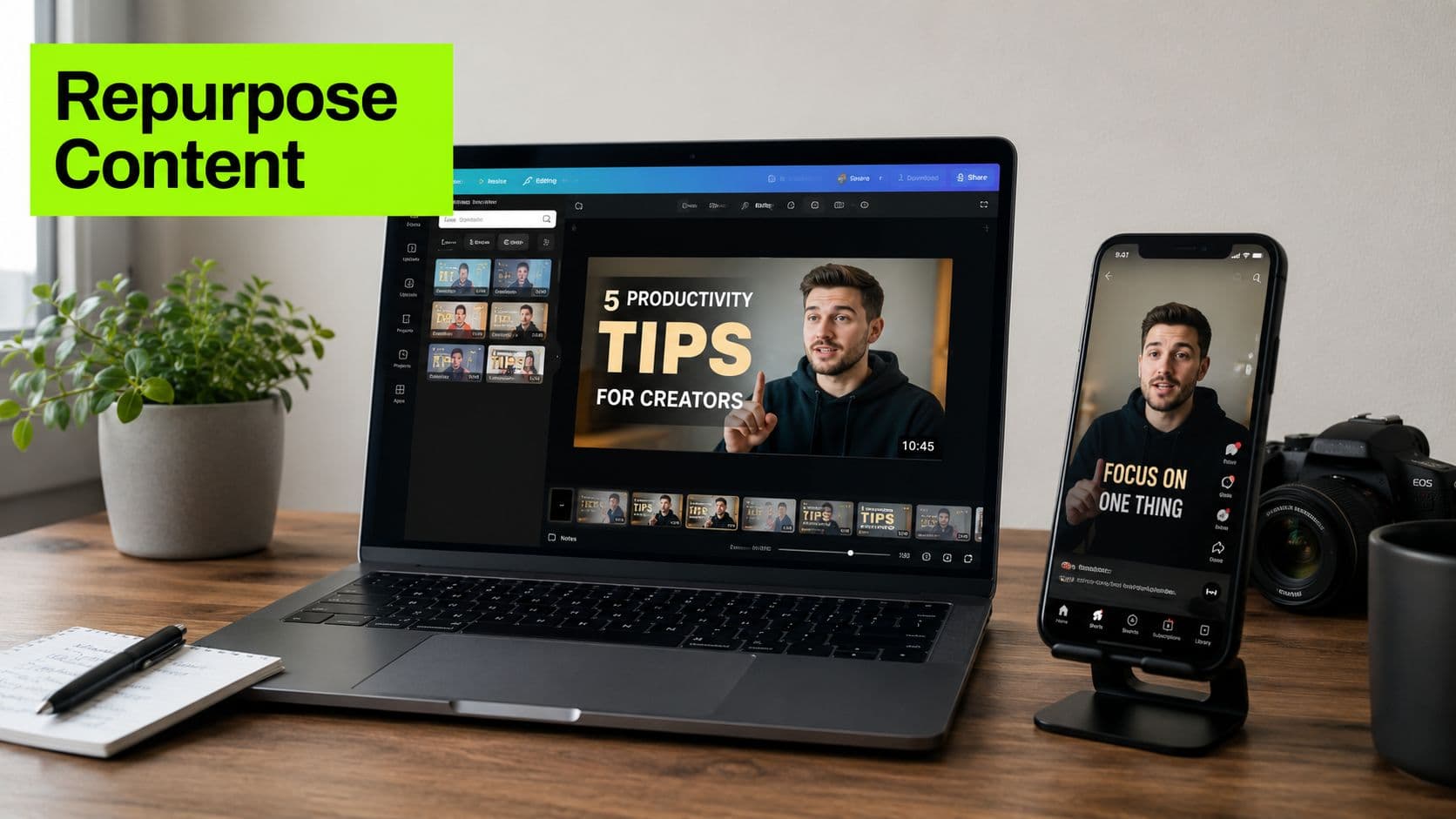
Once your main video is live on YouTube, it's time for the ultimate growth hack: repurposing. This is the secret to blowing up your reach without doubling or tripling your workload. The strategy is simple: create once, distribute everywhere.
Repurposing isn't about being lazy; it's about being efficient. You're taking the hard work you already did and giving it new life on platforms where different audiences can discover you.
Take that single long-form video and start slicing it into a dozen vertical clips for YouTube Shorts, TikTok, and Instagram Reels. You're not just making shorter versions of your video; you're pulling out the most valuable, shareable, or shocking moments.
Tools like the Satura AI clipper can automate a ton of this work, finding those viral-worthy moments for you. If you really want to maximize your reach and efficiency, diving into a full AI content repurposing workflow can turn one big video into a full week's worth of content. This systematic approach isn't just a tactic; it's a cornerstone of modern content creation.
- Find Highlight Moments: Scan your video for quick tips, surprising statistics, funny outtakes, or strong, debatable opinions. These are your golden nuggets.
- Reformat for Vertical: Make sure every clip is framed properly for a phone screen. This might mean adjusting the aspect ratio or zooming in. To get a better handle on this, it's worth learning about professional resolution scaling techniques.
- Add Context: Each clip needs to stand on its own. Use on-screen text and captions to give viewers the context they need without having seen the full video.
Using Data to Fuel Consistent Improvement
Let's get one thing straight: your first few videos are probably not going to go viral. That’s not just okay—it’s completely normal. The biggest mistake new creators make is waiting for perfection. They end up posting once a month, if ever, and then wonder why nothing is happening.
Success as a content creator is a marathon, not a sprint. Consistency is the single most critical factor for a new channel, far more than the quality of your very first video. The data is clear: creators who publish regularly have a much higher chance of success than those who drop a "perfect" video once in a blue moon.
Top creators focus on publishing more often, knowing their audience, and using basic SEO. They aren't waiting for a Hollywood-level production budget. A simple content calendar in a spreadsheet or even a notebook is all you need to stay on track. This rhythm is your most powerful tool for growth. You can see this same advice echoed across communities of real creators sharing their best practices.
Focus on Metrics That Matter
Once you're publishing consistently, you can start using data to get better. But "analytics" can feel like a four-letter word. The key is to ignore the noise and focus on the handful of metrics that tell you if people actually enjoy what you're making.
Instead of getting lost in dozens of data points, just start with these two:
Don’t get buried in spreadsheets. View your analytics as a direct conversation with your audience. They're telling you, "We loved this part," or "You lost us here."
Tools like Satura AI's Trustscore can even diagnose these weak points for you, translating raw numbers into plain-English advice. It might tell you your "hook strength" is low or your "share rate" needs a boost, helping you learn from every single video. This approach transforms data from something intimidating into your personal content creation coach. You can find out more about how this works in our guide to the modern video analytics platform.
- Audience Retention: This graph is your best friend and harshest critic. It shows you the exact moment people get bored and click away. A huge drop in the first 30 seconds means your hook isn't working. A dip in the middle might mean a section was confusing or just plain uninteresting.
- Click-Through Rate (CTR): This tells you if your title and thumbnail are good enough to make someone choose your video from a sea of others. A low CTR (under 2-3%) is a clear signal that your packaging needs work.
Frequently Asked Questions for New Creators
Alright, let's get straight to the questions every new creator asks. Getting these sorted out from day one means you can skip the common mistakes and build momentum way faster.
What are the common questions?
Do I Need Expensive Gear to Get Started?
Nope. Absolutely not. The phone in your pocket is more than enough to create incredible content. Some of the biggest creators today started with nothing else.
How Do I Find Endless Video Ideas?
The fear of running out of ideas is real, but it’s a problem you solve with a system, not a moment of inspiration. Don't just stare at a blank page and ask, "What video should I make?"
How Long Until I Start Making Money?
This is the big one, and you need to have realistic expectations. Monetization follows audience growth—it almost never happens on day one. Your first job is to provide real value and build a community that trusts you.
Is It Too Late to Start Content Creation?
Absolutely not. The creator economy is bigger than ever, but the tools we have in 2026 are also more powerful and easier to use than ever before. AI-powered platforms and streamlined workflows let a single person produce content that would have required a small team just a few years ago.
What is the short answer for How to Start Content Creation in 2026 for Beginners?
Learn how to start content creation with a practical guide for 2026. This roadmap covers finding your niche, creating videos, and growing an audience.
What should creators do first?
Audience Retention: This graph is your best friend and harshest critic. It shows you the exact moment people get bored and click away. A huge drop in the first 30 seconds means your hook isn't working. A dip in the middle might mean a section was confusing or just plain uninteresting.
Action checklist
Apply this to your channel today.
- 1Audience Retention: This graph is your best friend and harshest critic. It shows you the exact moment people get bored and click away. A huge drop in the first 30 seconds means your hook isn't working. A dip in the middle might mean a section was confusing or just plain uninteresting.
- 2Click-Through Rate (CTR): This tells you if your title and thumbnail are good enough to make someone choose your video from a sea of others. A low CTR (under 2-3%) is a clear signal that your packaging needs work.
- 3Dive into Reddit or Quora threads in your niche. Find the questions people ask over and over again.
- 4Use free tools to see what your target audience is searching for online.
- 5Pull inspiration from proven formats using a tool like Satura AI's Creative Library.