Captions vs Submagic
Captions vs Submagic for AI short-form editing
Choose Captions when personal AI presenters, style-led edits, dubbing, and Lipdub drive the workflow. Choose Submagic when animated caption polish, transcript trimming, publishing, and API delivery drive it. Both now cover AI actors, eye contact, B-roll, captions, and automated editing.
Fact-checked against official Captions and Submagic product, pricing, feature, help, and API pages on August 3, 2026.
Captions
Best for personal presenters and localization
Start here when AI Twin, generated actors, AI Edit, chat changes, dubbing, Lipdub, and recurring presenter-led versions define the job.
Submagic
Best for caption-led finishing and delivery
Start here when animated captions, transcript cuts, B-roll, audio polish, brand templates, publishing, and API automation matter most.
Satura
Best for the YouTube operating loop
Start here when editing must connect to research, clips, subtitles, thumbnails, metadata, CTR, retention, RPM, TrustScore, and channel health.
Feature and workflow comparison
Captions vs Submagic at a glance
The overlap is real: both now document actors, eye contact, captions, B-roll, AI edits, cleanup, and long-to-short workflows. The useful differences are the starting model, localization depth, delivery controls, and pricing units.
| Decision | Captions | Submagic | Verdict |
|---|---|---|---|
| Best first use | Create or transform presenter-led video with AI Edit, personal AI Twin, generated actors, eye-contact correction, dubbing, Lipdub, and generated media. | Finish short-form footage with animated captions, transcript-led trimming, B-roll, zoom, audio cleanup, effects, hook titles, descriptions, and publishing. | Choose Captions when the presenter and localized performance drive the workflow. Choose Submagic when caption-led finishing and repeatable delivery drive it. |
| Editing approach | AI Edit styles and chat prompts can apply cuts, captions, B-roll, images, zooms, transitions, music, and sound effects before manual fine-tuning. | AI Auto Edit starts from uploaded footage, while transcript and timeline controls support trimming, caption changes, B-roll, zoom, audio, images, GIFs, and effects. | Captions is style- and prompt-led. Submagic is caption- and transcript-led. Test the same imperfect source to compare correction time. |
| Animated captions | The public pricing page lists captions in 100+ languages, one Free template, 100+ Max and Scale templates, customization, keyframes, and transcript download. | Animated word-level styles, emojis, GIFs, colors, fonts, custom templates, transcript edits, subtitle downloads, and smart-dictionary controls are central to the product. | Submagic makes caption polish the core editing surface. Captions embeds captions inside a broader presenter-generation and AI Edit workflow. |
| AI presenters | AI Twin can generate a personal digital presenter from a recording, existing footage, or selfie, alongside custom AI actors and generated footage. | AI Actors Studio turns a script into a presenter clip using 120+ selectable avatars and voices, then hands the result into the short-form editor. | Test Captions first when reproducing your own likeness is required. Test Submagic first when a selectable actor library and caption-led finishing fit the job. |
| Eye contact and cleanup | Eye-contact correction sits alongside camera and teleprompter capture, denoise, silence trimming, background changes, B-roll, music, and style-led edits. | One-click gaze correction works in post-production, alongside silence and bad-take removal, clean audio, zoom, B-roll, captions, music, and effects. | Both document gaze correction and talking-head cleanup. Compare naturalness, face movement, audio repair, and manual fixes on the same take. |
| Translation and localization | Translated subtitles, dubbing, AI voice translation, and Lipdub support localized versions in a presenter-led workflow. | The translator workflow creates translated, styled subtitles and explicitly retains the original audio; official pages publish different language totals. | Captions is the clearer first test for translated voice and lip synchronization. Submagic fits translated on-screen captions over the original audio. |
| Long video to Shorts | AI Shorts can turn an uploaded long video or YouTube URL into clips on eligible plans and devices, separate from short-footage AI Edit. | Magic Clips can generate short candidates from long uploads or YouTube URLs, but current pricing lists it as a separate per-member add-on. | Both can repurpose long video. Include Submagic's add-on and Captions' plan and device eligibility when pricing approved clip yield. |
| Teams, publishing, and API | Scale and enterprise tiers provide higher credit pools, team-oriented controls, custom seats, support, onboarding, and data-training exclusions. | Eligible plans add brand kits, custom templates, direct social publishing, API minutes, integrations, webhooks, and documented editing and Magic Clips endpoints. | Submagic is the clearer first test for programmatic editing and direct publishing. Captions emphasizes scaled generative production and enterprise support. |
| Pricing and usage limits | The official iOS list runs from Free through Max and Scale credit tiers, while the credit guide also documents Pro and account-specific Free credits. | Free and paid tiers meter videos, duration, AI credits, export quality, API minutes, seats, and templates; Magic Clips is priced separately. | Captions is primarily credit-metered and platform-variable. Submagic exposes video and duration limits plus add-ons. Model the actual monthly workload. |
Decision paths
Choose around the job repeated every week
Choose Captions
Best starting point for AI presenter and localization workflows.
- A personal AI Twin, generated actors, prompt-led changes, or style-led AI Edit is central to production.
- Dubbing, translated voice, Lipdub, and recurring presenter-led versions matter more than caption specialization.
- Camera, teleprompter, eye-contact correction, generated media, and final short-form editing should stay connected.
Choose Submagic
Best starting point for caption-led finishing and delivery.
- Animated captions, transcript trimming, B-roll, zoom, audio cleanup, effects, hooks, and descriptions define the repeatable job.
- The team needs brand templates, smart dictionaries, direct publishing, or a documented editing API.
- Selectable stock presenters are sufficient and specialist short-form polish matters more than a personal digital twin.
Use both
Best when presenter generation and final caption polish are separate jobs.
- Create a personal Twin, dubbed version, or generated presenter sequence in Captions, then finish caption styling and delivery in Submagic.
- Choose one product to own the final transcript, timing, translation, and subtitle export.
- Keep the handoff only when it saves more correction time than exports, uploads, versions, and two subscriptions add.
Consider Satura
Best when the actual job is operating a YouTube channel.
- Research, AI assets, editing, clips, subtitles, thumbnails, metadata, and upload planning should connect.
- CTR, retention, TrustScore, RPM, and channel diagnostics need to shape the next video.
- A YouTube production and learning loop matters more than presenter specialization or caption-led finishing alone.
Two-editor workflow
Can Captions and Submagic work together?
Yes. Use both only when the handoff between presenter generation or localization and final caption-led delivery lowers total correction time enough to justify two products.
Create the presenter master
Use Captions when the source needs a personal Twin, generated actor, dubbing, Lipdub, or prompt-led visual changes, then approve the performance before export.
Choose one subtitle owner
Decide where wording, timing, translation, line breaks, and style become final. Avoid correcting two independent caption tracks after every edit.
Finish and distribute
Use Submagic when the approved master needs specialist caption treatment, transcript cuts, B-roll, audio polish, brand templates, publishing, or API delivery.
Pricing context
Compare credits with videos, duration, and add-ons
Captions prices generative usage through platform-dependent credit tiers. Submagic meters videos, duration, credits, exports, API minutes, and seats, with Magic Clips separate. Verify checkout before buying.
| Product | Free access | Paid access | Cost check |
|---|---|---|---|
| Captions | $0. The credit guide says some Free accounts may receive 60 to 200 one-time, non-refreshing credits. | Pro is $9.99/month with 200 credits in the official credit guide; Max is $24.99/month with 500 credits; Scale starts at $69.99/month with 1,400 credits. | The public pricing table reflects iOS. Billing, payment method, platform, country, currency, and live account eligibility can change price and features. |
| Submagic | $0/month; 3 videos, 200 MB and 1:30 maximum per video, with a watermark | Starter is $19/member/month; Pro is $39/member/month; Business + API is $69/member/month. | Annual equivalents are $12, $23, and $41 per member per month. Magic Clips is +$19/member/month monthly or +$12/member/month billed yearly. |
| Satura | Free account with browser editing and limited exports; no credit card is required to start. | Starter is $29/month, with an annual equivalent from $17/month. | Paid plans bundle AI credits, export minutes, connected YouTube channels, and the wider production and growth toolset. |
The YouTube third option
Connect the edit to the next content decision
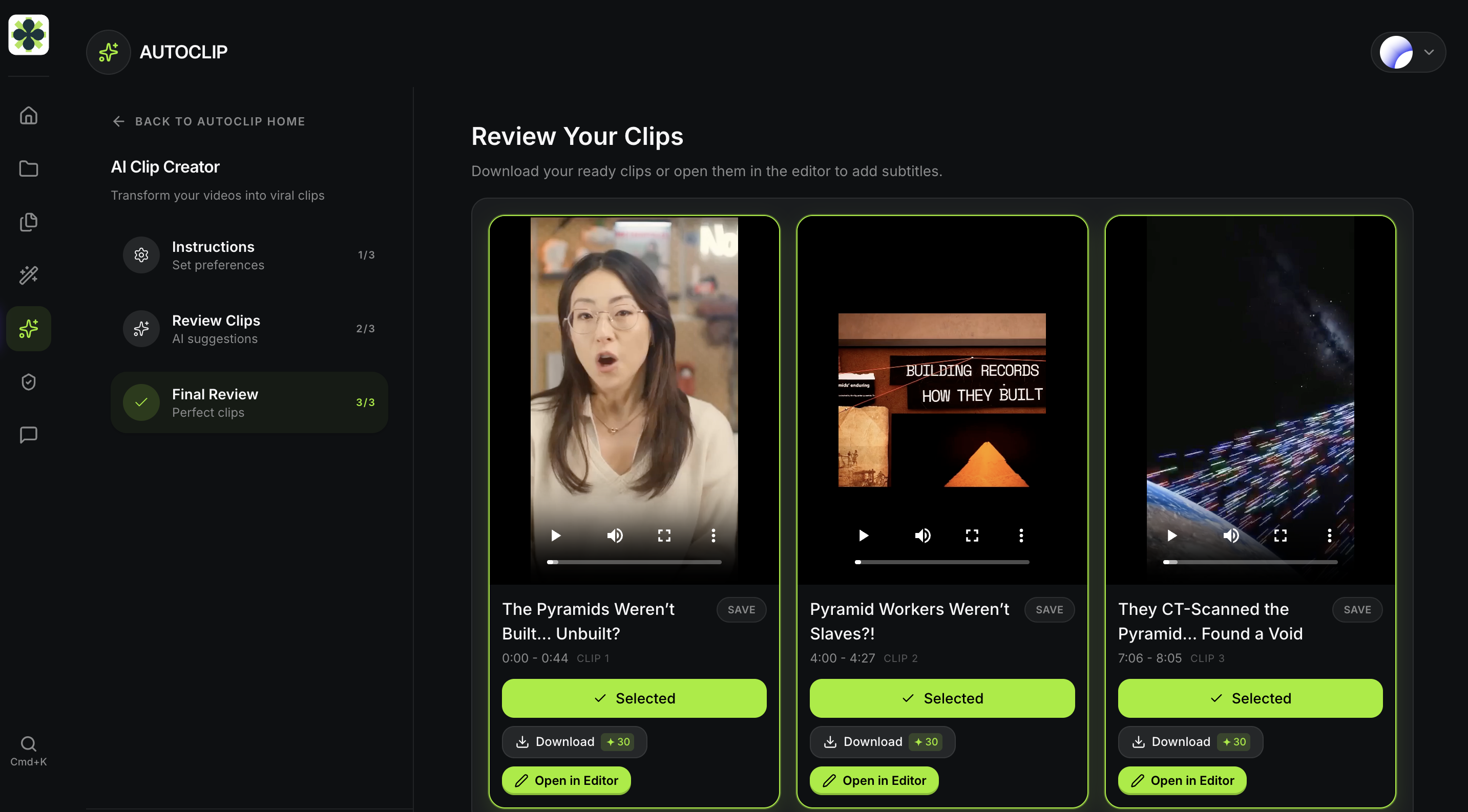
Captions and Submagic are capable short-form editors with substantial overlap. Satura is the alternative when the team needs one YouTube workflow for creation, clipping, packaging, publishing decisions, and performance diagnosis. It is not a replacement for Captions AI Twin and Lipdub or the Submagic editing API.
Fair product test
Test finished output, not the overlapping feature list
Test one raw talking-head take
Compare silence and bad-take removal, gaze repair, audio cleanup, captions, B-roll, zooms, styling, and minutes to an approved export.
Test one presenter script
Create the same actor-led clip and compare script handling, voice, lip-sync, expressions, visual fit, editability, credits, and rendering time.
Test one localized version
Use the same language pair and score subtitle accuracy, voice translation, lip movement, names, timing, styling, and manual correction.
Price the monthly workflow
Include credits, videos, duration, Magic Clips, exports, seats, API minutes, templates, publishing, corrections, and any second editor.
Official sources
Verify both products before choosing
Captions vs Submagic FAQ
Questions creators ask before choosing
Which is better, Captions or Submagic?
Captions is usually the better first test for personal AI Twin videos, generated presenters, style-led AI editing, dubbing, Lipdub, and presenter localization. Submagic is usually the better first test for animated caption polish, transcript trimming, short-form finishing, direct publishing, and editing APIs. Both now document AI actors, eye-contact correction, B-roll, captions, and automated editing, so there is no universal winner.
Is Captions or Submagic better for animated captions?
Submagic makes animated word-level captions, emojis, GIFs, custom styles, transcript edits, and brand controls a central editing workflow. Captions lists 100+ caption templates on Max and Scale and connects captions to AI Edit, presenters, and localization. Test the required language, names, timing, line breaks, brand style, and correction minutes rather than choosing from template count alone.
Does Captions or Submagic have better AI avatars?
Captions documents AI Twin for creating a personal digital presenter from a recording, existing footage, or selfie, plus custom generated actors. Submagic documents AI Actors Studio with 120+ selectable avatars and voices generated from a script. Choose around personal likeness, actor variety, voice quality, lip-sync, credits, and how much finishing the generated clip needs.
Does Captions or Submagic correct eye contact?
Both document AI eye-contact correction for talking-head footage. Captions connects it to camera, teleprompter, AI Edit, denoise, backgrounds, and generated media. Submagic connects it to caption-led editing, trimming, B-roll, zoom, audio cleanup, music, and effects. Test the same face movement and script-reading take in both products.
Is Captions or Submagic better for translation and dubbing?
Captions is the clearer first test when the deliverable requires translated voice, dubbing, or Lipdub in addition to subtitles. Submagic's official translator page describes translated and styled subtitles while retaining the original audio. Submagic's current pages publish different language totals, so verify the required language in the live account.
Can Captions and Submagic turn long videos into Shorts?
Yes. Captions offers AI Shorts for uploaded long video or YouTube URLs on eligible plans and devices. Submagic offers Magic Clips for long uploads and YouTube URLs, but its current pricing page lists Magic Clips as a separate add-on. Compare approved clip yield, context, reframing, caption correction, and total cost on the same source.
Are Captions and Submagic free?
Both provide limited free access. Captions lists a Free plan and its credit guide says some accounts may receive 60 to 200 one-time credits that do not refresh. Submagic lists three watermarked videos per month with 200 MB and 1 minute 30 second limits per video. Verify current export and feature access in each live account.
How does Captions vs Submagic pricing compare?
Captions publishes iOS Max and Scale credit tiers and documents Pro in its credit guide, while warning that platform, billing, country, currency, and payment method can change price. Submagic meters videos, duration, credits, export quality, API minutes, and seats from Starter through Business, with Magic Clips priced separately. Model the normal monthly output rather than comparing entry prices alone.
Can I use Captions and Submagic together, or should I use Satura?
You can create a personal Twin, generated presenter, or dubbed master in Captions and finish caption styling, transcript cuts, publishing, or API delivery in Submagic. Keep one subtitle owner and measure the handoff cost. Consider Satura instead when the larger requirement is a connected YouTube workflow spanning research, AI assets, editing, Shorts, thumbnails, metadata, CTR, retention, RPM, TrustScore, and channel diagnostics.
Related comparisons
Continue comparing the short-form workflow
Captions AI alternative
Compare Captions directly with Satura across talking-head automation, AI Twin, localization, credits, packaging, and analytics.
Read comparisonSubmagic vs CapCut
Compare caption-led automation with broad visual editing across captions, B-roll, clips, devices, publishing, APIs, and pricing.
Read comparisonSubmagic alternative
Compare Submagic directly with Satura across captions, editing, publishing, APIs, pricing, packaging, and analytics.
Read comparisonCaptions vs CapCut
Compare specialist presenter automation with broad cross-platform visual editing, templates, devices, and pricing.
Read comparisonOpusClip vs Submagic
Compare repurposing-first moment discovery with caption-led short-form finishing and the Magic Clips add-on.
Read comparisonAll alternatives
Browse head-to-head editor comparisons and specialist alternatives organized around the workflow each product serves best.
Read comparisonRun one real test
Finish the whole workflow before choosing
Compare presenter generation, editing, captions, localization, clips, export, publishing, packaging, performance diagnosis, and the next content decision.