What is the quick answer?
Learn how to build an influencer press kit brands actually open. Step-by-step guide with copyable templates, metrics that matter, and design tips.
Key takeaways
- Why Most Press Kits Get Ignored in 30 Seconds
- The Core Blocks Every Kit Needs in Order
- Start with positioning, not autobiography
- Build the audience snapshot
- Break down every platform
- Show content pillars and winning formats
Overview
You've sent the pitch, added your best social links, and waited. The brand replies with one question: “Can you send your media kit?” You attach a PDF, open it on your phone to check, and discover that the first page says almost nothing about who your audience is or what your content delivers.
That's the problem with most influencer press kits. They're designed like personal brochures, but brands use them as fast decision-making documents. A strong kit lets a buyer verify fit, recent performance, campaign experience, pricing, and next steps without chasing information across profiles, emails, and screenshots.
By 2026, creator marketing guidance commonly described an influencer press kit as a one-to-three-page document or shareable webpage that packages audience data, content, partnership options, and pricing for brands. The modern version is a living sales asset, not a résumé you export once and forget. FluxNote's influencer media kit guide outlines the standard foundation, while this guide focuses on the layer most creators skip: recency, auditability, and format-specific proof.
Why Most Press Kits Get Ignored in 30 Seconds
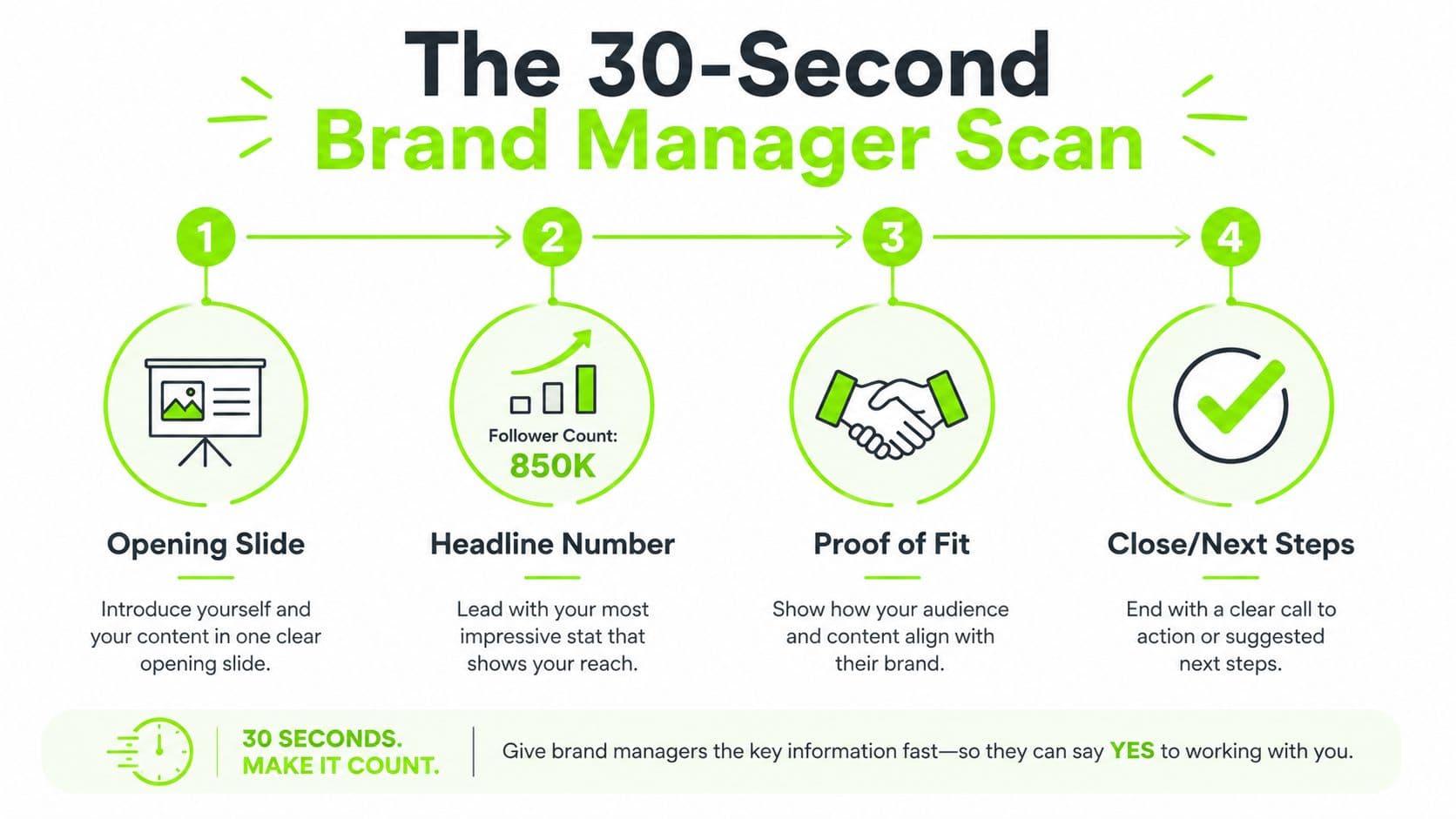
A brand manager opens your kit between meetings. They scan the opening slide, look for one meaningful number, check whether your audience fits the campaign, and decide whether the next page deserves attention. You don't need to tell your entire story in that moment. You need to make the commercial answer obvious.
Most creators lose that scan with a vague introduction such as “passionate lifestyle creator,” a follower count hidden in a footer, and a gallery of attractive images with no performance context. The kit may look polished, but polish can't rescue missing evidence.
The first screen has one job: show who you reach, what format works best for you, and how the brand can start a conversation.
Three silent disqualifiers appear repeatedly:
A winning first screen is much more direct. Use a one-line positioning statement, a date-stamped follower or subscriber number, the top-performing format by name, and one clear call to action. “Short-form skincare educator reaching beauty buyers through product demonstrations” is stronger than “content creator and influencer.”
If you work with an agency, it also helps to understand the kinds of campaigns agencies are planning and producing. Hooked's resource on trend-based content for agencies can sharpen the language you use when describing formats, audience fit, and creative relevance. Your pitch should connect to a real campaign need, not just announce that you have followers.
A useful companion when refining your opening is this guide on how to create a hook. Apply the same discipline to your kit's first line that you apply to the first seconds of a video. Lead with the reason to keep reading.
- Outdated screenshots: Old analytics make current claims difficult to trust, especially when a brand can request native platform verification.
- No platform breakdown: A blended total hides whether your audience watches YouTube, Instagram, TikTok, or another channel.
- A context-free rate card: Prices without deliverables, usage rights, turnaround, or campaign examples force the buyer to do extra work.
The Core Blocks Every Kit Needs in Order
Order matters because a brand manager should understand fit, scale, and proof before reaching the end of the first half. A strong influencer press kit usually contains seven core components, including a bio, audience metrics, demographics, content examples, services, pricing, and contact information, as summarized by Bizee's influencer media kit guidance.
Start with positioning, not autobiography
Your headline should describe the intersection of your niche, audience, and strongest format. Try one of these adaptable lines:
Your bio can then add personality without becoming a life story. Use this template:
“[Name] is a [niche] creator who helps [audience] discover [topic or result] through [primary formats]. Their content has generated [specific proof point], and their style is [personality hook]. They partner with brands that value [shared audience or brand principle].”
Keep it to three or four sentences. A brand needs enough context to understand your voice, not a chronological account of your career.
- “Short-form home cook creating practical recipe videos for busy young professionals.”
- “Travel creator helping budget-conscious couples plan memorable city breaks.”
- “Gaming commentator turning live-stream moments into fast, high-retention clips.”
Build the audience snapshot
Show the audience characteristics that determine campaign fit: top locations, age range, relevant interests, and any meaningful gender distribution available in your native analytics. Keep this block visually simple. A compact chart is more useful than decorative copy.
Break down every platform
List each active platform separately. Include followers or subscribers, average views or reach, engagement rate, and the period used to calculate that rate. A brand buying a Reel needs to see Reel performance, not a blended number that combines unrelated formats.
Show content pillars and winning formats
Name the subjects you cover and identify the formats that perform best. “Product tutorials, comparison clips, and creator-led demonstrations” gives a buyer more useful information than “lifestyle content.”
Add campaign highlights
Use two or three strong examples, each with the deliverable, objective, and relevant result. If you don't have paid partnerships yet, use high-performing organic content or UGC samples that demonstrate the exact production quality a brand would receive.
Finish with services, pricing, and contact details. If you're building a consistent visual system across your kit and other creator materials, a brand guidelines template can help you define typography, colors, tone, and image treatment before you design the final page.
The next block is where average kits become persuasive. Numbers need a proof layer, and that means showing when they were measured, where they came from, and how they relate to the format a brand wants to buy.
Metrics That Actually Move Brand Decisions
Follower count is useful context, but it isn't a campaign plan. Brands want to know whether your audience is relevant, whether people watch the format being purchased, and whether your content creates signals such as saves, shares, clicks, or sustained viewing.
Use three metric tiers, but don't blend them into one impressive-looking dashboard.
Tier one shows potential reach
Include followers, subscribers, and monthly views where those figures represent your active channels. Every figure needs a visible date. A number without a measurement window is incomplete, even if it looks impressive.
Tier two explains content response
Show engagement rate, average views, reach, and comments in a platform-specific layout. Label the calculation period, because a daily, weekly, monthly, or per-post rate can produce very different interpretations. Backstage's media kit guidance specifically emphasizes labeling the time window used for engagement rate.
Tier three supplies campaign evidence
For short-form video, add format-aware proof such as view-through rate, swipe ratio, save rate, share rate, link click-through rate, and audience retention at meaningful points. Use the native definitions provided by each platform, and don't compare unlike measurements as though they were interchangeable.
| Metric Tier | Example Metric | What Brand Learns | Verification |
|---|---|---|---|
| Reach | Followers, subscribers, monthly views | Potential audience scale | Native analytics screenshot with date |
| Engagement | Average views, engagement rate, comments | Whether viewers respond to content | Platform-specific export or screenshot |
| Proof | Retention, saves, shares, clicks | Whether the format supports the campaign objective | Dated post-level analytics |
Don't add a metric merely because the dashboard makes it available. Add it when it answers a buyer's question. A beauty brand may care about saves and product-page clicks. A travel brand may care about completion and shares. A podcast sponsor may care more about average views on repurposed clips than a total follower number.
Verification rule: If a metric can't be checked from a clean, dated screenshot or native export, leave it out.
Creators who want a deeper way to interpret retention, swipe behavior, and other video signals can review this video analytics platform guide. The principle is simple: present the evidence in the same format the brand plans to buy.
What are the common questions?
What is the short answer for How to Build an Influencer Press Kit That Gets Replies?
Learn how to build an influencer press kit brands actually open. Step-by-step guide with copyable templates, metrics that matter, and design tips.
What should creators do first?
Unclear dates: Every major metric should identify the period it covers.
Who is this guide for?
This guide is for YouTube creators, faceless channel operators, agencies, and teams using AI tools to improve video production and growth.
Action checklist
Apply this to your channel today.
- 1Unclear dates: Every major metric should identify the period it covers.
- 2Preview it on mobile.
- 3Test every link and embedded sample.
- 4Confirm the file size stays under 10 MB.
- 5Attach a personal note instead of a generic introduction.
Sources & methodology
- Satura editorial guide based on the source video, topic cluster, and article sections.
- Source video reviewed for this article: https://www.outrank.so/